 github-actions[bot]
acfba02409
github-actions[bot]
acfba02409
## Summary
44 improvements, 1 bug fix.

## Improvements
- **AI Prompts** — define prompt templates as code alongside your tasks,
version them on deploy, and override the text or model from the
dashboard without redeploying. Prompts integrate with the Vercel AI SDK
via `toAISDKTelemetry()` (links every generation span back to the
prompt) and with `chat.agent` via `chat.prompt.set()` +
`chat.toStreamTextOptions()`.
([#3629](https://github.com/triggerdotdev/trigger.dev/pull/3629))
- **Code-defined, deploy-versioned templates** — define with
`prompts.define({ id, model, config, variables, content })`. Every
deploy creates a new version visible in the dashboard. Mustache-style
placeholders (`{{var}}`, `{{#cond}}...{{/cond}}`) with Zod / ArkType /
Valibot-typed variables.
- **Dashboard overrides** — change a prompt's text or model from the
dashboard without redeploying. Overrides take priority over the deployed
"current" version and are environment-scoped (dev / staging / production
independent).
- **Resolve API** — `prompt.resolve(vars, { version?, label? })` returns
the compiled `text`, resolved `model`, `version`, and labels. Standalone
`prompts.resolve<typeof handle>(slug, vars)` for cross-file resolution
with full type inference on slug and variable shape.
- **AI SDK integration** — spread `resolved.toAISDKTelemetry({ ...extra
})` into any `generateText` / `streamText` call and every generation
span links to the prompt in the dashboard alongside its input variables,
model, tokens, and cost.
- **`chat.agent` integration** — `chat.prompt.set(resolved)` stores the
resolved prompt run-scoped; `chat.toStreamTextOptions({ registry })`
pulls `system`, `model` (resolved via the AI SDK provider registry),
`temperature` / `maxTokens` / etc., and telemetry into a single spread
for `streamText`.
- **Management SDK** — `prompts.list()`, `prompts.versions(slug)`,
`prompts.promote(slug, version)`, `prompts.createOverride(slug, body)`,
`prompts.updateOverride(slug, body)`, `prompts.removeOverride(slug)`,
`prompts.reactivateOverride(slug, version)`.
- **Dashboard** — prompts list with per-prompt usage sparklines;
per-prompt detail with Template / Details / Versions / Generations /
Metrics tabs. AI generation spans get a custom inspector showing the
linked prompt's metadata, input variables, and template content
alongside model, tokens, cost, and the message thread.
- Adds `onBoot` to `chat.agent` — a lifecycle hook that fires once per
worker process picking up the chat. Runs for the initial run, preloaded
runs, AND reactive continuation runs (post-cancel, crash, `endRun`,
`requestUpgrade`, OOM retry), before any other hook. Use it to
initialize `chat.local`, open per-process resources, or re-hydrate state
from your DB on continuation — anywhere the SAME run picking up after
suspend/resume isn't enough.
([#3543](https://github.com/triggerdotdev/trigger.dev/pull/3543))
- **AI SDK `useChat` integration** — a custom
[`ChatTransport`](https://sdk.vercel.ai/docs/ai-sdk-ui/transport)
(`useTriggerChatTransport`) plugs straight into Vercel AI SDK's
`useChat` hook. Text streaming, tool calls, reasoning, and `data-*`
parts all work natively over Trigger.dev's realtime streams. No custom
API routes needed.
- **First-turn fast path (`chat.headStart`)** — opt-in handler that runs
the first turn's `streamText` step in your warm server process while the
agent run boots in parallel, cutting cold-start TTFC by roughly half
(measured 2801ms → 1218ms on `claude-sonnet-4-6`). The agent owns step
2+ (tool execution, persistence, hooks) so heavy deps stay where they
belong. Web Fetch handler works natively in Next.js, Hono, SvelteKit,
Remix, Workers, etc.; bridge to Express/Fastify/Koa via
`chat.toNodeListener`. New `@trigger.dev/sdk/chat-server` subpath.
- **Multi-turn durability via Sessions** — every chat is backed by a
durable Session that outlives any individual run. Conversations resume
across page refreshes, idle timeout, crashes, and deploys; `resume:
true` reconnects via `lastEventId` so clients only see new chunks.
`sessions.list` enumerates chats for inbox-style UIs.
- **Auto-accumulated history, delta-only wire** — the backend
accumulates the full conversation across turns; clients only ship the
new message each turn. Long chats never hit the 512 KiB body cap.
Register `hydrateMessages` to be the source of truth yourself.
- **Lifecycle hooks** — `onPreload`, `onChatStart`,
`onValidateMessages`, `hydrateMessages`, `onTurnStart`,
`onBeforeTurnComplete`, `onTurnComplete`, `onChatSuspend`,
`onChatResume` — for persistence, validation, and post-turn work.
- **Stop generation** — client-driven `transport.stopGeneration(chatId)`
aborts mid-stream; the run stays alive for the next message, partial
response is captured, and aborted parts (stuck `partial-call` tools,
in-progress reasoning) are auto-cleaned.
- **Tool approvals (HITL)** — tools with `needsApproval: true` pause
until the user approves or denies via `addToolApprovalResponse`. The
runtime reconciles the updated assistant message by ID and continues
`streamText`.
- **Steering and background injection** — `pendingMessages` injects user
messages between tool-call steps so users can steer the agent
mid-execution; `chat.inject()` + `chat.defer()` adds context from
background work (self-review, RAG, safety checks) between turns.
- **Actions** — non-turn frontend commands (undo, rollback, regenerate,
edit) sent via `transport.sendAction`. Fire `hydrateMessages` +
`onAction` only — no turn hooks, no `run()`. `onAction` can return a
`StreamTextResult` for a model response, or `void` for side-effect-only.
- **Typed state primitives** — `chat.local<T>` for per-run state
accessible from hooks, `run()`, tools, and subtasks (auto-serialized
through `ai.toolExecute`); `chat.store` for typed shared data between
agent and client; `chat.history` for reading and mutating the message
chain; `clientDataSchema` for typed `clientData` in every hook.
- **`chat.toStreamTextOptions()`** — one spread into `streamText` wires
up versioned system [Prompts](https://trigger.dev/docs/ai/prompts),
model resolution, telemetry metadata, compaction, steering, and
background injection.
- **Multi-tab coordination** — `multiTab: true` + `useMultiTabChat`
prevents duplicate sends and syncs state across browser tabs via
`BroadcastChannel`. Non-active tabs go read-only with live updates.
- **Network resilience** — built-in indefinite retry with bounded
backoff, reconnect on `online` / tab refocus / bfcache restore,
`Last-Event-ID` mid-stream resume. No app code needed.
- **Sessions** — a durable, run-aware stream channel keyed on a stable
`externalId`. A Session is the unit of state that owns a multi-run
conversation: messages flow through `.in`, responses through `.out`,
both survive run boundaries. Sessions back the new `chat.agent` runtime,
and you can build on them directly for any pattern that needs durable
bi-directional streaming across runs.
([#3542](https://github.com/triggerdotdev/trigger.dev/pull/3542))
- Add `ai.toolExecute(task)` so you can wire a Trigger subtask in as the
`execute` handler of an AI SDK `tool()` while defining `description` and
`inputSchema` yourself — useful when you want full control over the tool
surface and just need Trigger's subtask machinery for the body.
([#3546](https://github.com/triggerdotdev/trigger.dev/pull/3546))
- Type `chat.createStartSessionAction` against your chat agent so
`clientData` is typed end-to-end on the first turn:
([#3684](https://github.com/triggerdotdev/trigger.dev/pull/3684))
- Add `region` to the runs list / retrieve API: filter runs by region
(`runs.list({ region: "..." })` / `filter[region]=<masterQueue>`) and
read each run's executing region from the new `region` field on the
response.
([#3612](https://github.com/triggerdotdev/trigger.dev/pull/3612))
- Add `TRIGGER_BUILD_SKIP_REWRITE_TIMESTAMP=1` escape hatch for local
self-hosted builds whose buildx driver doesn't support
`rewrite-timestamp` alongside push (e.g. orbstack's default `docker`
driver).
([#3618](https://github.com/triggerdotdev/trigger.dev/pull/3618))
- Reject overlong `idempotencyKey` values at the API boundary so they no
longer trip an internal size limit on the underlying unique index and
surface as a generic 500. Inputs are capped at 2048 characters — well
above what `idempotencyKeys.create()` produces (a 64-character hash) and
above any realistic raw key. Applies to `tasks.trigger`,
`tasks.batchTrigger`, `batch.create` (Phase 1 streaming batches),
`wait.createToken`, `wait.forDuration`, and the input/session stream
waitpoint endpoints. Over-limit requests now return a structured 400
instead.
([#3560](https://github.com/triggerdotdev/trigger.dev/pull/3560))
- **AI SDK `useChat` integration** — a custom
[`ChatTransport`](https://sdk.vercel.ai/docs/ai-sdk-ui/transport)
(`useTriggerChatTransport`) plugs straight into Vercel AI SDK's
`useChat` hook. Text streaming, tool calls, reasoning, and `data-*`
parts all work natively over Trigger.dev's realtime streams. No custom
API routes needed.
- **First-turn fast path (`chat.headStart`)** — opt-in handler that runs
the first turn's `streamText` step in your warm server process while the
agent run boots in parallel, cutting cold-start TTFC by roughly half
(measured 2801ms → 1218ms on `claude-sonnet-4-6`). The agent owns step
2+ (tool execution, persistence, hooks) so heavy deps stay where they
belong. Web Fetch handler works natively in Next.js, Hono, SvelteKit,
Remix, Workers, etc.; bridge to Express/Fastify/Koa via
`chat.toNodeListener`. New `@trigger.dev/sdk/chat-server` subpath.
- **Multi-turn durability via Sessions** — every chat is backed by a
durable Session that outlives any individual run. Conversations resume
across page refreshes, idle timeout, crashes, and deploys; `resume:
true` reconnects via `lastEventId` so clients only see new chunks.
`sessions.list` enumerates chats for inbox-style UIs.
- **Auto-accumulated history, delta-only wire** — the backend
accumulates the full conversation across turns; clients only ship the
new message each turn. Long chats never hit the 512 KiB body cap.
Register `hydrateMessages` to be the source of truth yourself.
- **Lifecycle hooks** — `onPreload`, `onChatStart`,
`onValidateMessages`, `hydrateMessages`, `onTurnStart`,
`onBeforeTurnComplete`, `onTurnComplete`, `onChatSuspend`,
`onChatResume` — for persistence, validation, and post-turn work.
- **Stop generation** — client-driven `transport.stopGeneration(chatId)`
aborts mid-stream; the run stays alive for the next message, partial
response is captured, and aborted parts (stuck `partial-call` tools,
in-progress reasoning) are auto-cleaned.
- **Tool approvals (HITL)** — tools with `needsApproval: true` pause
until the user approves or denies via `addToolApprovalResponse`. The
runtime reconciles the updated assistant message by ID and continues
`streamText`.
- **Steering and background injection** — `pendingMessages` injects user
messages between tool-call steps so users can steer the agent
mid-execution; `chat.inject()` + `chat.defer()` adds context from
background work (self-review, RAG, safety checks) between turns.
- **Actions** — non-turn frontend commands (undo, rollback, regenerate,
edit) sent via `transport.sendAction`. Fire `hydrateMessages` +
`onAction` only — no turn hooks, no `run()`. `onAction` can return a
`StreamTextResult` for a model response, or `void` for side-effect-only.
- **Typed state primitives** — `chat.local<T>` for per-run state
accessible from hooks, `run()`, tools, and subtasks (auto-serialized
through `ai.toolExecute`); `chat.store` for typed shared data between
agent and client; `chat.history` for reading and mutating the message
chain; `clientDataSchema` for typed `clientData` in every hook.
- **`chat.toStreamTextOptions()`** — one spread into `streamText` wires
up versioned system [Prompts](https://trigger.dev/docs/ai/prompts),
model resolution, telemetry metadata, compaction, steering, and
background injection.
- **Multi-tab coordination** — `multiTab: true` + `useMultiTabChat`
prevents duplicate sends and syncs state across browser tabs via
`BroadcastChannel`. Non-active tabs go read-only with live updates.
- **Network resilience** — built-in indefinite retry with bounded
backoff, reconnect on `online` / tab refocus / bfcache restore,
`Last-Event-ID` mid-stream resume. No app code needed.
- Retry `TASK_PROCESS_SIGSEGV` task crashes under the user's retry
policy instead of failing the run on the first segfault. SIGSEGV in Node
tasks is frequently non-deterministic (native addon races, JIT/GC
interaction, near-OOM in native code, host issues), so retrying on a
fresh process often succeeds. The retry is gated by the task's existing
`retry` config + `maxAttempts` — same path `TASK_PROCESS_SIGTERM` and
uncaught exceptions already use — so tasks without a retry policy still
fail fast.
([#3552](https://github.com/triggerdotdev/trigger.dev/pull/3552))
- The public interfaces for a plugin system. Initially consolidated
authentication and authorization interfaces.
([#3499](https://github.com/triggerdotdev/trigger.dev/pull/3499))
- Add MollifierBuffer and MollifierDrainer primitives for trigger burst
smoothing.
([#3614](https://github.com/triggerdotdev/trigger.dev/pull/3614))

## Bug fixes
- Fix `LocalsKey<T>` type incompatibility across dual-package builds.
The phantom value-type brand no longer uses a module-level `unique
symbol`, so a single TypeScript compilation that resolves the type from
both the ESM and CJS outputs (which can happen under certain pnpm
hoisting layouts) no longer sees two structurally-incompatible variants
of the same type.
([#3626](https://github.com/triggerdotdev/trigger.dev/pull/3626))

<details>
<summary>Raw changeset output</summary>

⚠️⚠️⚠️⚠️⚠️⚠️

`main` is currently in **pre mode** so this branch has prereleases
rather than normal releases. If you want to exit prereleases, run
`changeset pre exit` on `main`.

⚠️⚠️⚠️⚠️⚠️⚠️

# Releases
## @trigger.dev/sdk@4.5.0-rc.0

### Minor Changes

- **AI Prompts** — define prompt templates as code alongside your tasks,
version them on deploy, and override the text or model from the
dashboard without redeploying. Prompts integrate with the Vercel AI SDK
via `toAISDKTelemetry()` (links every generation span back to the
prompt) and with `chat.agent` via `chat.prompt.set()` +
`chat.toStreamTextOptions()`.
([#3629](https://github.com/triggerdotdev/trigger.dev/pull/3629))

    ```ts
    import { prompts } from "@trigger.dev/sdk";
    import { generateText } from "ai";
    import { openai } from "@ai-sdk/openai";
    import { z } from "zod";

    export const supportPrompt = prompts.define({
      id: "customer-support",
      model: "gpt-4o",
      config: { temperature: 0.7 },
      variables: z.object({
        customerName: z.string(),
        plan: z.string(),
        issue: z.string(),
      }),
      content: `You are a support agent for Acme.

    Customer: {{customerName}} ({{plan}} plan)
    Issue: {{issue}}`,
    });

    const resolved = await supportPrompt.resolve({
      customerName: "Alice",
      plan: "Pro",
      issue: "Can't access billing",
    });

    const result = await generateText({
      model: openai(resolved.model ?? "gpt-4o"),
      system: resolved.text,
      prompt: "Can't access billing",
      ...resolved.toAISDKTelemetry(),
    });
    ```

    **What you get:**

- **Code-defined, deploy-versioned templates** — define with
`prompts.define({ id, model, config, variables, content })`. Every
deploy creates a new version visible in the dashboard. Mustache-style
placeholders (`{{var}}`, `{{#cond}}...{{/cond}}`) with Zod / ArkType /
Valibot-typed variables.
- **Dashboard overrides** — change a prompt's text or model from the
dashboard without redeploying. Overrides take priority over the deployed
"current" version and are environment-scoped (dev / staging / production
independent).
- **Resolve API** — `prompt.resolve(vars, { version?, label? })` returns
the compiled `text`, resolved `model`, `version`, and labels. Standalone
`prompts.resolve<typeof handle>(slug, vars)` for cross-file resolution
with full type inference on slug and variable shape.
- **AI SDK integration** — spread `resolved.toAISDKTelemetry({ ...extra
})` into any `generateText` / `streamText` call and every generation
span links to the prompt in the dashboard alongside its input variables,
model, tokens, and cost.
- **`chat.agent` integration** — `chat.prompt.set(resolved)` stores the
resolved prompt run-scoped; `chat.toStreamTextOptions({ registry })`
pulls `system`, `model` (resolved via the AI SDK provider registry),
`temperature` / `maxTokens` / etc., and telemetry into a single spread
for `streamText`.
- **Management SDK** — `prompts.list()`, `prompts.versions(slug)`,
`prompts.promote(slug, version)`, `prompts.createOverride(slug, body)`,
`prompts.updateOverride(slug, body)`, `prompts.removeOverride(slug)`,
`prompts.reactivateOverride(slug, version)`.
- **Dashboard** — prompts list with per-prompt usage sparklines;
per-prompt detail with Template / Details / Versions / Generations /
Metrics tabs. AI generation spans get a custom inspector showing the
linked prompt's metadata, input variables, and template content
alongside model, tokens, cost, and the message thread.

See [/docs/ai/prompts](https://trigger.dev/docs/ai/prompts) for the full
reference — template syntax, version resolution order, override
workflow, and type utilities (`PromptHandle`, `PromptIdentifier`,
`PromptVariables`).

- Adds `onBoot` to `chat.agent` — a lifecycle hook that fires once per
worker process picking up the chat. Runs for the initial run, preloaded
runs, AND reactive continuation runs (post-cancel, crash, `endRun`,
`requestUpgrade`, OOM retry), before any other hook. Use it to
initialize `chat.local`, open per-process resources, or re-hydrate state
from your DB on continuation — anywhere the SAME run picking up after
suspend/resume isn't enough.
([#3543](https://github.com/triggerdotdev/trigger.dev/pull/3543))

    ```ts
const userContext = chat.local<{ name: string; plan: string }>({ id:
"userContext" });

    export const myChat = chat.agent({
      id: "my-chat",
      onBoot: async ({ clientData, continuation }) => {
const user = await db.user.findUnique({ where: { id: clientData.userId }
});
        userContext.init({ name: user.name, plan: user.plan });
      },
      run: async ({ messages, signal }) =>
streamText({ model: openai("gpt-4o"), messages, abortSignal: signal }),
    });
    ```

Use `onBoot` (not `onChatStart`) for state setup that must run every
time a worker picks up the chat — `onChatStart` fires once per chat and
won't run on continuation, leaving `chat.local` uninitialized when
`run()` tries to use it.

- **AI Agents** — run AI SDK chat completions as durable Trigger.dev
agents instead of fragile API routes. Define an agent in one function,
point `useChat` at it from React, and the conversation survives page
refreshes, network blips, and process restarts.
([#3543](https://github.com/triggerdotdev/trigger.dev/pull/3543))

    ```ts
    import { chat } from "@trigger.dev/sdk/ai";
    import { streamText } from "ai";
    import { openai } from "@ai-sdk/openai";

    export const myChat = chat.agent({
      id: "my-chat",
      run: async ({ messages, signal }) =>
streamText({ model: openai("gpt-4o"), messages, abortSignal: signal }),
    });
    ```

    ```tsx
    import { useChat } from "@ai-sdk/react";
import { useTriggerChatTransport } from "@trigger.dev/sdk/chat/react";

const transport = useTriggerChatTransport({ task: "my-chat",
accessToken, startSession });
    const { messages, sendMessage } = useChat({ transport });
    ```

    **What you get:**

- **AI SDK `useChat` integration** — a custom
[`ChatTransport`](https://sdk.vercel.ai/docs/ai-sdk-ui/transport)
(`useTriggerChatTransport`) plugs straight into Vercel AI SDK's
`useChat` hook. Text streaming, tool calls, reasoning, and `data-*`
parts all work natively over Trigger.dev's realtime streams. No custom
API routes needed.
- **First-turn fast path (`chat.headStart`)** — opt-in handler that runs
the first turn's `streamText` step in your warm server process while the
agent run boots in parallel, cutting cold-start TTFC by roughly half
(measured 2801ms → 1218ms on `claude-sonnet-4-6`). The agent owns step
2+ (tool execution, persistence, hooks) so heavy deps stay where they
belong. Web Fetch handler works natively in Next.js, Hono, SvelteKit,
Remix, Workers, etc.; bridge to Express/Fastify/Koa via
`chat.toNodeListener`. New `@trigger.dev/sdk/chat-server` subpath.
- **Multi-turn durability via Sessions** — every chat is backed by a
durable Session that outlives any individual run. Conversations resume
across page refreshes, idle timeout, crashes, and deploys; `resume:
true` reconnects via `lastEventId` so clients only see new chunks.
`sessions.list` enumerates chats for inbox-style UIs.
- **Auto-accumulated history, delta-only wire** — the backend
accumulates the full conversation across turns; clients only ship the
new message each turn. Long chats never hit the 512 KiB body cap.
Register `hydrateMessages` to be the source of truth yourself.
- **Lifecycle hooks** — `onPreload`, `onChatStart`,
`onValidateMessages`, `hydrateMessages`, `onTurnStart`,
`onBeforeTurnComplete`, `onTurnComplete`, `onChatSuspend`,
`onChatResume` — for persistence, validation, and post-turn work.
- **Stop generation** — client-driven `transport.stopGeneration(chatId)`
aborts mid-stream; the run stays alive for the next message, partial
response is captured, and aborted parts (stuck `partial-call` tools,
in-progress reasoning) are auto-cleaned.
- **Tool approvals (HITL)** — tools with `needsApproval: true` pause
until the user approves or denies via `addToolApprovalResponse`. The
runtime reconciles the updated assistant message by ID and continues
`streamText`.
- **Steering and background injection** — `pendingMessages` injects user
messages between tool-call steps so users can steer the agent
mid-execution; `chat.inject()` + `chat.defer()` adds context from
background work (self-review, RAG, safety checks) between turns.
- **Actions** — non-turn frontend commands (undo, rollback, regenerate,
edit) sent via `transport.sendAction`. Fire `hydrateMessages` +
`onAction` only — no turn hooks, no `run()`. `onAction` can return a
`StreamTextResult` for a model response, or `void` for side-effect-only.
- **Typed state primitives** — `chat.local<T>` for per-run state
accessible from hooks, `run()`, tools, and subtasks (auto-serialized
through `ai.toolExecute`); `chat.store` for typed shared data between
agent and client; `chat.history` for reading and mutating the message
chain; `clientDataSchema` for typed `clientData` in every hook.
- **`chat.toStreamTextOptions()`** — one spread into `streamText` wires
up versioned system [Prompts](https://trigger.dev/docs/ai/prompts),
model resolution, telemetry metadata, compaction, steering, and
background injection.
- **Multi-tab coordination** — `multiTab: true` + `useMultiTabChat`
prevents duplicate sends and syncs state across browser tabs via
`BroadcastChannel`. Non-active tabs go read-only with live updates.
- **Network resilience** — built-in indefinite retry with bounded
backoff, reconnect on `online` / tab refocus / bfcache restore,
`Last-Event-ID` mid-stream resume. No app code needed.

See [/docs/ai-chat](https://trigger.dev/docs/ai-chat/overview) for the
full surface — quick start, three backend approaches (`chat.agent`,
`chat.createSession`, raw task), persistence and code-sandbox patterns,
type-level guides, and API reference.

- Add read primitives to `chat.history` for HITL flows:
`getPendingToolCalls()`, `getResolvedToolCalls()`,
`extractNewToolResults(message)`, `getChain()`, and
`findMessage(messageId)`. These lift the accumulator-walking logic that
customers building human-in-the-loop tools were re-implementing into the
SDK. ([#3543](https://github.com/triggerdotdev/trigger.dev/pull/3543))

Use `getPendingToolCalls()` to gate fresh user turns while a tool call
is awaiting an answer. Use `extractNewToolResults(message)` to dedup
tool results when persisting to your own store — the helper returns only
the parts whose `toolCallId` is not already resolved on the chain.

    ```ts
    const pending = chat.history.getPendingToolCalls();
    if (pending.length > 0) {
      // an addToolOutput is expected before a new user message
    }

    onTurnComplete: async ({ responseMessage }) => {
const newResults = chat.history.extractNewToolResults(responseMessage);
      for (const r of newResults) {
await db.toolResults.upsert({ id: r.toolCallId, output: r.output,
errorText: r.errorText });
      }
    };
    ```

- **Sessions** — a durable, run-aware stream channel keyed on a stable
`externalId`. A Session is the unit of state that owns a multi-run
conversation: messages flow through `.in`, responses through `.out`,
both survive run boundaries. Sessions back the new `chat.agent` runtime,
and you can build on them directly for any pattern that needs durable
bi-directional streaming across runs.
([#3542](https://github.com/triggerdotdev/trigger.dev/pull/3542))

    ```ts
    import { sessions, tasks } from "@trigger.dev/sdk";

    // Trigger a task and subscribe to its session output in one call
const { runId, stream } = await tasks.triggerAndSubscribe("my-task",
payload, {
      externalId: "user-456",
    });

    for await (const chunk of stream) {
      // ...
    }

// Enumerate existing sessions (powers inbox-style UIs without a
separate index)
for await (const s of sessions.list({ type: "chat.agent", tag:
"user:user-456" })) {
      console.log(s.id, s.externalId, s.createdAt, s.closedAt);
    }
    ```

See [/docs/ai-chat/overview](https://trigger.dev/docs/ai-chat/overview)
for the full surface — Sessions powers the durable, resumable chat
runtime described there.

### Patch Changes

- Add Agent Skills for `chat.agent`. Drop a folder with a `SKILL.md` and
any helper scripts/references next to your task code, register it with
`skills.define({ id, path })`, and the CLI bundles it into the deploy
image automatically — no `trigger.config.ts` changes. The agent gets a
one-line summary in its system prompt and discovers full instructions on
demand via `loadSkill`, with `bash` and `readFile` tools scoped
per-skill (path-traversal guards, output caps, abort-signal
propagation).
([#3543](https://github.com/triggerdotdev/trigger.dev/pull/3543))

    ```ts
const pdfSkill = skills.define({ id: "pdf-extract", path:
"./skills/pdf-extract" });

    chat.skills.set([await pdfSkill.local()]);
    ```

Built on the [AI SDK cookbook
pattern](https://ai-sdk.dev/cookbook/guides/agent-skills) — portable
across providers. SDK + CLI only for now; dashboard-editable `SKILL.md`
text is on the roadmap.

- Add `ai.toolExecute(task)` so you can wire a Trigger subtask in as the
`execute` handler of an AI SDK `tool()` while defining `description` and
`inputSchema` yourself — useful when you want full control over the tool
surface and just need Trigger's subtask machinery for the body.
([#3546](https://github.com/triggerdotdev/trigger.dev/pull/3546))

    ```ts
    const myTool = tool({
      description: "...",
      inputSchema: z.object({ ... }),
      execute: ai.toolExecute(mySubtask),
    });
    ```

`ai.tool(task)` (`toolFromTask`) keeps doing the all-in-one wrap and now
aligns its return type with AI SDK's `ToolSet`. Minimum `ai` peer raised
to `^6.0.116` to avoid cross-version `ToolSet` mismatches in monorepos.

- Stamp `gen_ai.conversation.id` (the chat id) on every span and metric
emitted from inside a `chat.task` or `chat.agent` run. Lets you filter
dashboard spans, runs, and metrics by the chat conversation that
produced them — independent of the run boundary, so multi-run chats
correlate cleanly. No code changes required on the user side.
([#3543](https://github.com/triggerdotdev/trigger.dev/pull/3543))

- Type `chat.createStartSessionAction` against your chat agent so
`clientData` is typed end-to-end on the first turn:
([#3684](https://github.com/triggerdotdev/trigger.dev/pull/3684))

    ```ts
    import { chat } from "@trigger.dev/sdk/ai";
    import type { myChat } from "@/trigger/chat";

export const startChatSession = chat.createStartSessionAction<typeof
myChat>("my-chat");

// In the browser, threaded from the transport's typed startSession
callback:
    const transport = useTriggerChatTransport<typeof myChat>({
      task: "my-chat",
startSession: ({ chatId, clientData }) => startChatSession({ chatId,
clientData }),
      // ...
    });
    ```

`ChatStartSessionParams` gains a typed `clientData` field — folded into
the first run's `payload.metadata` so `onPreload` / `onChatStart` see
the same shape per-turn `metadata` carries via the transport. The opaque
session-level `metadata` field is unchanged.

- Unit-test `chat.agent` definitions offline with `mockChatAgent` from
`@trigger.dev/sdk/ai/test`. Drives a real agent's turn loop in-process —
no network, no task runtime — so you can send messages, actions, and
stop signals via driver methods, inspect captured output chunks, and
verify hooks fire. Pairs with `MockLanguageModelV3` from `ai/test` for
model mocking. `setupLocals` lets you pre-seed `locals` (DB clients,
service stubs) before `run()` starts.
([#3543](https://github.com/triggerdotdev/trigger.dev/pull/3543))

The broader `runInMockTaskContext` harness it's built on lives at
`@trigger.dev/core/v3/test` — useful for unit-testing any task code, not
just chat.

- Add `region` to the runs list / retrieve API: filter runs by region
(`runs.list({ region: "..." })` / `filter[region]=<masterQueue>`) and
read each run's executing region from the new `region` field on the
response.
([#3612](https://github.com/triggerdotdev/trigger.dev/pull/3612))

-   Updated dependencies:
    -   `@trigger.dev/core@4.5.0-rc.0`

## @trigger.dev/build@4.5.0-rc.0

### Patch Changes

- Add Agent Skills for `chat.agent`. Drop a folder with a `SKILL.md` and
any helper scripts/references next to your task code, register it with
`skills.define({ id, path })`, and the CLI bundles it into the deploy
image automatically — no `trigger.config.ts` changes. The agent gets a
one-line summary in its system prompt and discovers full instructions on
demand via `loadSkill`, with `bash` and `readFile` tools scoped
per-skill (path-traversal guards, output caps, abort-signal
propagation).
([#3543](https://github.com/triggerdotdev/trigger.dev/pull/3543))

    ```ts
const pdfSkill = skills.define({ id: "pdf-extract", path:
"./skills/pdf-extract" });

    chat.skills.set([await pdfSkill.local()]);
    ```

Built on the [AI SDK cookbook
pattern](https://ai-sdk.dev/cookbook/guides/agent-skills) — portable
across providers. SDK + CLI only for now; dashboard-editable `SKILL.md`
text is on the roadmap.

-   Updated dependencies:
    -   `@trigger.dev/core@4.5.0-rc.0`

## trigger.dev@4.5.0-rc.0

### Patch Changes

- Add Agent Skills for `chat.agent`. Drop a folder with a `SKILL.md` and
any helper scripts/references next to your task code, register it with
`skills.define({ id, path })`, and the CLI bundles it into the deploy
image automatically — no `trigger.config.ts` changes. The agent gets a
one-line summary in its system prompt and discovers full instructions on
demand via `loadSkill`, with `bash` and `readFile` tools scoped
per-skill (path-traversal guards, output caps, abort-signal
propagation).
([#3543](https://github.com/triggerdotdev/trigger.dev/pull/3543))

    ```ts
const pdfSkill = skills.define({ id: "pdf-extract", path:
"./skills/pdf-extract" });

    chat.skills.set([await pdfSkill.local()]);
    ```

Built on the [AI SDK cookbook
pattern](https://ai-sdk.dev/cookbook/guides/agent-skills) — portable
across providers. SDK + CLI only for now; dashboard-editable `SKILL.md`
text is on the roadmap.

- Add `TRIGGER_BUILD_SKIP_REWRITE_TIMESTAMP=1` escape hatch for local
self-hosted builds whose buildx driver doesn't support
`rewrite-timestamp` alongside push (e.g. orbstack's default `docker`
driver).
([#3618](https://github.com/triggerdotdev/trigger.dev/pull/3618))

- The CLI MCP server's agent-chat tools (`start_agent_chat`,
`send_agent_message`, `close_agent_chat`) now run on the new Sessions
primitive, so AI assistants driving a `chat.agent` get the same
idempotent-by-`chatId`, durable-across-runs behavior the browser
transport gets. Required PAT scopes go from `write:inputStreams` to
`read:sessions` + `write:sessions`.
([#3546](https://github.com/triggerdotdev/trigger.dev/pull/3546))

- MCP `list_runs` tool: add a `region` filter input and surface each
run's executing region in the formatted summary.
([#3612](https://github.com/triggerdotdev/trigger.dev/pull/3612))

-   Updated dependencies:
    -   `@trigger.dev/core@4.5.0-rc.0`
    -   `@trigger.dev/build@4.5.0-rc.0`
    -   `@trigger.dev/schema-to-json@4.5.0-rc.0`

## @trigger.dev/core@4.5.0-rc.0

### Patch Changes

- Add Agent Skills for `chat.agent`. Drop a folder with a `SKILL.md` and
any helper scripts/references next to your task code, register it with
`skills.define({ id, path })`, and the CLI bundles it into the deploy
image automatically — no `trigger.config.ts` changes. The agent gets a
one-line summary in its system prompt and discovers full instructions on
demand via `loadSkill`, with `bash` and `readFile` tools scoped
per-skill (path-traversal guards, output caps, abort-signal
propagation).
([#3543](https://github.com/triggerdotdev/trigger.dev/pull/3543))

    ```ts
const pdfSkill = skills.define({ id: "pdf-extract", path:
"./skills/pdf-extract" });

    chat.skills.set([await pdfSkill.local()]);
    ```

Built on the [AI SDK cookbook
pattern](https://ai-sdk.dev/cookbook/guides/agent-skills) — portable
across providers. SDK + CLI only for now; dashboard-editable `SKILL.md`
text is on the roadmap.

- Reject overlong `idempotencyKey` values at the API boundary so they no
longer trip an internal size limit on the underlying unique index and
surface as a generic 500. Inputs are capped at 2048 characters — well
above what `idempotencyKeys.create()` produces (a 64-character hash) and
above any realistic raw key. Applies to `tasks.trigger`,
`tasks.batchTrigger`, `batch.create` (Phase 1 streaming batches),
`wait.createToken`, `wait.forDuration`, and the input/session stream
waitpoint endpoints. Over-limit requests now return a structured 400
instead.
([#3560](https://github.com/triggerdotdev/trigger.dev/pull/3560))

- **AI Agents** — run AI SDK chat completions as durable Trigger.dev
agents instead of fragile API routes. Define an agent in one function,
point `useChat` at it from React, and the conversation survives page
refreshes, network blips, and process restarts.
([#3543](https://github.com/triggerdotdev/trigger.dev/pull/3543))

    ```ts
    import { chat } from "@trigger.dev/sdk/ai";
    import { streamText } from "ai";
    import { openai } from "@ai-sdk/openai";

    export const myChat = chat.agent({
      id: "my-chat",
      run: async ({ messages, signal }) =>
streamText({ model: openai("gpt-4o"), messages, abortSignal: signal }),
    });
    ```

    ```tsx
    import { useChat } from "@ai-sdk/react";
import { useTriggerChatTransport } from "@trigger.dev/sdk/chat/react";

const transport = useTriggerChatTransport({ task: "my-chat",
accessToken, startSession });
    const { messages, sendMessage } = useChat({ transport });
    ```

    **What you get:**

- **AI SDK `useChat` integration** — a custom
[`ChatTransport`](https://sdk.vercel.ai/docs/ai-sdk-ui/transport)
(`useTriggerChatTransport`) plugs straight into Vercel AI SDK's
`useChat` hook. Text streaming, tool calls, reasoning, and `data-*`
parts all work natively over Trigger.dev's realtime streams. No custom
API routes needed.
- **First-turn fast path (`chat.headStart`)** — opt-in handler that runs
the first turn's `streamText` step in your warm server process while the
agent run boots in parallel, cutting cold-start TTFC by roughly half
(measured 2801ms → 1218ms on `claude-sonnet-4-6`). The agent owns step
2+ (tool execution, persistence, hooks) so heavy deps stay where they
belong. Web Fetch handler works natively in Next.js, Hono, SvelteKit,
Remix, Workers, etc.; bridge to Express/Fastify/Koa via
`chat.toNodeListener`. New `@trigger.dev/sdk/chat-server` subpath.
- **Multi-turn durability via Sessions** — every chat is backed by a
durable Session that outlives any individual run. Conversations resume
across page refreshes, idle timeout, crashes, and deploys; `resume:
true` reconnects via `lastEventId` so clients only see new chunks.
`sessions.list` enumerates chats for inbox-style UIs.
- **Auto-accumulated history, delta-only wire** — the backend
accumulates the full conversation across turns; clients only ship the
new message each turn. Long chats never hit the 512 KiB body cap.
Register `hydrateMessages` to be the source of truth yourself.
- **Lifecycle hooks** — `onPreload`, `onChatStart`,
`onValidateMessages`, `hydrateMessages`, `onTurnStart`,
`onBeforeTurnComplete`, `onTurnComplete`, `onChatSuspend`,
`onChatResume` — for persistence, validation, and post-turn work.
- **Stop generation** — client-driven `transport.stopGeneration(chatId)`
aborts mid-stream; the run stays alive for the next message, partial
response is captured, and aborted parts (stuck `partial-call` tools,
in-progress reasoning) are auto-cleaned.
- **Tool approvals (HITL)** — tools with `needsApproval: true` pause
until the user approves or denies via `addToolApprovalResponse`. The
runtime reconciles the updated assistant message by ID and continues
`streamText`.
- **Steering and background injection** — `pendingMessages` injects user
messages between tool-call steps so users can steer the agent
mid-execution; `chat.inject()` + `chat.defer()` adds context from
background work (self-review, RAG, safety checks) between turns.
- **Actions** — non-turn frontend commands (undo, rollback, regenerate,
edit) sent via `transport.sendAction`. Fire `hydrateMessages` +
`onAction` only — no turn hooks, no `run()`. `onAction` can return a
`StreamTextResult` for a model response, or `void` for side-effect-only.
- **Typed state primitives** — `chat.local<T>` for per-run state
accessible from hooks, `run()`, tools, and subtasks (auto-serialized
through `ai.toolExecute`); `chat.store` for typed shared data between
agent and client; `chat.history` for reading and mutating the message
chain; `clientDataSchema` for typed `clientData` in every hook.
- **`chat.toStreamTextOptions()`** — one spread into `streamText` wires
up versioned system [Prompts](https://trigger.dev/docs/ai/prompts),
model resolution, telemetry metadata, compaction, steering, and
background injection.
- **Multi-tab coordination** — `multiTab: true` + `useMultiTabChat`
prevents duplicate sends and syncs state across browser tabs via
`BroadcastChannel`. Non-active tabs go read-only with live updates.
- **Network resilience** — built-in indefinite retry with bounded
backoff, reconnect on `online` / tab refocus / bfcache restore,
`Last-Event-ID` mid-stream resume. No app code needed.

See [/docs/ai-chat](https://trigger.dev/docs/ai-chat/overview) for the
full surface — quick start, three backend approaches (`chat.agent`,
`chat.createSession`, raw task), persistence and code-sandbox patterns,
type-level guides, and API reference.

- Stamp `gen_ai.conversation.id` (the chat id) on every span and metric
emitted from inside a `chat.task` or `chat.agent` run. Lets you filter
dashboard spans, runs, and metrics by the chat conversation that
produced them — independent of the run boundary, so multi-run chats
correlate cleanly. No code changes required on the user side.
([#3543](https://github.com/triggerdotdev/trigger.dev/pull/3543))

- Fix `LocalsKey<T>` type incompatibility across dual-package builds.
The phantom value-type brand no longer uses a module-level `unique
symbol`, so a single TypeScript compilation that resolves the type from
both the ESM and CJS outputs (which can happen under certain pnpm
hoisting layouts) no longer sees two structurally-incompatible variants
of the same type.
([#3626](https://github.com/triggerdotdev/trigger.dev/pull/3626))

- Unit-test `chat.agent` definitions offline with `mockChatAgent` from
`@trigger.dev/sdk/ai/test`. Drives a real agent's turn loop in-process —
no network, no task runtime — so you can send messages, actions, and
stop signals via driver methods, inspect captured output chunks, and
verify hooks fire. Pairs with `MockLanguageModelV3` from `ai/test` for
model mocking. `setupLocals` lets you pre-seed `locals` (DB clients,
service stubs) before `run()` starts.
([#3543](https://github.com/triggerdotdev/trigger.dev/pull/3543))

The broader `runInMockTaskContext` harness it's built on lives at
`@trigger.dev/core/v3/test` — useful for unit-testing any task code, not
just chat.

- Retry `TASK_PROCESS_SIGSEGV` task crashes under the user's retry
policy instead of failing the run on the first segfault. SIGSEGV in Node
tasks is frequently non-deterministic (native addon races, JIT/GC
interaction, near-OOM in native code, host issues), so retrying on a
fresh process often succeeds. The retry is gated by the task's existing
`retry` config + `maxAttempts` — same path `TASK_PROCESS_SIGTERM` and
uncaught exceptions already use — so tasks without a retry policy still
fail fast.
([#3552](https://github.com/triggerdotdev/trigger.dev/pull/3552))

- Add `region` to the runs list / retrieve API: filter runs by region
(`runs.list({ region: "..." })` / `filter[region]=<masterQueue>`) and
read each run's executing region from the new `region` field on the
response.
([#3612](https://github.com/triggerdotdev/trigger.dev/pull/3612))

- **Sessions** — a durable, run-aware stream channel keyed on a stable
`externalId`. A Session is the unit of state that owns a multi-run
conversation: messages flow through `.in`, responses through `.out`,
both survive run boundaries. Sessions back the new `chat.agent` runtime,
and you can build on them directly for any pattern that needs durable
bi-directional streaming across runs.
([#3542](https://github.com/triggerdotdev/trigger.dev/pull/3542))

    ```ts
    import { sessions, tasks } from "@trigger.dev/sdk";

    // Trigger a task and subscribe to its session output in one call
const { runId, stream } = await tasks.triggerAndSubscribe("my-task",
payload, {
      externalId: "user-456",
    });

    for await (const chunk of stream) {
      // ...
    }

// Enumerate existing sessions (powers inbox-style UIs without a
separate index)
for await (const s of sessions.list({ type: "chat.agent", tag:
"user:user-456" })) {
      console.log(s.id, s.externalId, s.createdAt, s.closedAt);
    }
    ```

See [/docs/ai-chat/overview](https://trigger.dev/docs/ai-chat/overview)
for the full surface — Sessions powers the durable, resumable chat
runtime described there.

## @trigger.dev/plugins@4.5.0-rc.0

### Patch Changes

- The public interfaces for a plugin system. Initially consolidated
authentication and authorization interfaces.
([#3499](https://github.com/triggerdotdev/trigger.dev/pull/3499))
-   Updated dependencies:
    -   `@trigger.dev/core@4.5.0-rc.0`

## @trigger.dev/python@4.5.0-rc.0

### Patch Changes

-   Updated dependencies:
    -   `@trigger.dev/sdk@4.5.0-rc.0`
    -   `@trigger.dev/core@4.5.0-rc.0`
    -   `@trigger.dev/build@4.5.0-rc.0`

## @trigger.dev/react-hooks@4.5.0-rc.0

### Patch Changes

-   Updated dependencies:
    -   `@trigger.dev/core@4.5.0-rc.0`

## @trigger.dev/redis-worker@4.5.0-rc.0

### Patch Changes

- Add MollifierBuffer and MollifierDrainer primitives for trigger burst
smoothing.
([#3614](https://github.com/triggerdotdev/trigger.dev/pull/3614))

MollifierBuffer (`accept`, `pop`, `ack`, `requeue`, `fail`,
`evaluateTrip`) is a per-env FIFO over Redis with atomic Lua transitions
for status tracking. `evaluateTrip` is a sliding-window trip evaluator
the webapp gate uses to detect per-env trigger bursts.

MollifierDrainer pops entries through a polling loop with a
user-supplied handler. The loop survives transient Redis errors via
capped exponential backoff (up to 5s), and per-env pop failures don't
poison the rest of the batch — one env's blip is logged and counted as
failed for that tick. Rotation is two-level: orgs at the top, envs
within each org. The buffer maintains `mollifier:orgs` and
`mollifier:org-envs:${orgId}` atomically with per-env queues, so the
drainer walks orgs → envs directly without an in-memory cache. The
`maxOrgsPerTick` option (default 500) caps how many orgs are scheduled
per tick; for each picked org, one env is popped (rotating round-robin
within the org). An org with N envs gets the same per-tick scheduling
slot as an org with 1 env, so tenant-level drainage throughput is
determined by org count rather than env count.

-   Updated dependencies:
    -   `@trigger.dev/core@4.5.0-rc.0`

## @trigger.dev/rsc@4.5.0-rc.0

### Patch Changes

-   Updated dependencies:
    -   `@trigger.dev/core@4.5.0-rc.0`

## @trigger.dev/schema-to-json@4.5.0-rc.0

### Patch Changes

-   Updated dependencies:
    -   `@trigger.dev/core@4.5.0-rc.0`

</details>

Co-authored-by: github-actions[bot] <41898282+github-actions[bot]@users.noreply.github.com>

Build and deploy fully‑managed AI agents and workflows
Website | Docs | Issues | Example projects | Feature requests | Public roadmap | Self-hosting








About Trigger.dev
Trigger.dev is the open-source platform for building AI workflows in TypeScript. Long-running tasks with retries, queues, observability, and elastic scaling.
The platform designed for building AI agents
Build AI agents using all the frameworks, services and LLMs you're used to, deploy them to Trigger.dev and get durable, long-running tasks with retries, queues, observability, and elastic scaling out of the box.
-
Long-running without timeouts: Execute your tasks with absolutely no timeouts, unlike AWS Lambda, Vercel, and other serverless platforms.
-
Durability, retries & queues: Build rock solid agents and AI applications using our durable tasks, retries, queues and idempotency.
-
True runtime freedom: Customize your deployed tasks with system packages – run browsers, Python scripts, FFmpeg and more.
-
Human-in-the-loop: Programmatically pause your tasks until a human can approve, reject or give feedback.
-
Realtime apps & streaming: Move your background jobs to the foreground by subscribing to runs or streaming AI responses to your app.
-
Observability & monitoring: Each run has full tracing and logs. Configure error alerts to catch bugs fast.
Key features:
- JavaScript and TypeScript SDK - Build background tasks using familiar programming models
- Long-running tasks - Handle resource-heavy tasks without timeouts
- Durable cron schedules - Create and attach recurring schedules of up to a year
- Trigger.dev Realtime - Trigger, subscribe to, and get real-time updates for runs, with LLM streaming support
- Build extensions - Hook directly into the build system and customize the build process. Run Python scripts, FFmpeg, browsers, and more.
- React hooks - Interact with the Trigger.dev API on your frontend using our React hooks package
- Batch triggering - Use batchTrigger() to initiate multiple runs of a task with custom payloads and options
- Structured inputs / outputs - Define precise data schemas for your tasks with runtime payload validation
- Waits - Add waits to your tasks to pause execution for a specified duration
- Preview branches - Create isolated environments for testing and development. Integrates with Vercel and git workflows
- Waitpoints - Add human-in-the-loop judgment at critical decision points without disrupting workflow
- Concurrency & queues - Set concurrency rules to manage how multiple tasks execute
- Multiple environments - Support for DEV, PREVIEW, STAGING, and PROD environments
- No infrastructure to manage - Auto-scaling infrastructure that eliminates timeouts and server management
- Automatic retries - If your task encounters an uncaught error, we automatically attempt to run it again
- Checkpointing - Tasks are inherently durable, thanks to our checkpointing feature
- Versioning - Atomic versioning allows you to deploy new versions without affecting running tasks
- Machines - Configure the number of vCPUs and GBs of RAM you want the task to use
- Observability & monitoring - Monitor every aspect of your tasks' performance with comprehensive logging and visualization tools
- Logging & tracing - Comprehensive logging and tracing for all your tasks
- Tags - Attach up to ten tags to each run, allowing you to filter via the dashboard, realtime, and the SDK
- Run metadata - Attach metadata to runs which updates as the run progresses and is available to use in your frontend for live updates
- Bulk actions - Perform actions on multiple runs simultaneously, including replaying and cancelling
- Real-time alerts - Choose your preferred notification method for run failures and deployments
Write tasks in your codebase
Create tasks where they belong: in your codebase. Version control, localhost, test and review like you're already used to.
import { task } from "@trigger.dev/sdk";

//1. You need to export each task
export const helloWorld = task({
  //2. Use a unique id for each task
  id: "hello-world",
  //3. The run function is the main function of the task
  run: async (payload: { message: string }) => {
    //4. You can write code that runs for a long time here, there are no timeouts
    console.log(payload.message);
  },
});
Deployment
Use our SDK to write tasks in your codebase. There's no infrastructure to manage, your tasks automatically scale and connect to our cloud. Or you can always self-host.
Environments
We support Development, Staging, Preview, and Production environments, allowing you to test your tasks before deploying them to production.
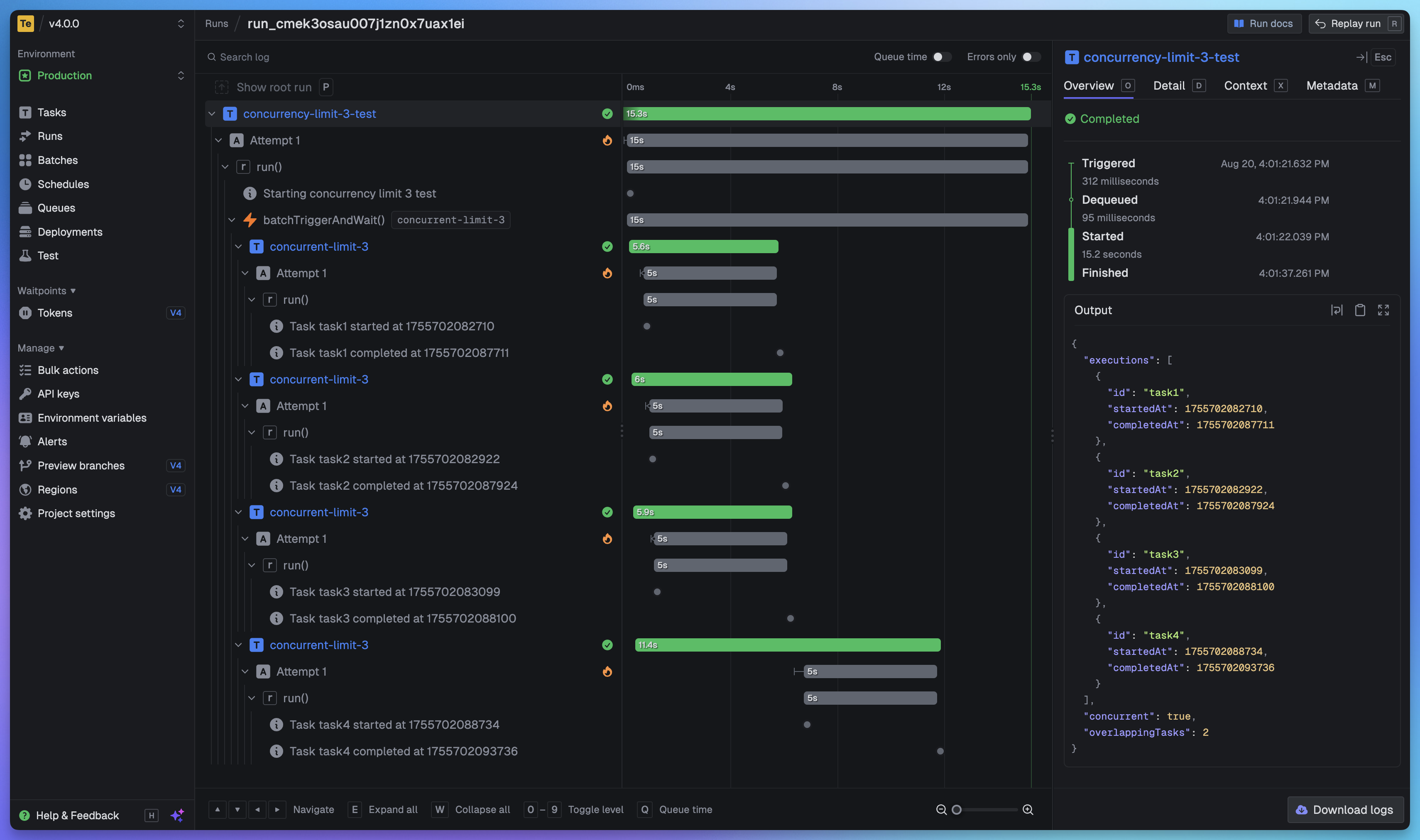
Full visibility of every job run
View every task in every run so you can tell exactly what happened. We provide a full trace view of every task run so you can see what happened at every step.
Getting started
The quickest way to get started is to create an account and project in our web app, and follow the instructions in the onboarding. Build and deploy your first task in minutes.
Useful links:
- Quick start - get up and running in minutes
- How it works - understand how Trigger.dev works under the hood
- Guides and examples - walk-through guides and code examples for popular frameworks and use cases
Self-hosting
If you prefer to self-host Trigger.dev, you can follow our self-hosting guides:
- Docker self-hosting guide - use Docker Compose to spin up a Trigger.dev instance
- Kubernetes self-hosting guide - use our official Helm chart to deploy Trigger.dev to your Kubernetes cluster
Support and community
We have a large active community in our official Discord server for support, including a dedicated channel for self-hosting.
Development
To setup and develop locally or contribute to the open source project, follow our development guide.