项目文件夹
 Ray
bfbd4b305c
Ray
bfbd4b305c
Flash returned an empty structure, and `submit_document(mode="flash")` and the CLI a hard error, for any PDF under 300 text weight, under 200 on its densest page, or with mostly-landscape pages. Both rules threw away documents the detector handles. Four more rules keyed on the document's script: the "other" script family (Arabic, Hebrew, Persian, Urdu, Devanagari, Bengali, Tamil, Thai, Khmer, Georgian, Armenian, Amharic, and numbers-only text) was refused as "no alphabetic text"; an unnumbered heading in a script other than the body's was dropped, so a Chinese report lost its English section titles; a kana-majority Japanese document had every detected heading discarded; a mostly-landscape document picked its title from page one without the body-paragraph check, so a slide deck's title became slide one's body text. These are Scholar's scope limits for an index of Latin and CJK papers; on PageIndex's default local mode they were silent refusals and silent losses.

**What changes**

- Layout decides, never script. The size and landscape bails, the script gate, the cross-script heading drop, the Japanese outline nullifier, the landscape title branch, the Cyrillic-only density threshold and the title scorer's cross-script penalty are deleted from this repo's copy of the port; the private `scholar/` tree stays a faithful port and the new tests guard the fork. Language now only decides which cues are available: case, keyword tables, numbering styles.
- When detection finds no hierarchy, `page_index_flash` returns one node per page titled `Page N`, covering every page, labelled `toc_source="pages"`. A flat tree over `FLAT_TREE_MAX_NODES` (10) pages comes back without the optimize and summary passes and is refused by the local client and the CLI through one shared `flash_rejection_reason()`, pointing at standard mode.
- Every page is in some node. A hierarchy that starts after page 1 (a memo whose first heading became the document title, a title slide, a report's cover and contents, a bookmark outline that begins on page 3) is preceded by a `Preface` node covering the pages before it, the node standard mode has always inserted for the same case; until now those pages were reachable from no node.
- `toc_source="unreadable"` means exactly that no page carries text; the refusal says so and points at OCR, not at standard mode, which would receive the same bytes.
- The character-level parser no longer raises on a glyph whose ToUnicode value is several code points (a Devanagari conjunct, a Thai cluster, an Arabic ligature); real Hindi and Thai PDFs used to fail with a `TypeError` before any rule ran.
- `toc_source` is present on every result: `detected`, `bookmarks`, `hybrid`, `pages`, `unreadable`. The README and the `page_index_flash` docstring list them, and describe a node as emitted: `node_id` on every node, `nodes` only on entries with children, `summary` only when summaries ran.
- `get_leaf_nodes` walks a flat page tree instead of raising `KeyError` on a node without a `nodes` key; it was the one tree helper reading the key unguarded.

**Behaviour change**

Small documents, slide decks, and Japanese, Arabic, Hebrew, Indic, Thai and mixed-script documents that used to fail flash indexing or lose headings now index; with the rules gone the same layout yields the same headings in every one of those scripts, and English is unchanged. A garbage text layer that still has layout structure now indexes as a garbage-titled tree instead of being refused. A Chinese-body report whose cover sets an English title over a Chinese subtitle now picks its title by layout; the deleted penalty could hand `doc_title` to a body paragraph. `extract_toc` yields the same nine example trees, node for node, before and after; `page_index_flash` adds the `Preface` node to the three whose hierarchy starts late (the two Federal Reserve reports, pages 1-4 and 1-2, and Four Lectures, page 1), the node standard mode already gives them, and leaves the other six identical.

**Tests**

Fixtures for Japanese, Chinese with English headings, Hindi and Arabic under `tests/data/flash/`, PyMuPDF-generated with open-licensed font subsets embedded; `make_fixtures.py` regenerates them byte-identically. Green on all three CI legs locally (with and without agent frameworks, pypdfium2 4 and 5).
PageIndex: Vectorless, Reasoning-based RAG
Reasoning-based RAG ◦ No Vector DB, No Chunking ◦ Context-Aware Retrieval ◦ Reads Like a Human
🌐 Website • ☁️ Cloud • 📖 Docs • 📝 Blog • ✉️ Contact
Updates
- [Aug '26] 🔥 PageIndex SDK:
pip install -U pageindexnow ships local mode: index, retrieve, and chat entirely on your machine with your own LLM key, or point the same client at PageIndex Cloud with an API key. - [Aug '26] ⚡ PageIndex Flash: fast tree index generation for text-based PDFs, now the default indexing method in PageIndex SDK local mode.
- Scale PageIndex to Millions of Documents: PageIndex File System is a file-level tree indexing layer that lets PageIndex reason over an entire corpus, not just a single document.
- PageIndex App: a human-like document analysis agent for long professional documents.
What is PageIndex?
Are you frustrated with vector database retrieval accuracy for long and complex documents? Vector-based RAG retrieves by semantic similarity. But similarity ≠ relevance — what retrieval actually needs is relevance, and relevance requires reasoning. On professional documents that demand contextual understanding, domain expertise, and multi-step reasoning, similarity search misses what is relevant but not similar, and returns what is similar but not relevant.
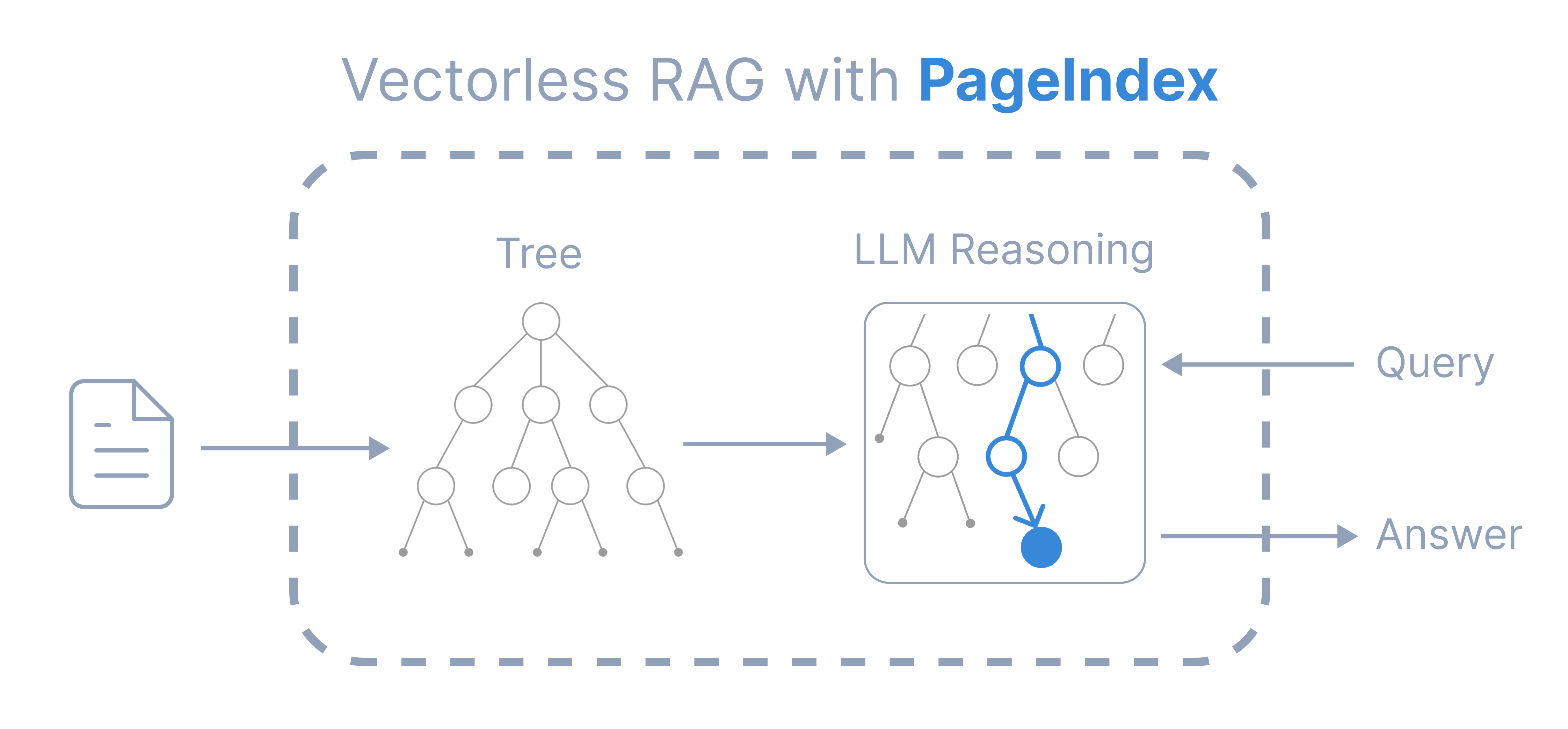
Inspired by AlphaGo, PageIndex replaces the vector index with a hierarchical tree index and lets an LLM reason its way through it, the way a human expert turns to and reads the right section of a long report. Retrieval happens in two steps:
- Index: generate a tree-structure index for each document
- Retrieve: agentically search that tree with LLM reasoning
TL;DR
PageIndex is a vectorless, reasoning-based RAG engine that mirrors how humans read, delivering traceable, explainable, and context-aware retrieval, with no vector DBs or chunking.
Compare with Vector RAG
| Vector RAG | PageIndex | |
|---|---|---|
| Index | vector index | tree index |
| Retrieval | semantic similarity search | LLM reasoning over the tree |
| Result | opaque, “vibe retrieval” | traceable to explicit references |
| Context | query embedding only | full context: conversation history, domain knowledge, etc. |
It is ideal for financial reports, legal documents, regulatory filings, technical manuals, medical literature, academic textbooks, and any other long, complex professional document.
Quickstart
pip install -U pageindex
import os
from pageindex import PageIndexClient

os.environ["OPENAI_API_KEY"] = "your-openai-key"

client = PageIndexClient(
    index="gpt-5.6-luna",               # model to build the tree index
    chat="gpt-5.6-sol",                 # model to search the tree
)
doc_id = client.submit_document("report.pdf")["doc_id"]

answer = client.chat("What was the 2023 operating margin?", doc_id=doc_id)
print(answer)
Model Recommendations
index=: a basic model is sufficient. The tree structure itself is extracted from the document layout without an LLM; the index model only summarizes and refines it, which a basic model does well.chat=: use the best model you can afford. The chat model searches the tree to retrieve information. See Query cost and accuracy.
Use PageIndex through the SDK client →
Configure other models, streaming, multi-document search, citations, and more.
Integrate PageIndex with your own agent →
Drop PageIndex tools into the OpenAI Agents SDK, the Claude Agent SDK, or any other framework.
Benchmarks
Local indexing cost and time
Building a tree locally runs about $0.001 per page with gpt-5.6-luna as the index model, so a 1,000-page textbook costs a little over a dollar and a few minutes, once, and every later question reuses it. PageIndex is designed not to rely heavily on the model used at index time, so in our experiments a basic model does not hurt quality.
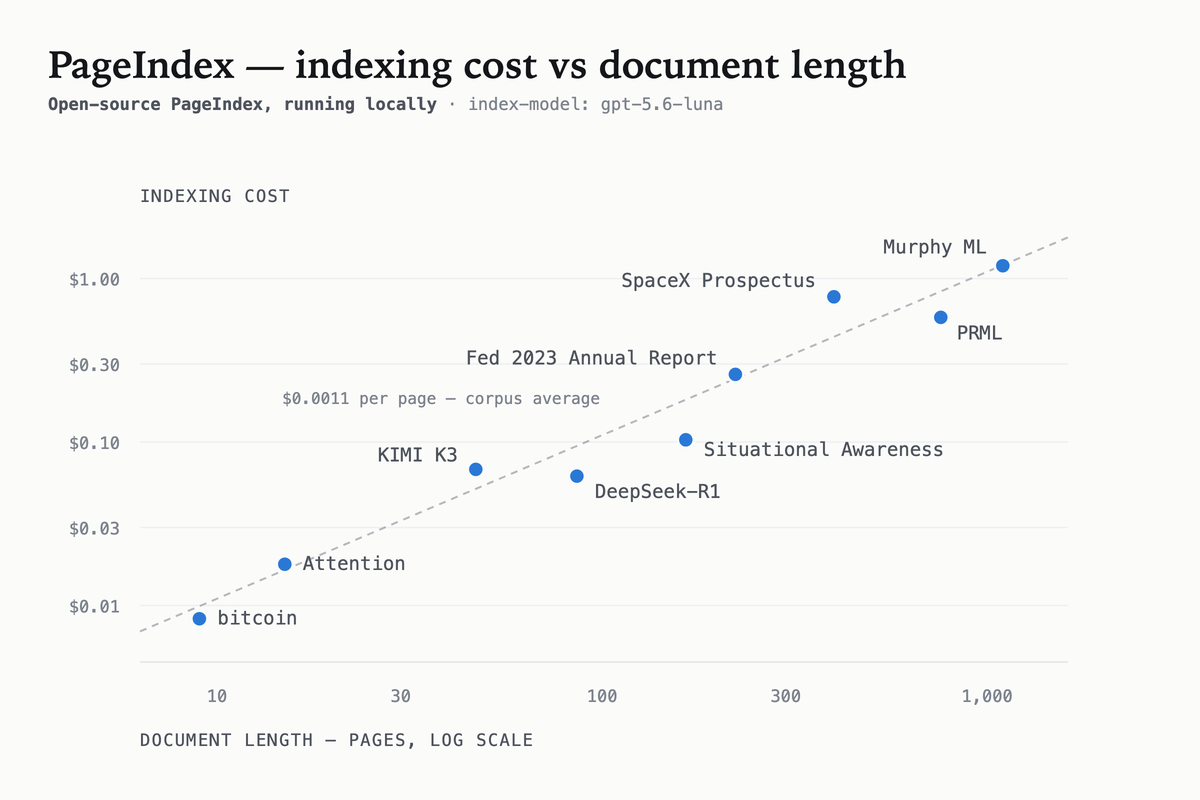
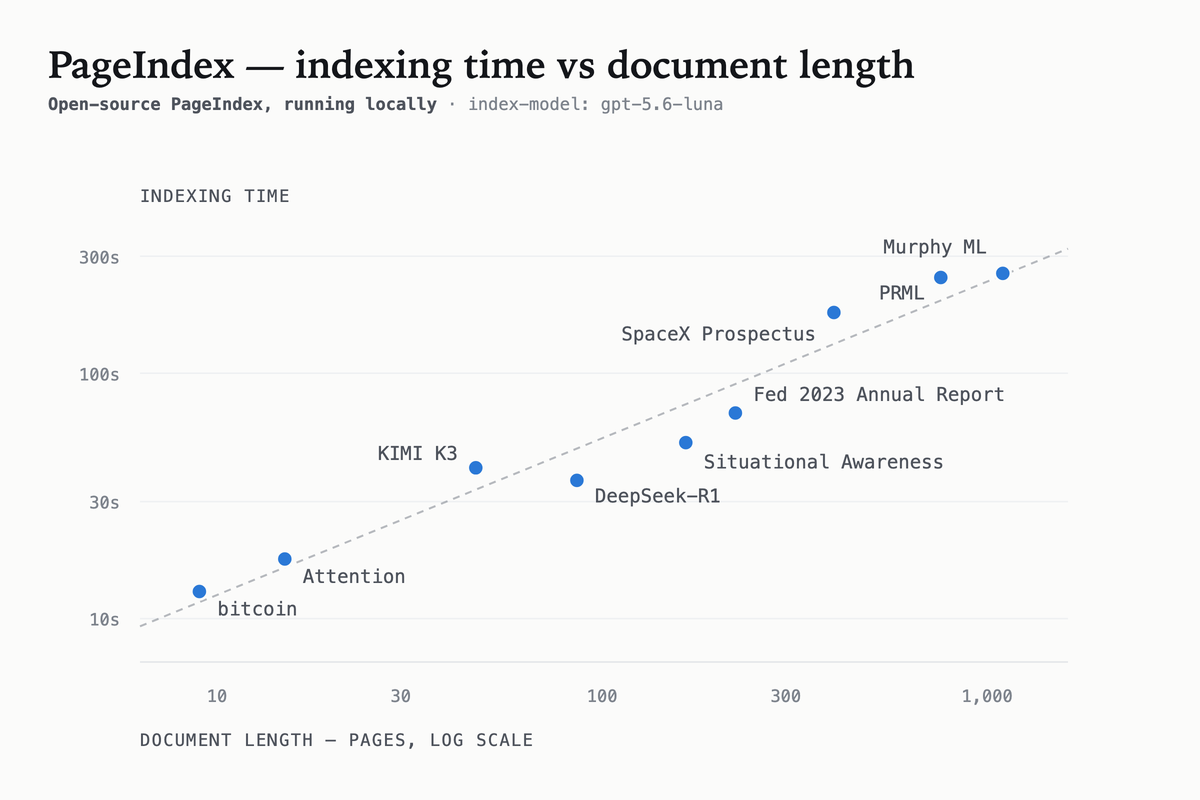
Indexing time also scales predictably with document length. In the same local setup, the benchmark documents (9 to 1,098 pages) finished in roughly 13 seconds to 4.5 minutes.
Query cost and accuracy
PageIndex-OSS-Benchmark measures exactly the setup in the quickstart above (PageIndexClient() in local mode, flash indexing, no OCR) on 62 lookup questions over 34 PDFs (1,945 pages) drawn from MMLongBench-Doc-V2. Every question's answer is a fact stated in running text, so a wrong answer is a retrieval or reading failure, not a reasoning one.
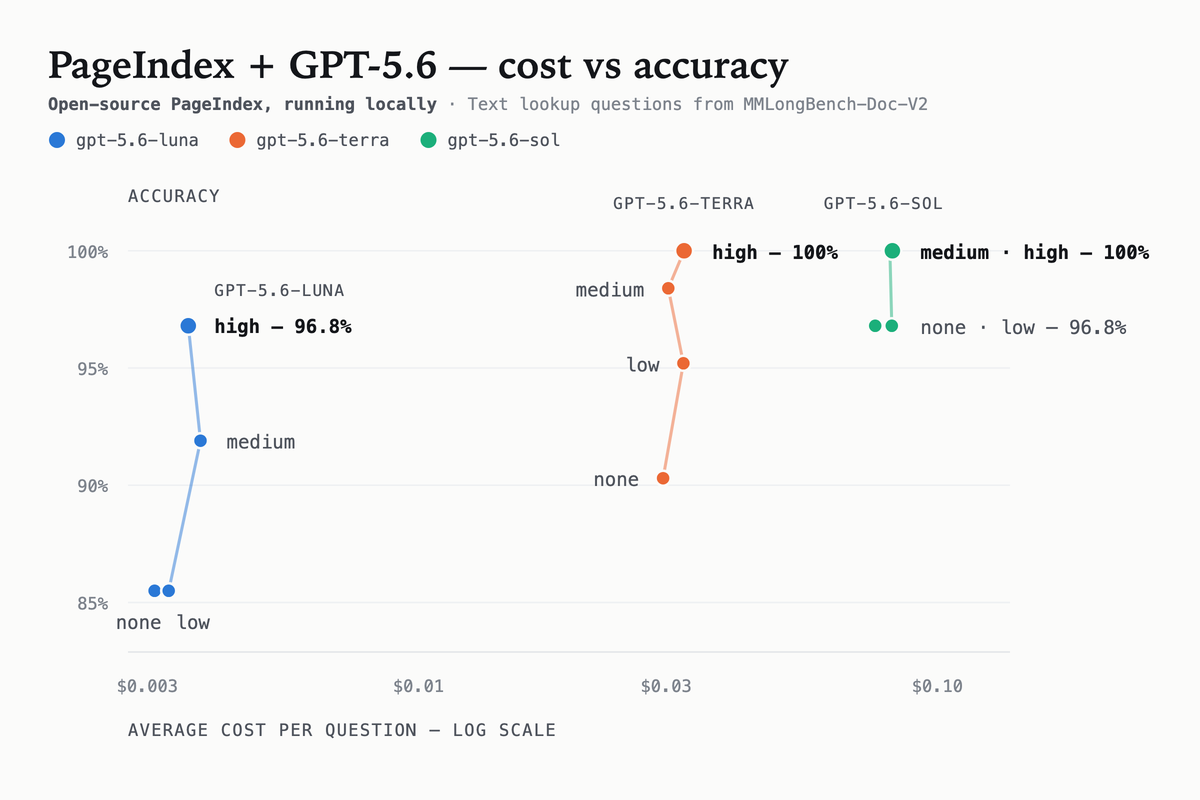
Full results, data, and the runner are in the benchmark repo.
Cost per query vs. native PDF input
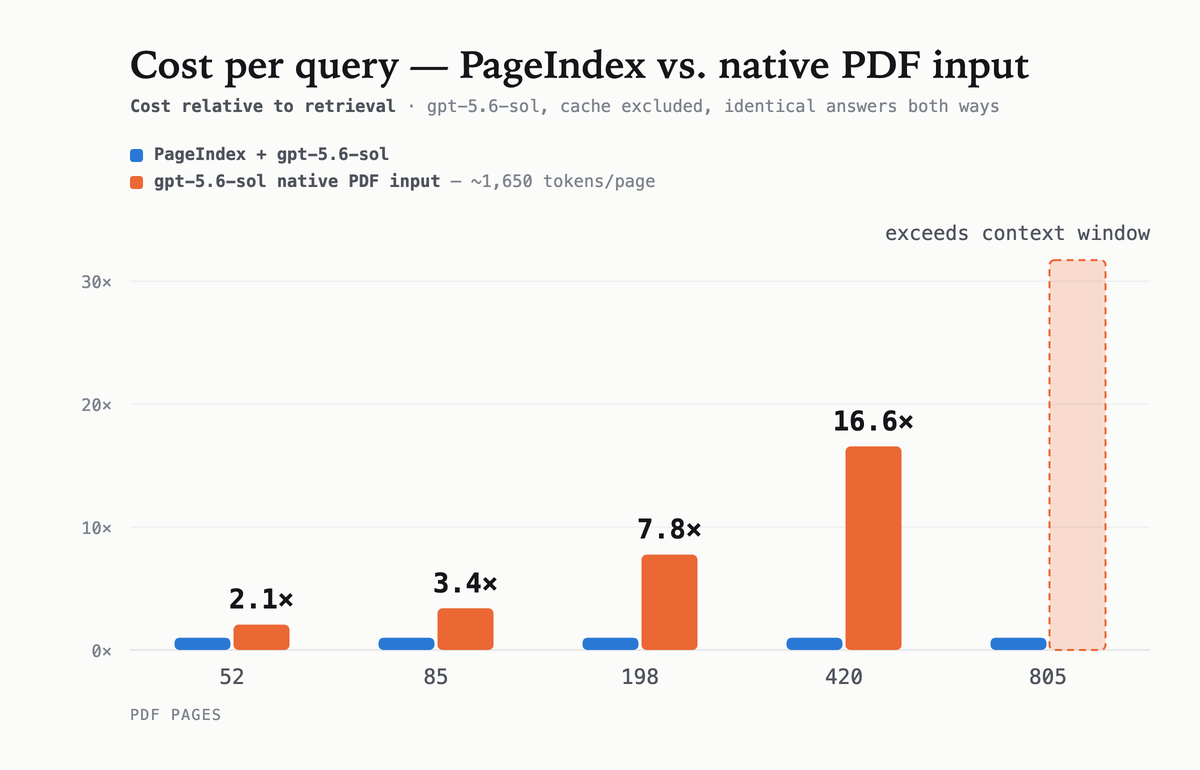
The alternative to retrieval is handing the model the whole PDF on every question. That cost grows with the document; PageIndex's does not, because it reads only the nodes its reasoning reaches. On documents where both routes return the same answer, native PDF input costs 2.1× more at 52 pages and 16.6× more at 420 (gpt-5.6-sol, prompt caching excluded) — and at 805 pages the document no longer fits in the context window at all.
Leading accuracy on FinanceBench
PageIndex reached a state-of-the-art 98.7% accuracy on FinanceBench (financial document QA benchmark), vastly outperforming vector-based RAG.

Explore the full FinanceBench evaluation results and the blog post.
PageIndex Cloud
The open-source version is ideal for text-heavy PDFs and local workflows. With PageIndex Cloud, document indexing and storage run in the cloud: PageIndex handles parsing, OCR, image understanding, tree-index construction, and managed storage for you. The chat and retrieval layer remains compatible with your model, so you can search the cloud-hosted index using the model provider your application already uses.
Moving indexing and storage from Local to Cloud only requires a PageIndex API key:
import os
from pageindex import PageIndexClient

os.environ["PAGEINDEX_API_KEY"] = "your-pageindex-key"
os.environ["OPENAI_API_KEY"] = "your-openai-key"

client = PageIndexClient(
    index="cloud",                       # build and store the index in PageIndex Cloud
    chat="gpt-5.6-sol",                  # use your preferred compatible model for chat
)
doc_id = client.submit_document("report.pdf", wait=True)["doc_id"]
print(client.chat("What was the 2023 operating margin?", doc_id=doc_id))
| Capability | Local (this repo) | Cloud (get an API key) |
|---|---|---|
| Best for | text-heavy PDFs and local workflows | scanned, image-heavy, and large document collections |
| Indexing | runs locally | runs in PageIndex Cloud, with production OCR and image understanding |
| Storage | local | managed in PageIndex Cloud |
| Chat model | your model | your model, or the managed chat included with your key |
| Citations | page-level | line-level |
| Image understanding | — | ✅ |
| Multi-document scale | manual | PageIndex File System |
| MCP server | — | ✅ |
More About PageIndex Cloud
- Scale PageIndex to Millions of Documents: PageIndex File System is a Cloud-only, file-level tree indexing layer that lets PageIndex reason over an entire corpus, not just a single document.
Ready to Try It?
- Get a PageIndex API key
- Read the PageIndex Cloud documentation
For dedicated deployment (VPC or on-premises), contact us or book a demo.
⭐ Support Us
Leave us a star 🌟 if you like our project. Thank you!
Please cite this work as:
Mingtian Zhang, Yu Tang and PageIndex Team,
"PageIndex: Next-Generation Vectorless, Reasoning-based RAG",
PageIndex Blog, Sep 2025.
Or use the BibTeX citation.
@article{zhang2025pageindex,
  author = {Mingtian Zhang and Yu Tang and PageIndex Team},
  title = {PageIndex: Next-Generation Vectorless, Reasoning-based RAG},
  journal = {PageIndex Blog},
  year = {2025},
  month = {September},
  note = {https://pageindex.ai/blog/pageindex-intro},
}
© 2026 PageIndex AI