 Eric Allam
db67a856fe
Eric Allam
db67a856fe
Implementing PlanetScale Insights improvement.

## Summary

Validating a schedule (creating or updating one through the API or the
dashboard, and deploying a project that declares schedules) looks up the
newest version of a task by slug. That lookup reads *every* version of
the task and sorts them to return one. A project gains a row per task on
every deploy, so the work grows with the project's age: the oldest
projects pay the most, and dev-mode redeploys make it worse. This was
picked because it was the largest single consumer of database time on
the schedules path, and the fix is a sort key with no index behind it.

## Fix

`BackgroundWorkerTask` is indexed on `(projectId, slug)`, which serves
the equality but not the `ORDER BY createdAt DESC`. Postgres seeks the
index, then bitmap-scans and top-N sorts the whole group to produce a
single row. Adding `createdAt` to the index lets it scan backward and
stop at the first row.

The same call site also selected all 21 columns, including five JSON
blobs, to read one field (`triggerSource`), so it now selects that field
alone.

## Benchmark

Local Postgres 17, 997,000 seeded rows / 748 MB, group sizes chosen to
match the distribution seen in production.

| Group size | Before | After |
| --- | --- | --- |
| 15,000 versions of one task | 11.118 ms, 1,510 buffers, 15,000 rows
scanned | 0.027 ms, 4 buffers, 1 row |
| 2,000 versions of one task | 2.081 ms, 1,455 buffers, 2,000 rows
scanned | 0.022 ms, 4 buffers, 1 row |

```
before:  Limit -> Sort (top-N heapsort) -> Bitmap Heap Scan
after:   Limit -> Index Scan Backward using BackgroundWorkerTask_projectId_slug_createdAt_idx
```

An ascending index scanned backward is enough here, so no descending
index is needed.

## Impact and risk

Real-world gain lands between the two rows above and scales with how
many deploys a project has accumulated. Projects with few deploys will
see little change, since there is barely anything to sort.

The new index costs noticeably more than the existing two-column one: 43
MB against 7.3 MB on the benchmark rig. Adding `createdAt` makes every
key unique, which defeats btree deduplication, so this is a real disk
and write cost rather than a rounding error. Writes to this table happen
at deploy time, not on the run path, so the write amplification is
acceptable. The existing `(projectId, slug)` index is now a redundant
prefix and could be dropped, but this PR keeps it so index usage can be
observed before removing it.

Behavior is unchanged: same predicate, same ordering, same row returned.
The narrowed select is the only code change, and the field it keeps is
the only one the caller read.

Deploy note: the migration is
`20260806100000_add_background_worker_task_project_id_slug_created_at_index`
and uses `CREATE INDEX CONCURRENTLY IF NOT EXISTS`, so it can be
pre-applied by hand before the deploy.

Build and deploy fully‑managed AI agents and workflows
Website | Docs | Issues | Example projects | Feature requests | Public roadmap | Self-hosting








About Trigger.dev
Trigger.dev is the open-source platform for building AI workflows in TypeScript. Long-running tasks with retries, queues, observability, and elastic scaling.
The platform designed for building AI agents
Build AI agents using all the frameworks, services and LLMs you're used to, deploy them to Trigger.dev and get durable, long-running tasks with retries, queues, observability, and elastic scaling out of the box.
-
Long-running without timeouts: Execute your tasks with absolutely no timeouts, unlike AWS Lambda, Vercel, and other serverless platforms.
-
Durability, retries & queues: Build rock solid agents and AI applications using our durable tasks, retries, queues and idempotency.
-
True runtime freedom: Customize your deployed tasks with system packages – run browsers, Python scripts, FFmpeg and more.
-
Human-in-the-loop: Programmatically pause your tasks until a human can approve, reject or give feedback.
-
Realtime apps & streaming: Move your background jobs to the foreground by subscribing to runs or streaming AI responses to your app.
-
Observability & monitoring: Each run has full tracing and logs. Configure error alerts to catch bugs fast.
Key features:
- JavaScript and TypeScript SDK - Build background tasks using familiar programming models
- Long-running tasks - Handle resource-heavy tasks without timeouts
- Durable cron schedules - Create and attach recurring schedules of up to a year
- Trigger.dev Realtime - Trigger, subscribe to, and get real-time updates for runs, with LLM streaming support
- Build extensions - Hook directly into the build system and customize the build process. Run Python scripts, FFmpeg, browsers, and more.
- React hooks - Interact with the Trigger.dev API on your frontend using our React hooks package
- Batch triggering - Use batchTrigger() to initiate multiple runs of a task with custom payloads and options
- Structured inputs / outputs - Define precise data schemas for your tasks with runtime payload validation
- Waits - Add waits to your tasks to pause execution for a specified duration
- Preview branches - Create isolated environments for testing and development. Integrates with Vercel and git workflows
- Waitpoints - Add human-in-the-loop judgment at critical decision points without disrupting workflow
- Concurrency & queues - Set concurrency rules to manage how multiple tasks execute
- Multiple environments - Support for DEV, PREVIEW, STAGING, and PROD environments
- No infrastructure to manage - Auto-scaling infrastructure that eliminates timeouts and server management
- Automatic retries - If your task encounters an uncaught error, we automatically attempt to run it again
- Checkpointing - Tasks are inherently durable, thanks to our checkpointing feature
- Versioning - Atomic versioning allows you to deploy new versions without affecting running tasks
- Machines - Configure the number of vCPUs and GBs of RAM you want the task to use
- Observability & monitoring - Monitor every aspect of your tasks' performance with comprehensive logging and visualization tools
- Logging & tracing - Comprehensive logging and tracing for all your tasks
- Tags - Attach up to ten tags to each run, allowing you to filter via the dashboard, realtime, and the SDK
- Run metadata - Attach metadata to runs which updates as the run progresses and is available to use in your frontend for live updates
- Bulk actions - Perform actions on multiple runs simultaneously, including replaying and cancelling
- Real-time alerts - Choose your preferred notification method for run failures and deployments
Write tasks in your codebase
Create tasks where they belong: in your codebase. Version control, localhost, test and review like you're already used to.
import { task } from "@trigger.dev/sdk";

//1. You need to export each task
export const helloWorld = task({
  //2. Use a unique id for each task
  id: "hello-world",
  //3. The run function is the main function of the task
  run: async (payload: { message: string }) => {
    //4. You can write code that runs for a long time here, there are no timeouts
    console.log(payload.message);
  },
});
Deployment
Use our SDK to write tasks in your codebase. There's no infrastructure to manage, your tasks automatically scale and connect to our cloud. Or you can always self-host.
Environments
We support Development, Staging, Preview, and Production environments, allowing you to test your tasks before deploying them to production.
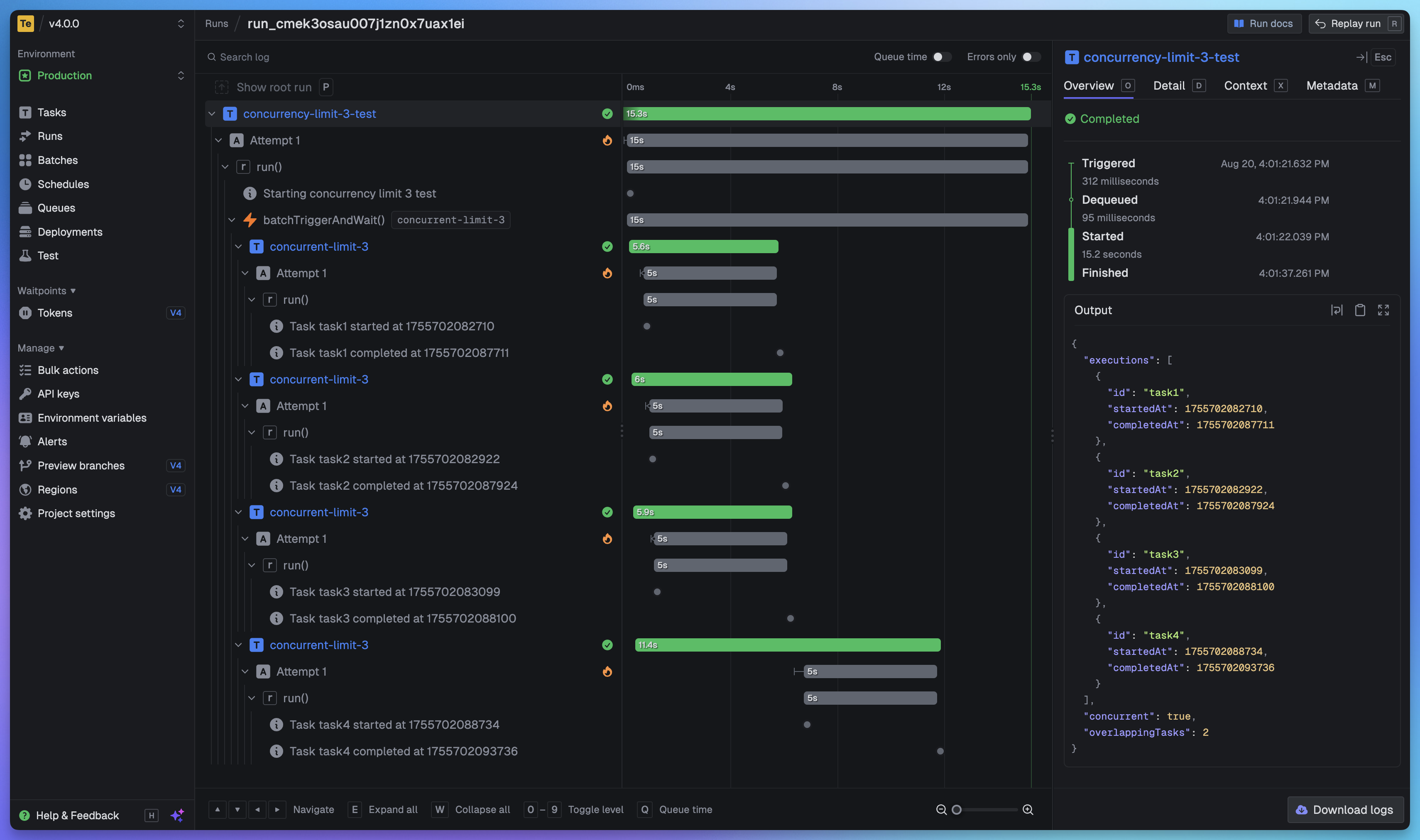
Full visibility of every job run
View every task in every run so you can tell exactly what happened. We provide a full trace view of every task run so you can see what happened at every step.
Getting started
The quickest way to get started is to create an account and project in our web app, and follow the instructions in the onboarding. Build and deploy your first task in minutes.
Useful links:
- Quick start - get up and running in minutes
- How it works - understand how Trigger.dev works under the hood
- Guides and examples - walk-through guides and code examples for popular frameworks and use cases
Self-hosting
If you prefer to self-host Trigger.dev, you can follow our self-hosting guides:
- Docker self-hosting guide - use Docker Compose to spin up a Trigger.dev instance
- Kubernetes self-hosting guide - use our official Helm chart to deploy Trigger.dev to your Kubernetes cluster
Support and community
We have a large active community in our official Discord server for support, including a dedicated channel for self-hosting.
Development
To setup and develop locally or contribute to the open source project, follow our development guide.