 Katia Bulatova
e768d0a724
Katia Bulatova
e768d0a724
## What & why

The dashboard agent can now run its model calls through AWS Bedrock
instead of the direct Anthropic API, chosen by a single env switch. It's
**off by default** (`DASHBOARD_AGENT_MODEL_PROVIDER` unset ⇒
`anthropic`), so merging changes nothing at runtime — the Bedrock path
is a dormant branch until an operator sets the switch and AWS config.
The default Anthropic path is byte-for-byte unchanged.

This also carries a related tenant-isolation hardening for the agent's
delegated token (kept together deliberately — both land the agent on
Bedrock for HIPAA readiness). Refs: TRI-13251, TRI-11032.

## What's inside

**Provider seam** —
`internal-packages/dashboard-agent/src/model-provider.ts`: the registry
now holds both `anthropic` and `bedrock`; `resolveDashboardAgentModel()`
maps the canonical `"anthropic:<id>"` strings the managed prompts carry
to the active provider, and the cache-breakpoint helpers emit the active
provider's shape — Anthropic `cacheControl` vs Bedrock `cachePoint`.
Managed prompt strings stay canonical, so stored prompts don't change
meaning. Unmapped model ids throw rather than shipping a guaranteed-404
profile. All agent, watch, compaction and title callsites route through
the resolver; the `dashboardAgentModelKey` locals override (test mock
injection) is preserved.

**Cache telemetry** — `step-cache.ts`: cache token usage is read from
the active provider (Anthropic reports it on provider metadata; Bedrock
reports the write on metadata and the read via standard usage), so
`gen_ai.usage.cache_*` is populated on both. This also fixes a latent
ordering bug where step attributes could null-overwrite the prompt-cache
read count.

**Webapp callsites** — `dashboardAgentHeadStart.server.ts` and the
head-start route resolve the model and the cache breakpoint through the
same seam, so the warm-up prefix and the following turn share one
provider. The head-start firing gate is provider-aware: on Bedrock it
gates on `AWS_REGION` and lets the SDK resolve credentials (IAM role /
static keys / session token / bearer), so a role-based deploy still
warms; on Anthropic it stays `Boolean(ANTHROPIC_API_KEY)`.
`app/env.server.ts` gains the optional AWS vars and validates
`DASHBOARD_AGENT_MODEL_PROVIDER`. `ANTHROPIC_API_KEY` is untouched and
not required on a Bedrock deploy.

**Tenant-isolation hardening** —
`internal-packages/rbac/src/fallback.ts`: for a **scoped** context, the
OSS `authenticateUserActor` now applies the same membership floor as the
session path — a delegated user-actor token whose user is not a member
of the scoped org/project is denied (403). Unscoped tokens keep their
prior behavior (no tenant claim, no lookup). The user lookup falls back
replica→primary so replication lag can't spuriously 401 a just-joined
member. Members and admins are unaffected. Previously this invariant
held only through per-route discipline; this makes it structural.

## Enabling Bedrock (later, ops)

- Set `DASHBOARD_AGENT_MODEL_PROVIDER=bedrock` **identically** in both
the webapp and the agent task container — the webapp warms the cache
prefix and the task reads it, so a split would silently miss the cache.
- Set `AWS_REGION` and provide credentials the Bedrock SDK can resolve
(IAM role preferred). For v1 this runs **without** an Anthropic API key.
Note: with no Anthropic key set, rollback is "turn the agent off", not
"unset the switch" (unsetting falls back to the Anthropic provider,
which then has no key).
- Two things to confirm before rollout: the Sonnet inference-profile id
is validated against the SDK's own model-id union but still warrants a
live smoke test; and Bedrock prompt caching for Sonnet is a 5-minute
window (not Anthropic's 1h), so input-token cost rises when flipped.

## Testing

Unit tests cover both provider paths: the provider switch and
per-provider cache shapes, a structural regex asserting Bedrock ids are
real inference profiles (not an echo of the table), the split-metadata
cache telemetry, and real-Postgres RBAC tests — member allowed, scoped
non-member denied (org-only and project-only), missing user → 401, admin
non-member exempt, unscoped success. `typecheck --filter webapp` and the
dashboard-agent + rbac suites pass.

Build and deploy fully‑managed AI agents and workflows
Website | Docs | Issues | Example projects | Feature requests | Public roadmap | Self-hosting








About Trigger.dev
Trigger.dev is the open-source platform for building AI workflows in TypeScript. Long-running tasks with retries, queues, observability, and elastic scaling.
The platform designed for building AI agents
Build AI agents using all the frameworks, services and LLMs you're used to, deploy them to Trigger.dev and get durable, long-running tasks with retries, queues, observability, and elastic scaling out of the box.
-
Long-running without timeouts: Execute your tasks with absolutely no timeouts, unlike AWS Lambda, Vercel, and other serverless platforms.
-
Durability, retries & queues: Build rock solid agents and AI applications using our durable tasks, retries, queues and idempotency.
-
True runtime freedom: Customize your deployed tasks with system packages – run browsers, Python scripts, FFmpeg and more.
-
Human-in-the-loop: Programmatically pause your tasks until a human can approve, reject or give feedback.
-
Realtime apps & streaming: Move your background jobs to the foreground by subscribing to runs or streaming AI responses to your app.
-
Observability & monitoring: Each run has full tracing and logs. Configure error alerts to catch bugs fast.
Key features:
- JavaScript and TypeScript SDK - Build background tasks using familiar programming models
- Long-running tasks - Handle resource-heavy tasks without timeouts
- Durable cron schedules - Create and attach recurring schedules of up to a year
- Trigger.dev Realtime - Trigger, subscribe to, and get real-time updates for runs, with LLM streaming support
- Build extensions - Hook directly into the build system and customize the build process. Run Python scripts, FFmpeg, browsers, and more.
- React hooks - Interact with the Trigger.dev API on your frontend using our React hooks package
- Batch triggering - Use batchTrigger() to initiate multiple runs of a task with custom payloads and options
- Structured inputs / outputs - Define precise data schemas for your tasks with runtime payload validation
- Waits - Add waits to your tasks to pause execution for a specified duration
- Preview branches - Create isolated environments for testing and development. Integrates with Vercel and git workflows
- Waitpoints - Add human-in-the-loop judgment at critical decision points without disrupting workflow
- Concurrency & queues - Set concurrency rules to manage how multiple tasks execute
- Multiple environments - Support for DEV, PREVIEW, STAGING, and PROD environments
- No infrastructure to manage - Auto-scaling infrastructure that eliminates timeouts and server management
- Automatic retries - If your task encounters an uncaught error, we automatically attempt to run it again
- Checkpointing - Tasks are inherently durable, thanks to our checkpointing feature
- Versioning - Atomic versioning allows you to deploy new versions without affecting running tasks
- Machines - Configure the number of vCPUs and GBs of RAM you want the task to use
- Observability & monitoring - Monitor every aspect of your tasks' performance with comprehensive logging and visualization tools
- Logging & tracing - Comprehensive logging and tracing for all your tasks
- Tags - Attach up to ten tags to each run, allowing you to filter via the dashboard, realtime, and the SDK
- Run metadata - Attach metadata to runs which updates as the run progresses and is available to use in your frontend for live updates
- Bulk actions - Perform actions on multiple runs simultaneously, including replaying and cancelling
- Real-time alerts - Choose your preferred notification method for run failures and deployments
Write tasks in your codebase
Create tasks where they belong: in your codebase. Version control, localhost, test and review like you're already used to.
import { task } from "@trigger.dev/sdk";

//1. You need to export each task
export const helloWorld = task({
  //2. Use a unique id for each task
  id: "hello-world",
  //3. The run function is the main function of the task
  run: async (payload: { message: string }) => {
    //4. You can write code that runs for a long time here, there are no timeouts
    console.log(payload.message);
  },
});
Deployment
Use our SDK to write tasks in your codebase. There's no infrastructure to manage, your tasks automatically scale and connect to our cloud. Or you can always self-host.
Environments
We support Development, Staging, Preview, and Production environments, allowing you to test your tasks before deploying them to production.
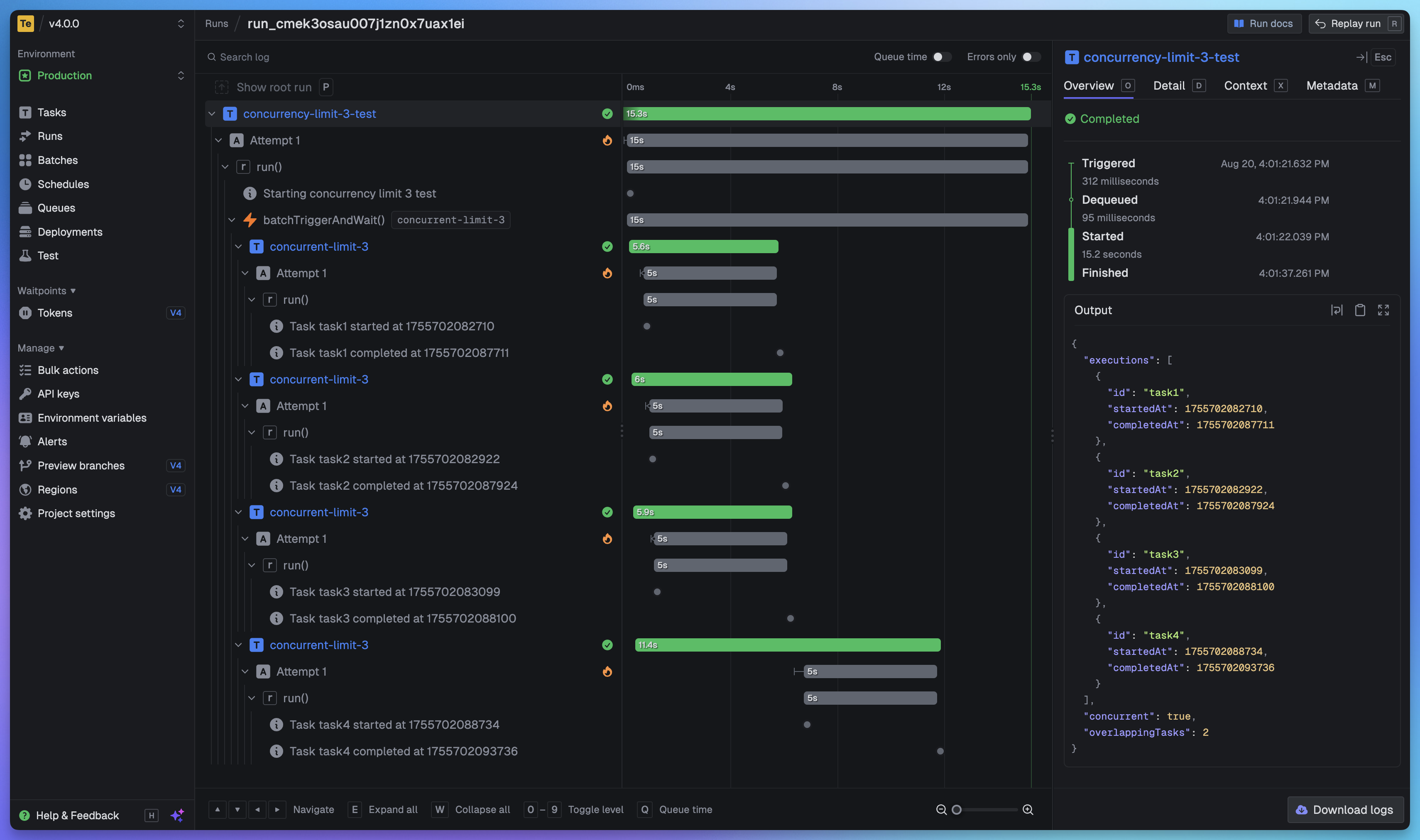
Full visibility of every job run
View every task in every run so you can tell exactly what happened. We provide a full trace view of every task run so you can see what happened at every step.
Getting started
The quickest way to get started is to create an account and project in our web app, and follow the instructions in the onboarding. Build and deploy your first task in minutes.
Useful links:
- Quick start - get up and running in minutes
- How it works - understand how Trigger.dev works under the hood
- Guides and examples - walk-through guides and code examples for popular frameworks and use cases
Self-hosting
If you prefer to self-host Trigger.dev, you can follow our self-hosting guides:
- Docker self-hosting guide - use Docker Compose to spin up a Trigger.dev instance
- Kubernetes self-hosting guide - use our official Helm chart to deploy Trigger.dev to your Kubernetes cluster
Support and community
We have a large active community in our official Discord server for support, including a dedicated channel for self-hosting.
Development
To setup and develop locally or contribute to the open source project, follow our development guide.