 Daniel Sutton
cc69ff4d26
Daniel Sutton
cc69ff4d26
Builds the Redis-backed half of the waitpoint coordinator, beside the
Postgres coordinator that #4753 extracted. Adds the coordination
protocol as Lua scripts, the run-ops-format waitpoint id scheme, and the
key layout. **No caller wires any of it up.**

Refs TRI-13440.

## Inert by construction

Merging this changes nothing observable. 3180 insertions, **zero
deletions**, nine new or additively-edited files.

- `WaitpointStoreCoordinator` is never constructed outside its own tests
and the benchmark.
- No env var, no config plumbing, no connection. It takes `redisOptions`
as a constructor argument.
- `waitpointSystem.ts` is untouched. Every live waitpoint operation
still runs on Postgres through the coordinator merged in #4753.
- No changeset and no `.server-changes` note — nothing here is
user-facing yet.

Deploying this needs no Redis or MemoryDB instance. That becomes a
prerequisite when a later change routes traffic onto the store behind a
per-organisation flag.

## What's here

**Nine Lua scripts**, each atomic on one hash tag. Seven mutate state —
create-if-absent, register-or-report, complete, idempotency reserve,
absorb, deliver, clear. One reads state (`runReadBlockState`) and is
separate because the pending, delivered and edge sets must be read as
one consistent view. One discards an idempotency loser.

**Two hash tags, deliberately.** `wp:{waitpointId}` holds a waitpoint's
record, status, completion envelope and watcher hash. `wp:run:{runId}:*`
holds one run's pending set, delivered set and edge set. A waitpoint has
N watchers, so it cannot live under any single run's tag.

**Waitpoint ids** reuse the run-ops body layout: a 24-char base32hex
core, a type char (`r`/`b`/`d`/`m`), and version char `w`. RUN and BATCH
ids derive from their anchor's core, so create-if-absent is idempotent
with no lock. `parseWaitpointId` is total and never throws.

**The single-slot guard.** Every script invocation goes through one
private wrapper that asserts all keys share a hash tag. A single-node
test server accepts what a real cluster rejects, so this assertion is
the only enforcement — and it is mutation-tested: removing it fails a
test.

## Measured

Against the same population of real Postgres rows:

| | store | postgres |
|---|---|---|
| pending count (the blocked/unblocked gate) | 0.13 ms p50 | 3.32 ms p50
|
| full-payload read | 1.45 ms p50 | 7.70 ms p50 |

Both are lower bounds: the benchmark charges Postgres a `COUNT(*)`,
while the resume-time read is a join with a partial select plus
filtering in JavaScript.

Store-only paths, no Postgres counterpart: block+complete+deliver 0.88
ms p50; 100-watcher fan-out 13.8 ms; a 1001-edge fan-in 149.8 ms, flat
at 0.15 ms per edge and round-trip bound rather than algorithmic.

The benchmark lives in `*.bench.test.ts` and is excluded from the
default suite.

## Review notes

- **The type surfaces are not reconciled yet, on purpose.** `types.ts`
(from #4753) carries the coordinator interface; `storeCoordinator.ts`
declares its own operation types because this was built in parallel. The
wiring change reconciles them.
- **The read-time resolver is not here.** Another lane froze its
contract while this was in flight, and its frozen types are not yet on
main. Building a second copy would fork a just-frozen contract.
- **Teardown is one-shard while registration is two-shard.** A terminal
clear leaves a run registered as a watcher on the waitpoints it was
blocked on, because the watcher hash is under a different tag and no
script may span slots. Recorded, not fixed here — it needs a retention
decision, and nothing observes it while the code is unwired.

## Verification

79 tests in the coordinator suite, 58 in the id suite. `typecheck` on
run-engine and webapp, `build` on core, `knip`, `oxfmt` and `oxlint` all
clean. The engine corpus passes 82/82.

Every invariant is mutation-tested rather than merely asserted. A
whole-branch review ran 14 mutants and killed 12; the two survivors were
fixed with their own mutation checks.

🤖 Generated with [Claude Code](https://claude.com/claude-code)

Build and deploy fully‑managed AI agents and workflows
Website | Docs | Issues | Example projects | Feature requests | Public roadmap | Self-hosting








About Trigger.dev
Trigger.dev is the open-source platform for building AI workflows in TypeScript. Long-running tasks with retries, queues, observability, and elastic scaling.
The platform designed for building AI agents
Build AI agents using all the frameworks, services and LLMs you're used to, deploy them to Trigger.dev and get durable, long-running tasks with retries, queues, observability, and elastic scaling out of the box.
-
Long-running without timeouts: Execute your tasks with absolutely no timeouts, unlike AWS Lambda, Vercel, and other serverless platforms.
-
Durability, retries & queues: Build rock solid agents and AI applications using our durable tasks, retries, queues and idempotency.
-
True runtime freedom: Customize your deployed tasks with system packages – run browsers, Python scripts, FFmpeg and more.
-
Human-in-the-loop: Programmatically pause your tasks until a human can approve, reject or give feedback.
-
Realtime apps & streaming: Move your background jobs to the foreground by subscribing to runs or streaming AI responses to your app.
-
Observability & monitoring: Each run has full tracing and logs. Configure error alerts to catch bugs fast.
Key features:
- JavaScript and TypeScript SDK - Build background tasks using familiar programming models
- Long-running tasks - Handle resource-heavy tasks without timeouts
- Durable cron schedules - Create and attach recurring schedules of up to a year
- Trigger.dev Realtime - Trigger, subscribe to, and get real-time updates for runs, with LLM streaming support
- Build extensions - Hook directly into the build system and customize the build process. Run Python scripts, FFmpeg, browsers, and more.
- React hooks - Interact with the Trigger.dev API on your frontend using our React hooks package
- Batch triggering - Use batchTrigger() to initiate multiple runs of a task with custom payloads and options
- Structured inputs / outputs - Define precise data schemas for your tasks with runtime payload validation
- Waits - Add waits to your tasks to pause execution for a specified duration
- Preview branches - Create isolated environments for testing and development. Integrates with Vercel and git workflows
- Waitpoints - Add human-in-the-loop judgment at critical decision points without disrupting workflow
- Concurrency & queues - Set concurrency rules to manage how multiple tasks execute
- Multiple environments - Support for DEV, PREVIEW, STAGING, and PROD environments
- No infrastructure to manage - Auto-scaling infrastructure that eliminates timeouts and server management
- Automatic retries - If your task encounters an uncaught error, we automatically attempt to run it again
- Checkpointing - Tasks are inherently durable, thanks to our checkpointing feature
- Versioning - Atomic versioning allows you to deploy new versions without affecting running tasks
- Machines - Configure the number of vCPUs and GBs of RAM you want the task to use
- Observability & monitoring - Monitor every aspect of your tasks' performance with comprehensive logging and visualization tools
- Logging & tracing - Comprehensive logging and tracing for all your tasks
- Tags - Attach up to ten tags to each run, allowing you to filter via the dashboard, realtime, and the SDK
- Run metadata - Attach metadata to runs which updates as the run progresses and is available to use in your frontend for live updates
- Bulk actions - Perform actions on multiple runs simultaneously, including replaying and cancelling
- Real-time alerts - Choose your preferred notification method for run failures and deployments
Write tasks in your codebase
Create tasks where they belong: in your codebase. Version control, localhost, test and review like you're already used to.
import { task } from "@trigger.dev/sdk";

//1. You need to export each task
export const helloWorld = task({
  //2. Use a unique id for each task
  id: "hello-world",
  //3. The run function is the main function of the task
  run: async (payload: { message: string }) => {
    //4. You can write code that runs for a long time here, there are no timeouts
    console.log(payload.message);
  },
});
Deployment
Use our SDK to write tasks in your codebase. There's no infrastructure to manage, your tasks automatically scale and connect to our cloud. Or you can always self-host.
Environments
We support Development, Staging, Preview, and Production environments, allowing you to test your tasks before deploying them to production.
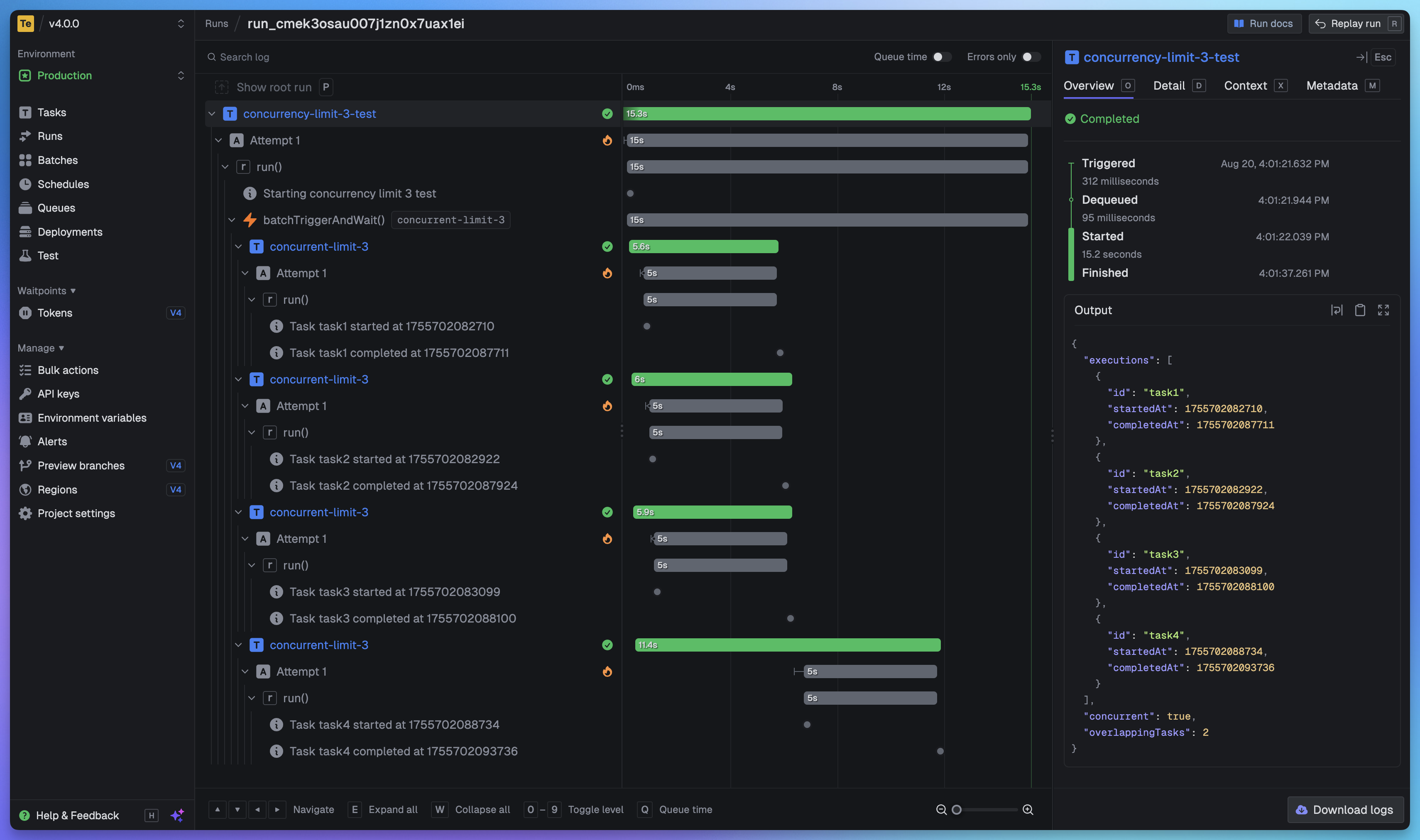
Full visibility of every job run
View every task in every run so you can tell exactly what happened. We provide a full trace view of every task run so you can see what happened at every step.
Getting started
The quickest way to get started is to create an account and project in our web app, and follow the instructions in the onboarding. Build and deploy your first task in minutes.
Useful links:
- Quick start - get up and running in minutes
- How it works - understand how Trigger.dev works under the hood
- Guides and examples - walk-through guides and code examples for popular frameworks and use cases
Self-hosting
If you prefer to self-host Trigger.dev, you can follow our self-hosting guides:
- Docker self-hosting guide - use Docker Compose to spin up a Trigger.dev instance
- Kubernetes self-hosting guide - use our official Helm chart to deploy Trigger.dev to your Kubernetes cluster
Support and community
We have a large active community in our official Discord server for support, including a dedicated channel for self-hosting.
Development
To setup and develop locally or contribute to the open source project, follow our development guide.