 Eric Allam
c72ebf9084
Eric Allam
c72ebf9084
## Summary

`batchTriggerAndWait()` could leave a parent run waiting forever. The
2-phase batch API blocks the parent on the batch's waitpoint as soon as
the batch is created, but the batch is only sealed at the end of item
streaming. If streaming never completed, nothing sealed the batch,
nothing completed the waitpoint, and the parent stayed suspended with no
timeout and no way to recover.

Supersedes #4016, which added the reaper alone.

## Fix

Admission for item streaming was being decided twice. Batch creation
passes its own rate limiter, which fixes `expectedCount` and blocks the
parent, and then the item stream had to pass the general API limiter as
well, competing with unrelated traffic. A second limiter could therefore
veto work the first had already committed the parent to. Creation now
mints a bounded grant that the item stream spends, so an admitted batch
can finish streaming. The grant is capped per batch rather than
exempting the path, and every failure mode (no grant, spent grant,
unreachable store) falls back to the normal limiter.

That makes stranding much rarer but not impossible, since a request
timeout or a crash can still end streaming for good. So a seal-timeout
reaper aborts any batch still unsealed after `BATCH_SEAL_TIMEOUT_MS` and
completes the parent's waitpoint with an error, letting
`batchTriggerAndWait()` reject instead of hang. It is race-safe against
a late seal, and it is only scheduled for batches that actually block a
parent, so fire-and-forget batches cost nothing.

Finally, the batches page used to report "Batch completion checked." for
these batches while doing nothing, because the completion path returns
early on an unsealed batch. It now says the batch cannot be resumed.

Rate limiting is no longer the reason a batch strands, so the reaper's
default stays at 30 minutes, comfortably above the SDK's worst-case
stream-retry budget.

## Verification

Unit and container tests cover the grant cap, the bypass ordering (it
runs after the authorization check, so it can never skip
authentication), and the reaper's abort, seal race, idempotency, and
no-waitpoint cases.

Also verified end-to-end against a running stack. With the general limit
exhausted, batch creation and other API calls returned 429 while a
granted batch still streamed and sealed; an ungranted batch id was rate
limited rather than bypassed; and the grant cut off exactly at its
configured attempt count. Reproducing the stranded state on a real
parent run, the batch was aborted at the timeout, the waitpoint
completed with an error, and the parent resumed and finished instead of
hanging. A parentless batch left unsealed was untouched well past the
reaper window.

## Verified against deployed runs

The reaper was proven end to end with a real deployed run (locally-run
supervisor, containerised
run) and a real network fault, rather than a simulated one: toxiproxy
severs the phase 2 item
stream mid-flight so every SDK stream retry genuinely fails, while phase
1 still succeeds. Only
the batch calls traverse the fault, so control-plane traffic is
untouched.

The reproduction is the shape that actually strands a parent: the task
catches the
`BatchTriggerError` the SDK throws and carries on, so the phase 1 block
outlives the thrown error
and the parent hangs at its next suspension point.

With the reaper disabled, the parent sat in `EXECUTING_WITH_WAITPOINTS`
for over 24 minutes holding
two blockers, and stayed stuck across a full infrastructure restart:

```
 type     | status    | has_timeout
 BATCH    | PENDING   | f            <- orphan, completedAfter NULL
 DATETIME | COMPLETED | t            <- the wait already elapsed
```

With the reaper enabled the same task under the same fault completed in
about 75 seconds with zero
blockers left, the batch `ABORTED`, and its waitpoint completed carrying
the error.

Two conditions are required to observe this at all, which is worth
knowing for any future test:
the run must be deployed rather than `trigger dev` (dev runs execute in
process and finish while
still holding blocker rows), and the wait after the caught error must
exceed the checkpoint
threshold, or it is served in process and never suspends.

### Why completing the batch waitpoint is sufficient

`batchTriggerAndWait` runs create, then stream, then wait. A phase 2
failure throws before the wait
is ever reached, and the reaper only fires on an unsealed batch, so the
parent is never suspended
awaiting the batch when it runs. The parent therefore does not need a
synthetic result, only to stop
being blocked. Note this reasoning depends on that ordering: if the wait
were ever reached with an
unsealed batch, completing the batch waitpoint alone would not settle
the caller.

## Follow-ups

- Batches stranded before this ships still need a one-off recovery; the
reaper only schedules at creation time.
- That same property leaves a gap if the process dies between creating
the batch and scheduling the job. A periodic sweep would close it, but
wants a supporting index.
- When a partially streamed batch aborts, children already enqueued keep
running while the parent fails. Left as-is deliberately, since
cancelling triggered work is a bigger semantic call.

Build and deploy fully‑managed AI agents and workflows
Website | Docs | Issues | Example projects | Feature requests | Public roadmap | Self-hosting








About Trigger.dev
Trigger.dev is the open-source platform for building AI workflows in TypeScript. Long-running tasks with retries, queues, observability, and elastic scaling.
The platform designed for building AI agents
Build AI agents using all the frameworks, services and LLMs you're used to, deploy them to Trigger.dev and get durable, long-running tasks with retries, queues, observability, and elastic scaling out of the box.
-
Long-running without timeouts: Execute your tasks with absolutely no timeouts, unlike AWS Lambda, Vercel, and other serverless platforms.
-
Durability, retries & queues: Build rock solid agents and AI applications using our durable tasks, retries, queues and idempotency.
-
True runtime freedom: Customize your deployed tasks with system packages – run browsers, Python scripts, FFmpeg and more.
-
Human-in-the-loop: Programmatically pause your tasks until a human can approve, reject or give feedback.
-
Realtime apps & streaming: Move your background jobs to the foreground by subscribing to runs or streaming AI responses to your app.
-
Observability & monitoring: Each run has full tracing and logs. Configure error alerts to catch bugs fast.
Key features:
- JavaScript and TypeScript SDK - Build background tasks using familiar programming models
- Long-running tasks - Handle resource-heavy tasks without timeouts
- Durable cron schedules - Create and attach recurring schedules of up to a year
- Trigger.dev Realtime - Trigger, subscribe to, and get real-time updates for runs, with LLM streaming support
- Build extensions - Hook directly into the build system and customize the build process. Run Python scripts, FFmpeg, browsers, and more.
- React hooks - Interact with the Trigger.dev API on your frontend using our React hooks package
- Batch triggering - Use batchTrigger() to initiate multiple runs of a task with custom payloads and options
- Structured inputs / outputs - Define precise data schemas for your tasks with runtime payload validation
- Waits - Add waits to your tasks to pause execution for a specified duration
- Preview branches - Create isolated environments for testing and development. Integrates with Vercel and git workflows
- Waitpoints - Add human-in-the-loop judgment at critical decision points without disrupting workflow
- Concurrency & queues - Set concurrency rules to manage how multiple tasks execute
- Multiple environments - Support for DEV, PREVIEW, STAGING, and PROD environments
- No infrastructure to manage - Auto-scaling infrastructure that eliminates timeouts and server management
- Automatic retries - If your task encounters an uncaught error, we automatically attempt to run it again
- Checkpointing - Tasks are inherently durable, thanks to our checkpointing feature
- Versioning - Atomic versioning allows you to deploy new versions without affecting running tasks
- Machines - Configure the number of vCPUs and GBs of RAM you want the task to use
- Observability & monitoring - Monitor every aspect of your tasks' performance with comprehensive logging and visualization tools
- Logging & tracing - Comprehensive logging and tracing for all your tasks
- Tags - Attach up to ten tags to each run, allowing you to filter via the dashboard, realtime, and the SDK
- Run metadata - Attach metadata to runs which updates as the run progresses and is available to use in your frontend for live updates
- Bulk actions - Perform actions on multiple runs simultaneously, including replaying and cancelling
- Real-time alerts - Choose your preferred notification method for run failures and deployments
Write tasks in your codebase
Create tasks where they belong: in your codebase. Version control, localhost, test and review like you're already used to.
import { task } from "@trigger.dev/sdk";

//1. You need to export each task
export const helloWorld = task({
  //2. Use a unique id for each task
  id: "hello-world",
  //3. The run function is the main function of the task
  run: async (payload: { message: string }) => {
    //4. You can write code that runs for a long time here, there are no timeouts
    console.log(payload.message);
  },
});
Deployment
Use our SDK to write tasks in your codebase. There's no infrastructure to manage, your tasks automatically scale and connect to our cloud. Or you can always self-host.
Environments
We support Development, Staging, Preview, and Production environments, allowing you to test your tasks before deploying them to production.
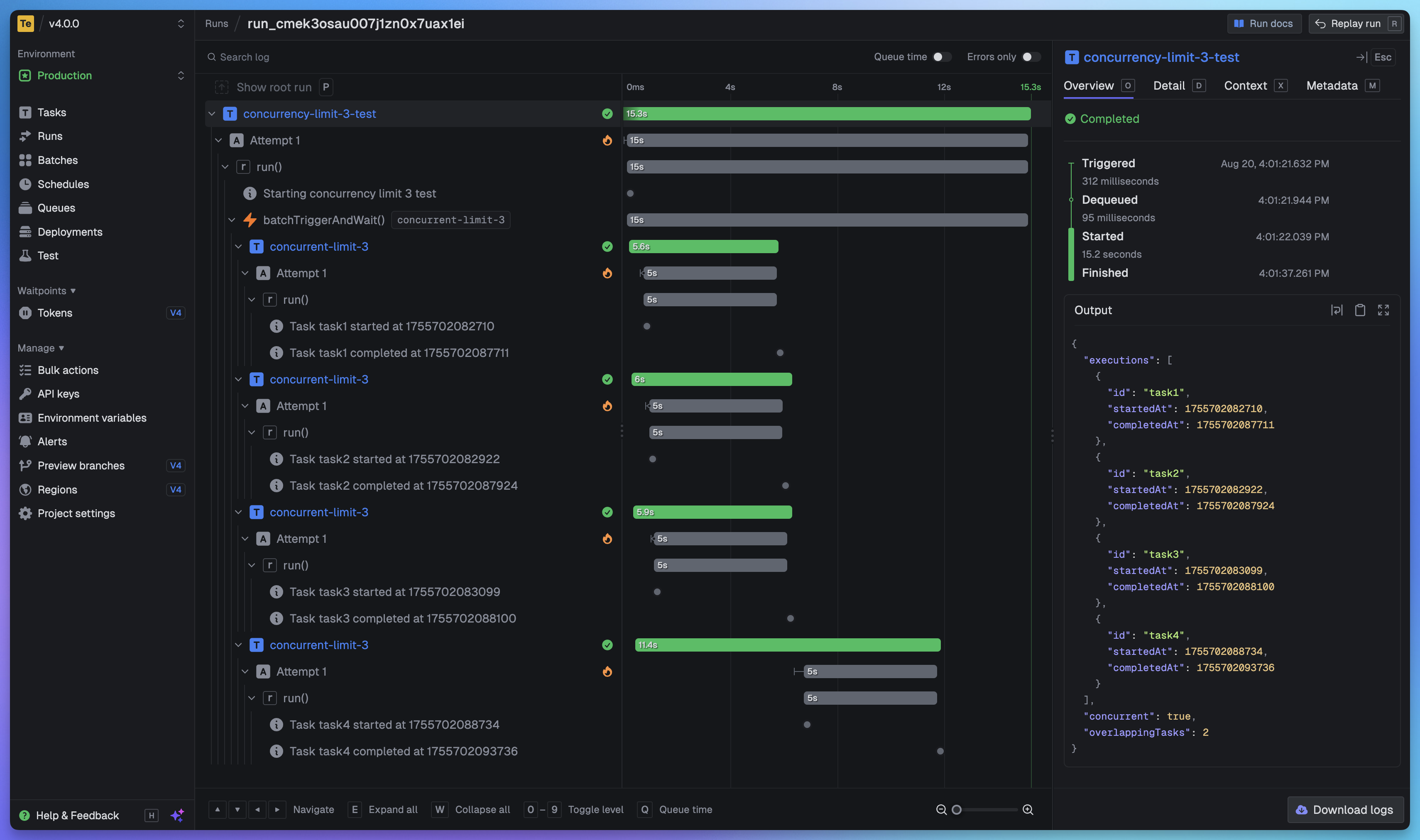
Full visibility of every job run
View every task in every run so you can tell exactly what happened. We provide a full trace view of every task run so you can see what happened at every step.
Getting started
The quickest way to get started is to create an account and project in our web app, and follow the instructions in the onboarding. Build and deploy your first task in minutes.
Useful links:
- Quick start - get up and running in minutes
- How it works - understand how Trigger.dev works under the hood
- Guides and examples - walk-through guides and code examples for popular frameworks and use cases
Self-hosting
If you prefer to self-host Trigger.dev, you can follow our self-hosting guides:
- Docker self-hosting guide - use Docker Compose to spin up a Trigger.dev instance
- Kubernetes self-hosting guide - use our official Helm chart to deploy Trigger.dev to your Kubernetes cluster
Support and community
We have a large active community in our official Discord server for support, including a dedicated channel for self-hosting.
Development
To setup and develop locally or contribute to the open source project, follow our development guide.