 James Ritchie
b2b4c510e2
James Ritchie
b2b4c510e2
## Summary

Improves and unifies the run-activity charts by extracting a shared set
of chart primitives and adopting them on the three task landing pages
(agent, standard, scheduled), with the density and label fixes also
carried over to the dashboard and custom query charts.

Main changes a reviewer should know about:

- **Shared primitives (DRY).** New `ChartCard` (title +
maximize/fullscreen), `ChartSyncContext` (cross-chart hover + zoom
state), `useXAxisTicks` (width-aware tick selection),
`activityTimeAxis`, and `statusColors`, plus a server-side
`activitySeries.server.ts` holding `chooseBucketSeconds`, status
grouping, and the zero-fill helpers. The three task routes and both
presenters were refactored onto these, removing roughly 3x duplicated
tick logic, status-color tables, and bucket-ladder code.
- **Denser bars on short ranges.** Server-side bucketing now uses
`chooseBucketSeconds` (nice-interval ladder, ~72 target, capped at 120
buckets) instead of the hardcoded 1h/6h/1d ladder, so a 5m or 1h range
no longer collapses into a single bar.
- **Width-aware x-axis labels.** Labels are selected to fit the measured
plot width (always first + last, evenly spaced, de-duplicated by
rendered text), stay horizontal, and reflow on panel/window resize.
Y-axis values default to compact form (8K, 1.2M) in
`ChartBar`/`ChartLine`.
- **Synced hover line.** Hovering one of the agent page's three charts
draws a dashed vertical line at the same bucket on the *other* two, and
suppresses it on the hovered chart. It is opt-in via
`ChartSyncProvider`, so single-chart pages are unaffected.
- **Maximize button.** Each chart gets a fullscreen dialog toggle
(reuses the existing dashboard-widget pattern, `v` shortcut while
hovered).
- **Drag-to-zoom on task pages.** Dragging across a task chart sets the
Time/Date filter (`from`/`to` URL params, clearing `period`/`cursor`),
with a From/To tooltip shown during the drag.
- **Custom query charts.** Long categorical x labels (run IDs, task
names) middle-truncate and auto-rotate only when needed, and label
thinning is now width-aware for both bar and line variants. Dashboard
line-chart label density is also width-aware, tuned by a
`TIME_AXIS_LABEL_SPACING_PX` constant.
- **Tests.** 46 new unit tests for the pure logic (bucket selection,
tick spacing, time-axis formatting, zoom range, truncation).

## Intentionally unchanged

- **No click/drag zoom on the dashboard or custom query charts.**
Drag-to-zoom is wired up on the task landing pages only; zooming the
dashboard and custom charts is deliberately deferred to a separate
follow-up PR. A plain click (without a drag) on a task chart is a no-op.
- **The 25 mini activity charts on the Task list (`_index`) page are
untouched.** They are hand-rolled raw-Recharts sparklines kept
deliberately lightweight and do not use these primitives.
- **Other raw-Recharts sparklines are untouched** (the usage sparkline,
errors and prompts pages).
- **No ClickHouse query semantics changed** beyond the bucket-interval
parameter (same filters, same FINAL / `_is_deleted` handling).
- **Webapp-only.** No public package (`packages/*`) changes, so there is
no changeset; the `.server-changes/` entries cover it.

---

## Testing

Added 46 unit tests covering server-side bucket selection, width-aware
tick spacing, time-axis formatting, zoom-range math, and categorical
label truncation (`pnpm --filter webapp run test`), and `pnpm run
typecheck --filter webapp` passes. Manually exercised each task landing
page (agent, standard, scheduled) plus the dashboard and custom query
charts, stepping the Date/Time filter through 5m, 1h, 24h, 7d, and 30d
to confirm dense bars on short ranges, non-overlapping labels that
reflow on resize, the synced hover line across the agent charts, the
maximize button, and drag-to-zoom updating the filter.

---

## Changelog

The activity charts on the task landing pages and the dashboard and
custom query charts now share one set of reusable primitives. X-axis
labels are width-aware so they never overlap and reflow when a panel
resizes, y-axis values are abbreviated (8K, 1.2M), and short time ranges
render dense bars instead of collapsing into a single bar. Hovering any
agent chart mirrors a vertical line on the others, every chart gains a
maximize button, and dragging across a task chart zooms the Time/Date
filter. Long categorical labels such as run IDs and task names
middle-truncate and auto-rotate only when needed.

---


https://github.com/user-attachments/assets/6be09e38-3a0e-4947-b6e3-4839daa2fbe0

Build and deploy fully‑managed AI agents and workflows
Website | Docs | Issues | Example projects | Feature requests | Public roadmap | Self-hosting








About Trigger.dev
Trigger.dev is the open-source platform for building AI workflows in TypeScript. Long-running tasks with retries, queues, observability, and elastic scaling.
The platform designed for building AI agents
Build AI agents using all the frameworks, services and LLMs you're used to, deploy them to Trigger.dev and get durable, long-running tasks with retries, queues, observability, and elastic scaling out of the box.
-
Long-running without timeouts: Execute your tasks with absolutely no timeouts, unlike AWS Lambda, Vercel, and other serverless platforms.
-
Durability, retries & queues: Build rock solid agents and AI applications using our durable tasks, retries, queues and idempotency.
-
True runtime freedom: Customize your deployed tasks with system packages – run browsers, Python scripts, FFmpeg and more.
-
Human-in-the-loop: Programmatically pause your tasks until a human can approve, reject or give feedback.
-
Realtime apps & streaming: Move your background jobs to the foreground by subscribing to runs or streaming AI responses to your app.
-
Observability & monitoring: Each run has full tracing and logs. Configure error alerts to catch bugs fast.
Key features:
- JavaScript and TypeScript SDK - Build background tasks using familiar programming models
- Long-running tasks - Handle resource-heavy tasks without timeouts
- Durable cron schedules - Create and attach recurring schedules of up to a year
- Trigger.dev Realtime - Trigger, subscribe to, and get real-time updates for runs, with LLM streaming support
- Build extensions - Hook directly into the build system and customize the build process. Run Python scripts, FFmpeg, browsers, and more.
- React hooks - Interact with the Trigger.dev API on your frontend using our React hooks package
- Batch triggering - Use batchTrigger() to initiate multiple runs of a task with custom payloads and options
- Structured inputs / outputs - Define precise data schemas for your tasks with runtime payload validation
- Waits - Add waits to your tasks to pause execution for a specified duration
- Preview branches - Create isolated environments for testing and development. Integrates with Vercel and git workflows
- Waitpoints - Add human-in-the-loop judgment at critical decision points without disrupting workflow
- Concurrency & queues - Set concurrency rules to manage how multiple tasks execute
- Multiple environments - Support for DEV, PREVIEW, STAGING, and PROD environments
- No infrastructure to manage - Auto-scaling infrastructure that eliminates timeouts and server management
- Automatic retries - If your task encounters an uncaught error, we automatically attempt to run it again
- Checkpointing - Tasks are inherently durable, thanks to our checkpointing feature
- Versioning - Atomic versioning allows you to deploy new versions without affecting running tasks
- Machines - Configure the number of vCPUs and GBs of RAM you want the task to use
- Observability & monitoring - Monitor every aspect of your tasks' performance with comprehensive logging and visualization tools
- Logging & tracing - Comprehensive logging and tracing for all your tasks
- Tags - Attach up to ten tags to each run, allowing you to filter via the dashboard, realtime, and the SDK
- Run metadata - Attach metadata to runs which updates as the run progresses and is available to use in your frontend for live updates
- Bulk actions - Perform actions on multiple runs simultaneously, including replaying and cancelling
- Real-time alerts - Choose your preferred notification method for run failures and deployments
Write tasks in your codebase
Create tasks where they belong: in your codebase. Version control, localhost, test and review like you're already used to.
import { task } from "@trigger.dev/sdk";

//1. You need to export each task
export const helloWorld = task({
  //2. Use a unique id for each task
  id: "hello-world",
  //3. The run function is the main function of the task
  run: async (payload: { message: string }) => {
    //4. You can write code that runs for a long time here, there are no timeouts
    console.log(payload.message);
  },
});
Deployment
Use our SDK to write tasks in your codebase. There's no infrastructure to manage, your tasks automatically scale and connect to our cloud. Or you can always self-host.
Environments
We support Development, Staging, Preview, and Production environments, allowing you to test your tasks before deploying them to production.
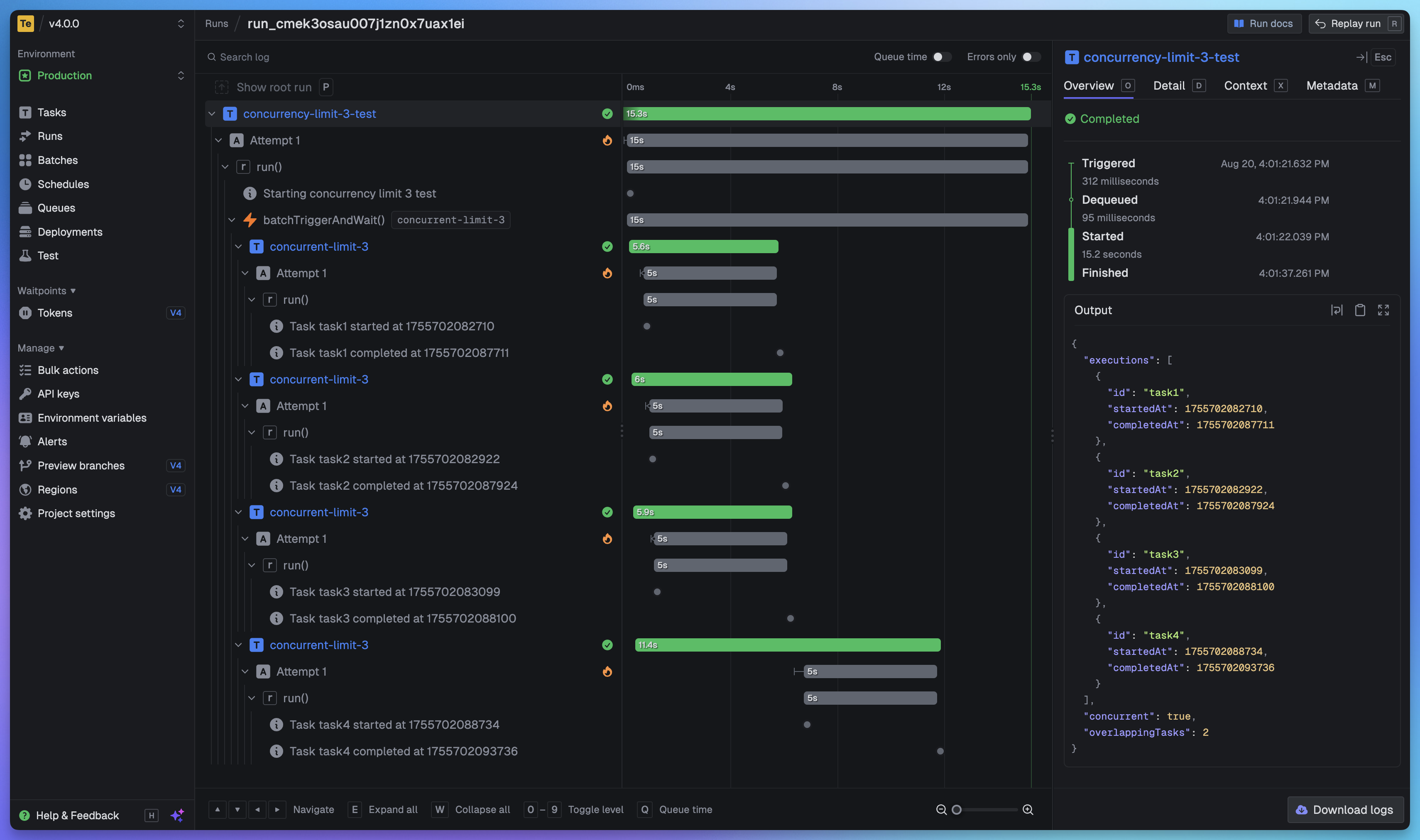
Full visibility of every job run
View every task in every run so you can tell exactly what happened. We provide a full trace view of every task run so you can see what happened at every step.
Getting started
The quickest way to get started is to create an account and project in our web app, and follow the instructions in the onboarding. Build and deploy your first task in minutes.
Useful links:
- Quick start - get up and running in minutes
- How it works - understand how Trigger.dev works under the hood
- Guides and examples - walk-through guides and code examples for popular frameworks and use cases
Self-hosting
If you prefer to self-host Trigger.dev, you can follow our self-hosting guides:
- Docker self-hosting guide - use Docker Compose to spin up a Trigger.dev instance
- Kubernetes self-hosting guide - use our official Helm chart to deploy Trigger.dev to your Kubernetes cluster
Support and community
We have a large active community in our official Discord server for support, including a dedicated channel for self-hosting.
Development
To setup and develop locally or contribute to the open source project, follow our development guide.