 Daniel Sutton
aa9b888988
Daniel Sutton
aa9b888988
## What

`RoutingRunStore` held two named store fields, `#new` and `#legacy`, and
took its routing policy from the order the statements happened to run
in. It now holds a `Map<ShardKey, RunStore>`, and the three policies
that were implicit are readable data:

- **`#probeOrder`** (`new` → `legacy`) — the sequential probe for a
lookup with no routable id. The first non-null result wins, and the
*last* entry owns the canonical not-found throw.
- **`#precedence`** (`legacy` → `new`) — ascending authority for a
merge, so the highest-authority shard wins a duplicate id.
- **`#idlessRouteShard`** (`new`) and **`#idlessWaitpointShard`**
(`legacy`) — the two id-less defaults, which differ by role and were
previously two unrelated literals in unrelated methods.

The two orders are the **reverse of each other**, which is why they are
separate fields rather than one ordering. Nine sites observe the
result-array order and must iterate `#probeOrder`; five decide a value
by which shard wins a duplicate and must iterate `#precedence`. Five
more sum counts and are order-independent, because addition commutes.

Four helpers absorb the twenty-six hand-written fan-outs —
`#probeFirst`, `#fanOut(order, fn)`, `#fanOutPartitioned`,
`#shardsExcept` — and `#shardKeyOf` replaces the inline
residency-to-store ternaries. `#fanOut` takes its order as an argument
so every call site states which policy it uses.

The constructor keeps its exact options type. No union arm, no `shards`
member: that would loosen the excess-property check and silently retire
the `@ts-expect-error onLegacyRead` lock in the test corpus. N-way
construction is a later change.

## One behaviour change

`findManyTaskRunWaitpoints` merged its edge rows NEW-first into a
last-wins dedupe, so a duplicate edge id resolved to the **legacy** row
— the opposite of the rule the other four merges follow, and the
opposite of what `dedupeEdgesById`'s own comment claimed. No test pinned
it in either direction.

It now resolves NEW-wins, consistent with every sibling merge, and a new
test pins the winner so it cannot drift back silently.

Reaching this case needs one edge id present on both stores at the same
time, with no routable `taskRunId`. That only arises from drain
mirroring. The drain seam is removed (`runOpsStore.test.ts`, "fan-out
spans NEW+LEGACY with no drain seam"), so **no new duplicates can be
created** — but removing the code does not delete rows it previously
wrote, and this class still carries comments treating mirrored rows as a
live data condition. Whether any historical duplicate edge rows persist
is an empirical question about production data, not something this diff
settles.

If such a row is hit, the two copies either agree — in which case the
winner is immaterial — or they have diverged, in which case NEW is the
authoritative copy by the router's own precedence rule. So the corrected
behaviour is at least as correct as the old one in every reachable case.

Everything else is behaviour-preserving.

## How it was verified

- **`internal-packages/run-store`: 69 files, 379 tests pass.** The
corpus is the regression gate for this refactor. 67 of the 68
pre-existing test files are byte-identical; the one that differs
(`runOpsStore.mixedResidency.test.ts`) changes only `//` comments.
- **`internal-packages/run-engine`: 12 files, 69 tests pass** — every
file that constructs the router, exercised at runtime.
- **The `@ts-expect-error onLegacyRead` lock still fires.**
`tsconfig.build.json` excludes `*.test.ts`, so a green typecheck does
not cover it. A scratch probe confirmed `tsc` still reports `TS2353` for
`onLegacyRead` and no error for the three real options.
- **All 48 construction sites outside the package compile unchanged.**
`tsconfig.check.json` also excludes `*.test.ts`, so the 25 webapp test
files were checked with the test exclusion dropped and compared against
the same check on the base commit: 614 errors before, 614 after, zero
present in one and not the other. Those 614 are pre-existing in
never-typechecked test files.
- `typecheck` passes for `run-store`, `run-engine` and `webapp`. `knip`
reports nothing in `run-store`.

## Also

Refreshes the sixteen stale `runOpsStore.ts` line references in
`runOpsStore.mixedResidency.test.ts`, each verified against the symbol
it names.

## Notes for the reviewer

- The riskiest possible mistake in this diff is a fan-out passing the
wrong order — the compiler cannot catch it, because both orders are
`readonly ShardKey[]`. The five `#precedence` sites are `#findRunsOpen`,
`findRunsByIdempotencyKeys`, `#collectManyWaitpoints`,
`findManyTaskRunWaitpoints` and `findManyWaitpointTags`. Those are the
lines worth the closest read.
- Four sites previously derived "the other store" by object identity
(`home === this.#new ? ...`). They now compare keys. The two are
equivalent: in single-database mode both keys map to the same store
object, and when the stores are distinct, identity and key comparison
agree.
- No changeset and no `.server-changes` note: the package is internal
and the one behaviour change is unreachable in production, so a release
note would tell a user nothing.
- Two CI checks fail for reasons that predate this branch and reproduce
on the base commit: `lint` (~16 unknown `react/*` rules make
`.oxlintrc.json` fail to parse, which disables oxlint entirely —
including the two `trigger-runops` fences) and `knip` (`unrun`, an
unused devDependency on the default branch). Both want their own fix.

Build and deploy fully‑managed AI agents and workflows
Website | Docs | Issues | Example projects | Feature requests | Public roadmap | Self-hosting








About Trigger.dev
Trigger.dev is the open-source platform for building AI workflows in TypeScript. Long-running tasks with retries, queues, observability, and elastic scaling.
The platform designed for building AI agents
Build AI agents using all the frameworks, services and LLMs you're used to, deploy them to Trigger.dev and get durable, long-running tasks with retries, queues, observability, and elastic scaling out of the box.
-
Long-running without timeouts: Execute your tasks with absolutely no timeouts, unlike AWS Lambda, Vercel, and other serverless platforms.
-
Durability, retries & queues: Build rock solid agents and AI applications using our durable tasks, retries, queues and idempotency.
-
True runtime freedom: Customize your deployed tasks with system packages – run browsers, Python scripts, FFmpeg and more.
-
Human-in-the-loop: Programmatically pause your tasks until a human can approve, reject or give feedback.
-
Realtime apps & streaming: Move your background jobs to the foreground by subscribing to runs or streaming AI responses to your app.
-
Observability & monitoring: Each run has full tracing and logs. Configure error alerts to catch bugs fast.
Key features:
- JavaScript and TypeScript SDK - Build background tasks using familiar programming models
- Long-running tasks - Handle resource-heavy tasks without timeouts
- Durable cron schedules - Create and attach recurring schedules of up to a year
- Trigger.dev Realtime - Trigger, subscribe to, and get real-time updates for runs, with LLM streaming support
- Build extensions - Hook directly into the build system and customize the build process. Run Python scripts, FFmpeg, browsers, and more.
- React hooks - Interact with the Trigger.dev API on your frontend using our React hooks package
- Batch triggering - Use batchTrigger() to initiate multiple runs of a task with custom payloads and options
- Structured inputs / outputs - Define precise data schemas for your tasks with runtime payload validation
- Waits - Add waits to your tasks to pause execution for a specified duration
- Preview branches - Create isolated environments for testing and development. Integrates with Vercel and git workflows
- Waitpoints - Add human-in-the-loop judgment at critical decision points without disrupting workflow
- Concurrency & queues - Set concurrency rules to manage how multiple tasks execute
- Multiple environments - Support for DEV, PREVIEW, STAGING, and PROD environments
- No infrastructure to manage - Auto-scaling infrastructure that eliminates timeouts and server management
- Automatic retries - If your task encounters an uncaught error, we automatically attempt to run it again
- Checkpointing - Tasks are inherently durable, thanks to our checkpointing feature
- Versioning - Atomic versioning allows you to deploy new versions without affecting running tasks
- Machines - Configure the number of vCPUs and GBs of RAM you want the task to use
- Observability & monitoring - Monitor every aspect of your tasks' performance with comprehensive logging and visualization tools
- Logging & tracing - Comprehensive logging and tracing for all your tasks
- Tags - Attach up to ten tags to each run, allowing you to filter via the dashboard, realtime, and the SDK
- Run metadata - Attach metadata to runs which updates as the run progresses and is available to use in your frontend for live updates
- Bulk actions - Perform actions on multiple runs simultaneously, including replaying and cancelling
- Real-time alerts - Choose your preferred notification method for run failures and deployments
Write tasks in your codebase
Create tasks where they belong: in your codebase. Version control, localhost, test and review like you're already used to.
import { task } from "@trigger.dev/sdk";

//1. You need to export each task
export const helloWorld = task({
  //2. Use a unique id for each task
  id: "hello-world",
  //3. The run function is the main function of the task
  run: async (payload: { message: string }) => {
    //4. You can write code that runs for a long time here, there are no timeouts
    console.log(payload.message);
  },
});
Deployment
Use our SDK to write tasks in your codebase. There's no infrastructure to manage, your tasks automatically scale and connect to our cloud. Or you can always self-host.
Environments
We support Development, Staging, Preview, and Production environments, allowing you to test your tasks before deploying them to production.
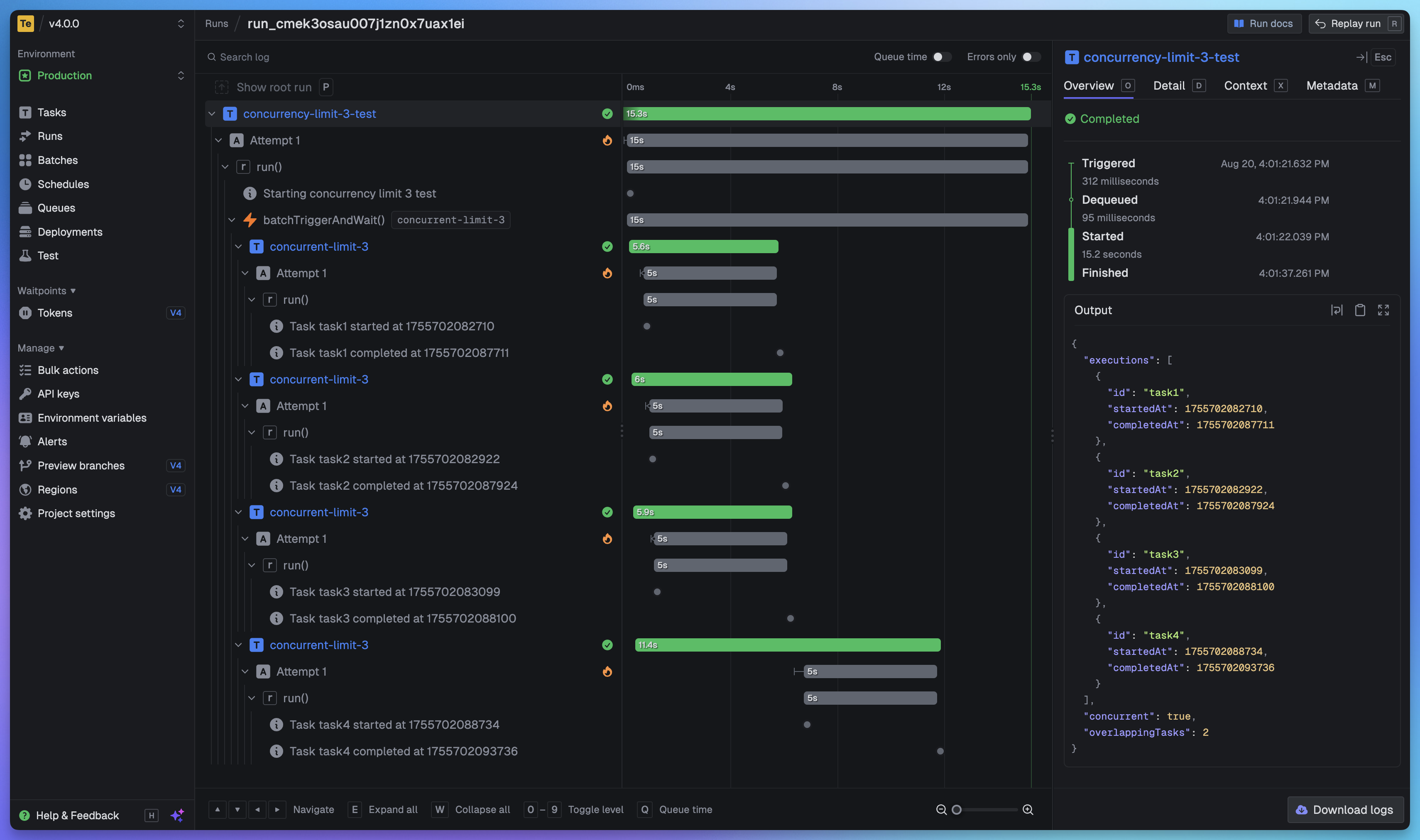
Full visibility of every job run
View every task in every run so you can tell exactly what happened. We provide a full trace view of every task run so you can see what happened at every step.
Getting started
The quickest way to get started is to create an account and project in our web app, and follow the instructions in the onboarding. Build and deploy your first task in minutes.
Useful links:
- Quick start - get up and running in minutes
- How it works - understand how Trigger.dev works under the hood
- Guides and examples - walk-through guides and code examples for popular frameworks and use cases
Self-hosting
If you prefer to self-host Trigger.dev, you can follow our self-hosting guides:
- Docker self-hosting guide - use Docker Compose to spin up a Trigger.dev instance
- Kubernetes self-hosting guide - use our official Helm chart to deploy Trigger.dev to your Kubernetes cluster
Support and community
We have a large active community in our official Discord server for support, including a dedicated channel for self-hosting.
Development
To setup and develop locally or contribute to the open source project, follow our development guide.