 github-actions[bot]
aa0bfceff4
github-actions[bot]
aa0bfceff4
## Summary
4 new features, 12 improvements, 5 bug fixes.

## Improvements
- `trigger.dev deploy` now asks the server whether to build with Depot
or the native build server unless `--native-build`, `--depot-build`, or
`--local-build` is passed, so the native build server can be rolled out
per organization without a CLI change. `--local-bundle` and `--detach`
now require `--native-build`.
([#4803](https://github.com/triggerdotdev/trigger.dev/pull/4803))
- Add an experimental `--local-bundle` deploy flag that runs the install
and bundling steps on your machine and uploads only the build output;
the image is still built remotely. Useful when your project's install
step needs tooling or credentials that only exist locally.
([#4331](https://github.com/triggerdotdev/trigger.dev/pull/4331))
- Send the CLI version header on all API requests so deployments are
attributable to a CLI version
([#4778](https://github.com/triggerdotdev/trigger.dev/pull/4778))
- A message that arrives mid-turn and is not injected into that turn is
now answered as the next turn, instead of being dropped. This is what
the `pendingMessages` docs have always described, and it applies to the
default too: configuring `pendingMessages` without a `shouldInject`
declines every batch, which previously meant every mid-turn message was
lost with no error at either end.
([#4795](https://github.com/triggerdotdev/trigger.dev/pull/4795))

  ```ts
  chat.agent({
  id: "my-chat",
  pendingMessages: {
    onReceived: ({ message }) =>
      logger.info("arrived mid-turn", { id: message.id }),
    // Only interrupt once the agent has started calling tools.
    shouldInject: ({ steps }) => steps.length > 0,
  },
  run: async ({ messages, signal }) =>
    streamText({
      model,
      messages,
      abortSignal: signal,
      // Required for injection. Without it nothing injects, and every
      // mid-turn message is answered as the next turn instead.
      ...chat.toStreamTextOptions(),
    }),
  });
  ```

A declined message keeps its place in the queue, so it survives a crash
and is answered by whichever run picks the conversation up. An injected
one is consumed at the moment it is injected, so it is never also
answered as a later turn.
- Browser chats now keep the active turn open across page reloads when
older completion records are replayed.
([#4643](https://github.com/triggerdotdev/trigger.dev/pull/4643))
- Add `chat.endAndContinue()` so fully hand-rolled custom chat agents
can hand a conversation off to a fresh run on the latest deployed task
version while preserving unconsumed Session input.
([#4647](https://github.com/triggerdotdev/trigger.dev/pull/4647))
- Custom chat agents now validate and parse client data declared with
`chat.withClientData({ schema })` before passing it to agent code.
([#4646](https://github.com/triggerdotdev/trigger.dev/pull/4646))

## Bug fixes
- Fixes a case where a chat could silently lose a message. If a message
arrived while the agent was between turns and a stop arrived after it,
the cursor the next boot resumed from could point past that message, so
it was never answered and no error was raised. This affected
`chat.agent`, not just custom agents.
([#4644](https://github.com/triggerdotdev/trigger.dev/pull/4644))

Fixes a recovered answer being cut off. After a crash the agent replays
the message it had not answered yet, but it was replaying the stop that
arrived after that message too, so the turn answering it was aborted the
moment it began. A stop is now only applied to the turn that was live
when it arrived. That holds however the stop got there: sent after the
last completed turn, or sent to a chat whose most recent turn was
completed by an older version of the SDK.

One limitation to know about: the recovered answer is persisted
correctly, but a chat page that stayed open across the crash keeps
showing the partial answer it had already received. Reload the page to
see the full recovered answer.

Also fixes a retried send being answered twice. When a send was retried
and its idempotency claim was lost, the agent could consume the same
message a second time.

Custom agent loops can now inspect pending chat input without consuming
it, and consume one record at a time, with `chat.messages.hasPending()`
and `chat.messages.next()`. Records carry stable identifiers so a
redelivery is recognisable.

  ```ts
  if (await chat.messages.hasPending()) {
  const record = await chat.messages.next({ timeoutInSeconds: 0 });
  if (record) handle(record.payload);
  }
  ```

`hasPending()` answers for messages alone, so a message sitting behind a
stop, or behind a record this version of the SDK does not recognise,
still reports as pending and is still delivered. Anything the agent has
no consumer for is discarded rather than left where it would make every
message queued behind it undeliverable. `chat.messages.next()` returning
`undefined` means no message became consumable before the timeout.

`chat.writeTurnComplete()`'s `sessionInEventId` is the cursor that is
safe to resume from, not the sequence of the record the turn answered.
It is held back behind any message still waiting to be handled, so a
value below the record you just handled is expected.
- Fixed a chat agent hanging after an interrupted turn: when a run was
killed mid-answer (out of memory, crash, or eviction) and only the one
message it was answering was still outstanding, the new run never
replied to it. That message is now re-answered on the new run.
([#4768](https://github.com/triggerdotdev/trigger.dev/pull/4768))
- Fix chat transport discarding the next turn after stopping generation.
`skipToTurnComplete` is now reset when a new message or action is sent,
so a message sent after `stopGeneration` streams normally instead of
leaving the chat stuck in a streaming state.
([#4744](https://github.com/triggerdotdev/trigger.dev/pull/4744))
- Fixes a message sent while the agent was mid-answer being lost if the
run then crashed. The cursor written at the end of each turn could point
past a message that had arrived during that turn but had not been
answered yet, so the next boot skipped it and no error was raised
anywhere. Such a message is now held until a turn actually takes it.
([#4795](https://github.com/triggerdotdev/trigger.dev/pull/4795))

This also removes the in-memory buffer those messages used to sit in, on
both `chat.agent` and `chat.createSession()`, so a message waiting for
its turn is durable rather than only present in the worker that received
it.

## Server changes

These changes affect the self-hosted Docker image and Trigger.dev Cloud:

- Self-hosted instances can now disable the admin dashboard and user
impersonation entirely. See the self-hosting docs for the new setting.
([#4774](https://github.com/triggerdotdev/trigger.dev/pull/4774))
- The dashboard has two new themes, Black and White, plus appearance
options for stronger colors and underlined links.
([#4547](https://github.com/triggerdotdev/trigger.dev/pull/4547))
- Deployment logs no longer jump to the bottom while you are reading
earlier output. Scroll up to pause auto-scroll, and scroll back down or
use the new scroll-to-bottom button in the log header to resume
following.
([#4776](https://github.com/triggerdotdev/trigger.dev/pull/4776))
- Customize the runs list: show, hide, and reorder columns, and add
smart columns that pull a value straight out of a run's payload,
metadata, or output. Your column choices are saved in the page URL, so
you can share a view, bookmark it, or save it straight to your
favorites.
([#4652](https://github.com/triggerdotdev/trigger.dev/pull/4652))
- Stop the browser offering to autofill or save environment variable
values as saved credentials.
([#4777](https://github.com/triggerdotdev/trigger.dev/pull/4777))
- Cut webapp CPU usage by about a quarter on the routes that workers
call most, freeing headroom at the same request rate. Detailed
event-loop blocking traces are no longer recorded by default, because
producing them was itself a large part of that cost.
([#4746](https://github.com/triggerdotdev/trigger.dev/pull/4746))
- When a runs list or runs.list API request spans too much data to
complete, it now returns a clear, actionable error asking you to narrow
the time range, instead of failing with a generic error.
([#4773](https://github.com/triggerdotdev/trigger.dev/pull/4773))
- Improved the performance and reliability of the runs list and the
runs.list API, especially for large projects and filtered views.
([#4763](https://github.com/triggerdotdev/trigger.dev/pull/4763))
- New Vercel connections now get version skew protection turned on
automatically, so each run uses the task version its deployment shipped
with. Automatic atomic deployments are deprecated and no longer offered
when you connect a project, but stay available in your Vercel
integration settings.
([#4741](https://github.com/triggerdotdev/trigger.dev/pull/4741))
- The Staging branch setting now shows an upgrade prompt on plans that
don't include a Staging environment, instead of looking editable and
then silently doing nothing when saved.
([#4784](https://github.com/triggerdotdev/trigger.dev/pull/4784))

<details>
<summary>Raw changeset output</summary>

# Releases
## @trigger.dev/build@4.5.13

### Patch Changes

- Updated dependencies:
  - `@trigger.dev/core@4.5.13`
## trigger.dev@4.5.13

### Patch Changes

- `trigger.dev deploy` now asks the server whether to build with Depot
or the native build server unless `--native-build`, `--depot-build`, or
`--local-build` is passed, so the native build server can be rolled out
per organization without a CLI change. `--local-bundle` and `--detach`
now require `--native-build`.
([#4803](https://github.com/triggerdotdev/trigger.dev/pull/4803))
- Add an experimental `--local-bundle` deploy flag that runs the install
and bundling steps on your machine and uploads only the build output;
the image is still built remotely. Useful when your project's install
step needs tooling or credentials that only exist locally.
([#4331](https://github.com/triggerdotdev/trigger.dev/pull/4331))
- Send the CLI version header on all API requests so deployments are
attributable to a CLI version
([#4778](https://github.com/triggerdotdev/trigger.dev/pull/4778))
- Updated dependencies:
  - `@trigger.dev/core@4.5.13`
  - `@trigger.dev/build@4.5.13`
  - `@trigger.dev/schema-to-json@4.5.13`
## @trigger.dev/core@4.5.13

### Patch Changes

- `trigger.dev deploy` now asks the server whether to build with Depot
or the native build server unless `--native-build`, `--depot-build`, or
`--local-build` is passed, so the native build server can be rolled out
per organization without a CLI change. `--local-bundle` and `--detach`
now require `--native-build`.
([#4803](https://github.com/triggerdotdev/trigger.dev/pull/4803))
- Add an experimental `--local-bundle` deploy flag that runs the install
and bundling steps on your machine and uploads only the build output;
the image is still built remotely. Useful when your project's install
step needs tooling or credentials that only exist locally.
([#4331](https://github.com/triggerdotdev/trigger.dev/pull/4331))
- A message that arrives mid-turn and is not injected into that turn is
now answered as the next turn, instead of being dropped. This is what
the `pendingMessages` docs have always described, and it applies to the
default too: configuring `pendingMessages` without a `shouldInject`
declines every batch, which previously meant every mid-turn message was
lost with no error at either end.
([#4795](https://github.com/triggerdotdev/trigger.dev/pull/4795))

  ```ts
  chat.agent({
    id: "my-chat",
    pendingMessages: {
      onReceived: ({ message }) =>
        logger.info("arrived mid-turn", { id: message.id }),
      // Only interrupt once the agent has started calling tools.
      shouldInject: ({ steps }) => steps.length > 0,
    },
    run: async ({ messages, signal }) =>
      streamText({
        model,
        messages,
        abortSignal: signal,
        // Required for injection. Without it nothing injects, and every
        // mid-turn message is answered as the next turn instead.
        ...chat.toStreamTextOptions(),
      }),
  });
  ```

A declined message keeps its place in the queue, so it survives a crash
and is answered by whichever run picks the conversation up. An injected
one is consumed at the moment it is injected, so it is never also
answered as a later turn.

- Fixes a case where a chat could silently lose a message. If a message
arrived while the agent was between turns and a stop arrived after it,
the cursor the next boot resumed from could point past that message, so
it was never answered and no error was raised. This affected
`chat.agent`, not just custom agents.
([#4644](https://github.com/triggerdotdev/trigger.dev/pull/4644))

Fixes a recovered answer being cut off. After a crash the agent replays
the message it had not answered yet, but it was replaying the stop that
arrived after that message too, so the turn answering it was aborted the
moment it began. A stop is now only applied to the turn that was live
when it arrived. That holds however the stop got there: sent after the
last completed turn, or sent to a chat whose most recent turn was
completed by an older version of the SDK.

One limitation to know about: the recovered answer is persisted
correctly, but a chat page that stayed open across the crash keeps
showing the partial answer it had already received. Reload the page to
see the full recovered answer.

Also fixes a retried send being answered twice. When a send was retried
and its idempotency claim was lost, the agent could consume the same
message a second time.

Custom agent loops can now inspect pending chat input without consuming
it, and consume one record at a time, with `chat.messages.hasPending()`
and `chat.messages.next()`. Records carry stable identifiers so a
redelivery is recognisable.

  ```ts
  if (await chat.messages.hasPending()) {
    const record = await chat.messages.next({ timeoutInSeconds: 0 });
    if (record) handle(record.payload);
  }
  ```

`hasPending()` answers for messages alone, so a message sitting behind a
stop, or behind a record this version of the SDK does not recognise,
still reports as pending and is still delivered. Anything the agent has
no consumer for is discarded rather than left where it would make every
message queued behind it undeliverable. `chat.messages.next()` returning
`undefined` means no message became consumable before the timeout.

`chat.writeTurnComplete()`'s `sessionInEventId` is the cursor that is
safe to resume from, not the sequence of the record the turn answered.
It is held back behind any message still waiting to be handled, so a
value below the record you just handled is expected.
## @trigger.dev/python@4.5.13

### Patch Changes

- Updated dependencies:
  - `@trigger.dev/sdk@4.5.13`
  - `@trigger.dev/core@4.5.13`
  - `@trigger.dev/build@4.5.13`
## @trigger.dev/react-hooks@4.5.13

### Patch Changes

- Updated dependencies:
  - `@trigger.dev/core@4.5.13`
## @trigger.dev/redis-worker@4.5.13

### Patch Changes

- Updated dependencies:
  - `@trigger.dev/core@4.5.13`
## @trigger.dev/rsc@4.5.13

### Patch Changes

- Updated dependencies:
  - `@trigger.dev/core@4.5.13`
## @trigger.dev/schema-to-json@4.5.13

### Patch Changes

- Updated dependencies:
  - `@trigger.dev/core@4.5.13`
## @trigger.dev/sdk@4.5.13

### Patch Changes

- Fixed a chat agent hanging after an interrupted turn: when a run was
killed mid-answer (out of memory, crash, or eviction) and only the one
message it was answering was still outstanding, the new run never
replied to it. That message is now re-answered on the new run.
([#4768](https://github.com/triggerdotdev/trigger.dev/pull/4768))
- Browser chats now keep the active turn open across page reloads when
older completion records are replayed.
([#4643](https://github.com/triggerdotdev/trigger.dev/pull/4643))
- Add `chat.endAndContinue()` so fully hand-rolled custom chat agents
can hand a conversation off to a fresh run on the latest deployed task
version while preserving unconsumed Session input.
([#4647](https://github.com/triggerdotdev/trigger.dev/pull/4647))
- Fix chat transport discarding the next turn after stopping generation.
`skipToTurnComplete` is now reset when a new message or action is sent,
so a message sent after `stopGeneration` streams normally instead of
leaving the chat stuck in a streaming state.
([#4744](https://github.com/triggerdotdev/trigger.dev/pull/4744))
- Custom chat agents now validate and parse client data declared with
`chat.withClientData({ schema })` before passing it to agent code.
([#4646](https://github.com/triggerdotdev/trigger.dev/pull/4646))
- Fixes a message sent while the agent was mid-answer being lost if the
run then crashed. The cursor written at the end of each turn could point
past a message that had arrived during that turn but had not been
answered yet, so the next boot skipped it and no error was raised
anywhere. Such a message is now held until a turn actually takes it.
([#4795](https://github.com/triggerdotdev/trigger.dev/pull/4795))

This also removes the in-memory buffer those messages used to sit in, on
both `chat.agent` and `chat.createSession()`, so a message waiting for
its turn is durable rather than only present in the worker that received
it.

- A message that arrives mid-turn and is not injected into that turn is
now answered as the next turn, instead of being dropped. This is what
the `pendingMessages` docs have always described, and it applies to the
default too: configuring `pendingMessages` without a `shouldInject`
declines every batch, which previously meant every mid-turn message was
lost with no error at either end.
([#4795](https://github.com/triggerdotdev/trigger.dev/pull/4795))

  ```ts
  chat.agent({
    id: "my-chat",
    pendingMessages: {
      onReceived: ({ message }) =>
        logger.info("arrived mid-turn", { id: message.id }),
      // Only interrupt once the agent has started calling tools.
      shouldInject: ({ steps }) => steps.length > 0,
    },
    run: async ({ messages, signal }) =>
      streamText({
        model,
        messages,
        abortSignal: signal,
        // Required for injection. Without it nothing injects, and every
        // mid-turn message is answered as the next turn instead.
        ...chat.toStreamTextOptions(),
      }),
  });
  ```

A declined message keeps its place in the queue, so it survives a crash
and is answered by whichever run picks the conversation up. An injected
one is consumed at the moment it is injected, so it is never also
answered as a later turn.

- Fixes a case where a chat could silently lose a message. If a message
arrived while the agent was between turns and a stop arrived after it,
the cursor the next boot resumed from could point past that message, so
it was never answered and no error was raised. This affected
`chat.agent`, not just custom agents.
([#4644](https://github.com/triggerdotdev/trigger.dev/pull/4644))

Fixes a recovered answer being cut off. After a crash the agent replays
the message it had not answered yet, but it was replaying the stop that
arrived after that message too, so the turn answering it was aborted the
moment it began. A stop is now only applied to the turn that was live
when it arrived. That holds however the stop got there: sent after the
last completed turn, or sent to a chat whose most recent turn was
completed by an older version of the SDK.

One limitation to know about: the recovered answer is persisted
correctly, but a chat page that stayed open across the crash keeps
showing the partial answer it had already received. Reload the page to
see the full recovered answer.

Also fixes a retried send being answered twice. When a send was retried
and its idempotency claim was lost, the agent could consume the same
message a second time.

Custom agent loops can now inspect pending chat input without consuming
it, and consume one record at a time, with `chat.messages.hasPending()`
and `chat.messages.next()`. Records carry stable identifiers so a
redelivery is recognisable.

  ```ts
  if (await chat.messages.hasPending()) {
    const record = await chat.messages.next({ timeoutInSeconds: 0 });
    if (record) handle(record.payload);
  }
  ```

`hasPending()` answers for messages alone, so a message sitting behind a
stop, or behind a record this version of the SDK does not recognise,
still reports as pending and is still delivered. Anything the agent has
no consumer for is discarded rather than left where it would make every
message queued behind it undeliverable. `chat.messages.next()` returning
`undefined` means no message became consumable before the timeout.

`chat.writeTurnComplete()`'s `sessionInEventId` is the cursor that is
safe to resume from, not the sequence of the record the turn answered.
It is held back behind any message still waiting to be handled, so a
value below the record you just handled is expected.

- Updated dependencies:
  - `@trigger.dev/core@4.5.13`

</details>

Co-authored-by: github-actions[bot] <41898282+github-actions[bot]@users.noreply.github.com>

Build and deploy fully‑managed AI agents and workflows
Website | Docs | Issues | Example projects | Feature requests | Public roadmap | Self-hosting








About Trigger.dev
Trigger.dev is the open-source platform for building AI workflows in TypeScript. Long-running tasks with retries, queues, observability, and elastic scaling.
The platform designed for building AI agents
Build AI agents using all the frameworks, services and LLMs you're used to, deploy them to Trigger.dev and get durable, long-running tasks with retries, queues, observability, and elastic scaling out of the box.
-
Long-running without timeouts: Execute your tasks with absolutely no timeouts, unlike AWS Lambda, Vercel, and other serverless platforms.
-
Durability, retries & queues: Build rock solid agents and AI applications using our durable tasks, retries, queues and idempotency.
-
True runtime freedom: Customize your deployed tasks with system packages – run browsers, Python scripts, FFmpeg and more.
-
Human-in-the-loop: Programmatically pause your tasks until a human can approve, reject or give feedback.
-
Realtime apps & streaming: Move your background jobs to the foreground by subscribing to runs or streaming AI responses to your app.
-
Observability & monitoring: Each run has full tracing and logs. Configure error alerts to catch bugs fast.
Key features:
- JavaScript and TypeScript SDK - Build background tasks using familiar programming models
- Long-running tasks - Handle resource-heavy tasks without timeouts
- Durable cron schedules - Create and attach recurring schedules of up to a year
- Trigger.dev Realtime - Trigger, subscribe to, and get real-time updates for runs, with LLM streaming support
- Build extensions - Hook directly into the build system and customize the build process. Run Python scripts, FFmpeg, browsers, and more.
- React hooks - Interact with the Trigger.dev API on your frontend using our React hooks package
- Batch triggering - Use batchTrigger() to initiate multiple runs of a task with custom payloads and options
- Structured inputs / outputs - Define precise data schemas for your tasks with runtime payload validation
- Waits - Add waits to your tasks to pause execution for a specified duration
- Preview branches - Create isolated environments for testing and development. Integrates with Vercel and git workflows
- Waitpoints - Add human-in-the-loop judgment at critical decision points without disrupting workflow
- Concurrency & queues - Set concurrency rules to manage how multiple tasks execute
- Multiple environments - Support for DEV, PREVIEW, STAGING, and PROD environments
- No infrastructure to manage - Auto-scaling infrastructure that eliminates timeouts and server management
- Automatic retries - If your task encounters an uncaught error, we automatically attempt to run it again
- Checkpointing - Tasks are inherently durable, thanks to our checkpointing feature
- Versioning - Atomic versioning allows you to deploy new versions without affecting running tasks
- Machines - Configure the number of vCPUs and GBs of RAM you want the task to use
- Observability & monitoring - Monitor every aspect of your tasks' performance with comprehensive logging and visualization tools
- Logging & tracing - Comprehensive logging and tracing for all your tasks
- Tags - Attach up to ten tags to each run, allowing you to filter via the dashboard, realtime, and the SDK
- Run metadata - Attach metadata to runs which updates as the run progresses and is available to use in your frontend for live updates
- Bulk actions - Perform actions on multiple runs simultaneously, including replaying and cancelling
- Real-time alerts - Choose your preferred notification method for run failures and deployments
Write tasks in your codebase
Create tasks where they belong: in your codebase. Version control, localhost, test and review like you're already used to.
import { task } from "@trigger.dev/sdk";

//1. You need to export each task
export const helloWorld = task({
  //2. Use a unique id for each task
  id: "hello-world",
  //3. The run function is the main function of the task
  run: async (payload: { message: string }) => {
    //4. You can write code that runs for a long time here, there are no timeouts
    console.log(payload.message);
  },
});
Deployment
Use our SDK to write tasks in your codebase. There's no infrastructure to manage, your tasks automatically scale and connect to our cloud. Or you can always self-host.
Environments
We support Development, Staging, Preview, and Production environments, allowing you to test your tasks before deploying them to production.
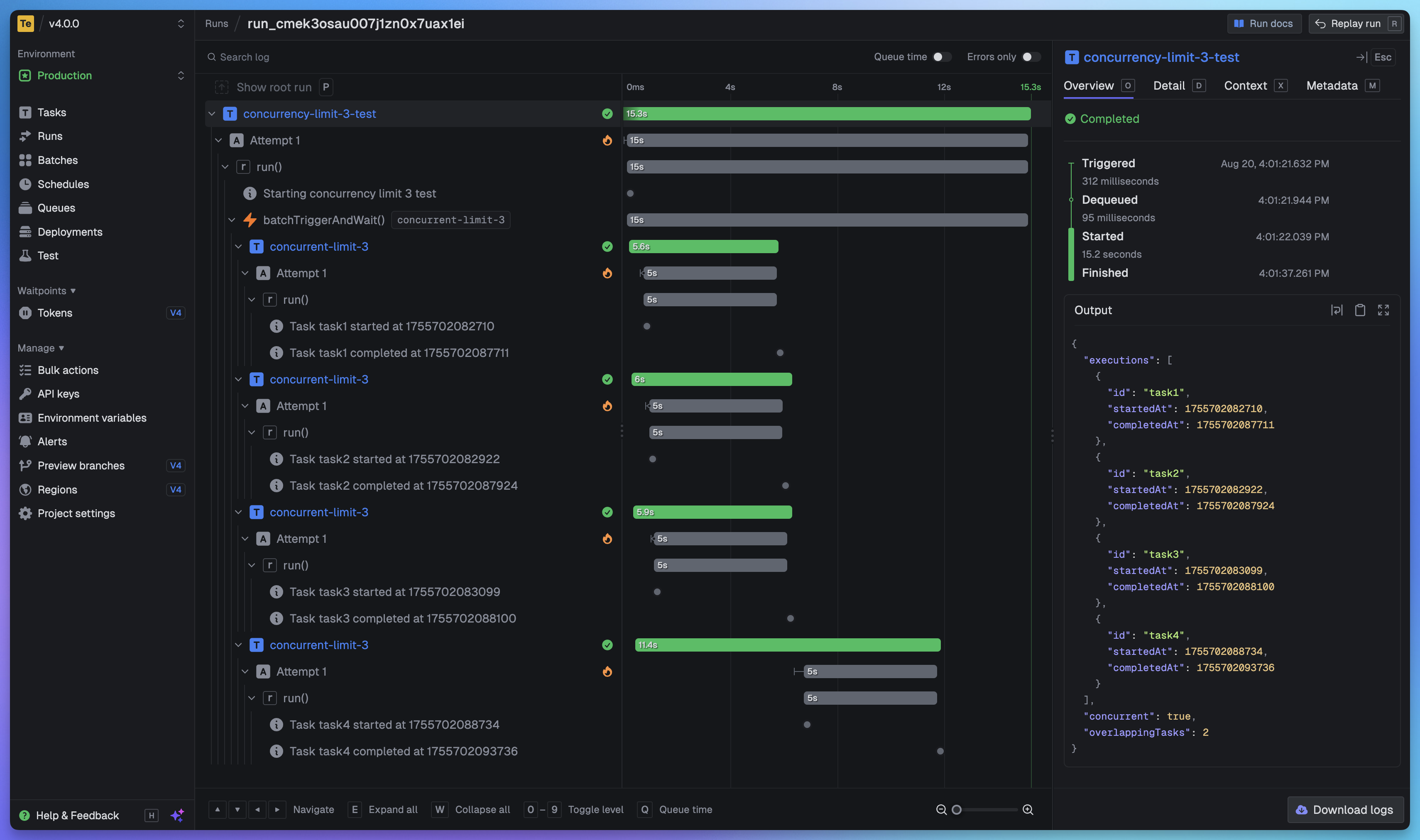
Full visibility of every job run
View every task in every run so you can tell exactly what happened. We provide a full trace view of every task run so you can see what happened at every step.
Getting started
The quickest way to get started is to create an account and project in our web app, and follow the instructions in the onboarding. Build and deploy your first task in minutes.
Useful links:
- Quick start - get up and running in minutes
- How it works - understand how Trigger.dev works under the hood
- Guides and examples - walk-through guides and code examples for popular frameworks and use cases
Self-hosting
If you prefer to self-host Trigger.dev, you can follow our self-hosting guides:
- Docker self-hosting guide - use Docker Compose to spin up a Trigger.dev instance
- Kubernetes self-hosting guide - use our official Helm chart to deploy Trigger.dev to your Kubernetes cluster
Support and community
We have a large active community in our official Discord server for support, including a dedicated channel for self-hosting.
Development
To setup and develop locally or contribute to the open source project, follow our development guide.