 nicktrn
976171ea16
nicktrn
976171ea16
## Summary

Adds a set of PAT-authenticated management API endpoints so orgs,
projects, members/invites, environment variables, and a few
project/environment settings can be managed programmatically (scripting,
automation) rather than only through the dashboard. Each route is a thin
wrapper over the **existing** service the dashboard already uses, with
the same authorization applied at the route layer - no new business
logic.

## Endpoints

**Organizations**
- `POST /api/v1/orgs` - create an org (`createOrganization`)
- `PATCH /api/v1/orgs/:orgParam` - rename (title)
- `DELETE /api/v1/orgs/:orgParam` - soft-delete
(`DeleteOrganizationService`; keeps the active-subscription guard)

**Members & invites**
- `GET /api/v1/orgs/:orgParam/members` - list members + pending invites
- `DELETE /api/v1/orgs/:orgParam/members/:memberId` - remove a member
(last-member guarded)
- `POST /api/v1/orgs/:orgParam/invites` - invite by email
(`inviteMembers`, sends the invite email)
- `DELETE /api/v1/orgs/:orgParam/invites/:inviteId` - revoke an invite

**Projects**
- `PATCH /api/v1/projects/:projectRef` - rename
(`ProjectSettingsService`)
- `DELETE /api/v1/projects/:projectRef` - soft-delete
(`DeleteProjectService`)
- `PUT /api/v1/projects/:projectRef/default-region` - set the default
region by worker-group name (`SetDefaultRegionService`)
- project GET/list now return `defaultRegion` (worker-group name, or
null when unset)

**Environments**
- `POST /api/v1/projects/:projectRef/:env/pause` and `/resume`
(`PauseEnvironmentService`)
- `POST /api/v1/projects/:projectRef/:env/regenerate-api-key` - rotate
the env secret key (`regenerateApiKey`, RBAC `write:apiKeys`)
- env var create now accepts an optional `isSecret` flag

## Auth & authorization

- All routes authenticate with a **Personal Access Token**
(`Authorization: Bearer tr_pat_...`).
- Org/project routes are built on the PAT route builders in
`apiBuilder.server.ts`: `createLoaderPATApiRoute` (already existed) and
**`createActionPATApiRoute`** (added here - the loader builder had no
mutation counterpart). The builder runs auth, resolves the org/project
role-floor via `context`, and enforces a declarative `authorization`
block using the same RBAC actions the dashboard applies
(`manage:organization` / `read:members` / `manage:members` /
`manage:project`). Handlers keep a membership-scoped query as the floor,
so a non-member gets a 404. This also gives these routes `tenantContext`
user attribution (Sentry) and `ServiceValidationError`-to-status mapping
for free.
- **Membership floor (important).** The OSS RBAC fallback grants a
permissive ability, so `ability.can(...)` can't reject a non-member on
self-hosted. Every handler therefore resolves the target scoped to the
caller's membership (`members: { some: { userId } }`) → 404 for
non-members. `authorization` is the *role* gate; this is the *tenant*
gate. `resolveOrganizationForApiUser`
(`organizationApiAccess.server.ts`) is the org-tier version of the
existing `findProjectByRef` - org-addressed PAT routes are new, so no
such helper existed before.
- Env-tier routes reuse the existing `authorizePatEnvironmentAccess`
(`write:apiKeys`).

### What `createActionPATApiRoute` gives you

A route is pure declaration - the builder handles auth, RBAC,
validation, tracing, and error mapping:

```ts
export const action = createActionPATApiRoute(
  {
    method: "PUT",                          // one verb, or ["PATCH", "DELETE"] for multi-verb routes
    params: ParamsSchema,
    body: SetDefaultRegionRequestBody,      // zod-validated
    context: async ({ projectRef }) => {    // resolve the org for the RBAC role-floor
      const project = await prisma.project.findFirst({
        where: { externalRef: projectRef, deletedAt: null },
        select: { organizationId: true },
      });
      return project ? { organizationId: project.organizationId } : {};
    },
    authorization: { action: "manage", resource: () => ({ type: "project" }) },
  },
  async ({ params, body, authentication, ability }) => {
    // auth + authz already enforced. Just do the work.
    // `throw new ServiceValidationError("Region not found", 400)` → mapped to that status.
    return json({ ok: true });
  }
);
```

Handled for you, so handlers stay thin:

- **Method allowlist** - `method` accepts a verb or an array; any other
verb → `405` with an `Allow` header, *before* auth runs:
  ```ts
const allowedMethods = method ? (Array.isArray(method) ? method :
[method]) : undefined;
if (allowedMethods && !(allowedMethods as
string[]).includes(request.method.toUpperCase())) {
return json({ error: "Method not allowed" }, { status: 405, headers: {
Allow: allowedMethods.join(", ") } });
  }
  ```
- **PAT / user-actor auth** in a single roundtrip → `401` on
missing/invalid/revoked token.
- **RBAC** - `context` computes the caller's role-floor for the target
org/project; `authorization` gates it → `403` with a structured error
body.
- **Sentry attribution** - `tenantContext.enrich({ userId })` so events
from the handler carry the acting user.
- **Typed errors** - a thrown `ServiceValidationError` is mapped to its
`.status` (default 400); anything else → `500`, and expected boundary
errors are logged as `warn` (kept out of Sentry).
- **Validation** - params / query / headers / body are all zod-checked →
`400` with details.

## Notes for reviewers

- Everything wraps an existing service; the intent is API parity for
things that are currently dashboard-only, not new behaviour.
- `createActionPATApiRoute` is new shared infra (the PAT + RBAC mutation
builder that didn't exist). It's self-contained - the loader builder and
existing routes are untouched.
- `@trigger.dev/core` gets one additive field (`defaultRegion` on the
project response, optional/nullable for client-server version skew) -
changeset included, patch.
- `removeTeamMember`'s last-member guard is now atomic (Serializable
transaction via the `$transaction` helper, with retry), so the dashboard
and API both get it server-side. Added a `## Transactions` rule to
`apps/webapp/CLAUDE.md` (always use the `$transaction` helper);
migrating the remaining direct usages is tracked in TRI-11698.

## Open questions

- ~~Is PAT the right auth (vs OAT for automation)?~~ **Resolved: PAT.**
Organization Access Tokens are currently internal-only (used by the
image builder) and not user-accessible, so they can't back this yet.
- Should any of these be gated behind a flag or scope?
- Naming/shape of the routes.

Build and deploy fully‑managed AI agents and workflows
Website | Docs | Issues | Example projects | Feature requests | Public roadmap | Self-hosting








About Trigger.dev
Trigger.dev is the open-source platform for building AI workflows in TypeScript. Long-running tasks with retries, queues, observability, and elastic scaling.
The platform designed for building AI agents
Build AI agents using all the frameworks, services and LLMs you're used to, deploy them to Trigger.dev and get durable, long-running tasks with retries, queues, observability, and elastic scaling out of the box.
-
Long-running without timeouts: Execute your tasks with absolutely no timeouts, unlike AWS Lambda, Vercel, and other serverless platforms.
-
Durability, retries & queues: Build rock solid agents and AI applications using our durable tasks, retries, queues and idempotency.
-
True runtime freedom: Customize your deployed tasks with system packages – run browsers, Python scripts, FFmpeg and more.
-
Human-in-the-loop: Programmatically pause your tasks until a human can approve, reject or give feedback.
-
Realtime apps & streaming: Move your background jobs to the foreground by subscribing to runs or streaming AI responses to your app.
-
Observability & monitoring: Each run has full tracing and logs. Configure error alerts to catch bugs fast.
Key features:
- JavaScript and TypeScript SDK - Build background tasks using familiar programming models
- Long-running tasks - Handle resource-heavy tasks without timeouts
- Durable cron schedules - Create and attach recurring schedules of up to a year
- Trigger.dev Realtime - Trigger, subscribe to, and get real-time updates for runs, with LLM streaming support
- Build extensions - Hook directly into the build system and customize the build process. Run Python scripts, FFmpeg, browsers, and more.
- React hooks - Interact with the Trigger.dev API on your frontend using our React hooks package
- Batch triggering - Use batchTrigger() to initiate multiple runs of a task with custom payloads and options
- Structured inputs / outputs - Define precise data schemas for your tasks with runtime payload validation
- Waits - Add waits to your tasks to pause execution for a specified duration
- Preview branches - Create isolated environments for testing and development. Integrates with Vercel and git workflows
- Waitpoints - Add human-in-the-loop judgment at critical decision points without disrupting workflow
- Concurrency & queues - Set concurrency rules to manage how multiple tasks execute
- Multiple environments - Support for DEV, PREVIEW, STAGING, and PROD environments
- No infrastructure to manage - Auto-scaling infrastructure that eliminates timeouts and server management
- Automatic retries - If your task encounters an uncaught error, we automatically attempt to run it again
- Checkpointing - Tasks are inherently durable, thanks to our checkpointing feature
- Versioning - Atomic versioning allows you to deploy new versions without affecting running tasks
- Machines - Configure the number of vCPUs and GBs of RAM you want the task to use
- Observability & monitoring - Monitor every aspect of your tasks' performance with comprehensive logging and visualization tools
- Logging & tracing - Comprehensive logging and tracing for all your tasks
- Tags - Attach up to ten tags to each run, allowing you to filter via the dashboard, realtime, and the SDK
- Run metadata - Attach metadata to runs which updates as the run progresses and is available to use in your frontend for live updates
- Bulk actions - Perform actions on multiple runs simultaneously, including replaying and cancelling
- Real-time alerts - Choose your preferred notification method for run failures and deployments
Write tasks in your codebase
Create tasks where they belong: in your codebase. Version control, localhost, test and review like you're already used to.
import { task } from "@trigger.dev/sdk";

//1. You need to export each task
export const helloWorld = task({
  //2. Use a unique id for each task
  id: "hello-world",
  //3. The run function is the main function of the task
  run: async (payload: { message: string }) => {
    //4. You can write code that runs for a long time here, there are no timeouts
    console.log(payload.message);
  },
});
Deployment
Use our SDK to write tasks in your codebase. There's no infrastructure to manage, your tasks automatically scale and connect to our cloud. Or you can always self-host.
Environments
We support Development, Staging, Preview, and Production environments, allowing you to test your tasks before deploying them to production.
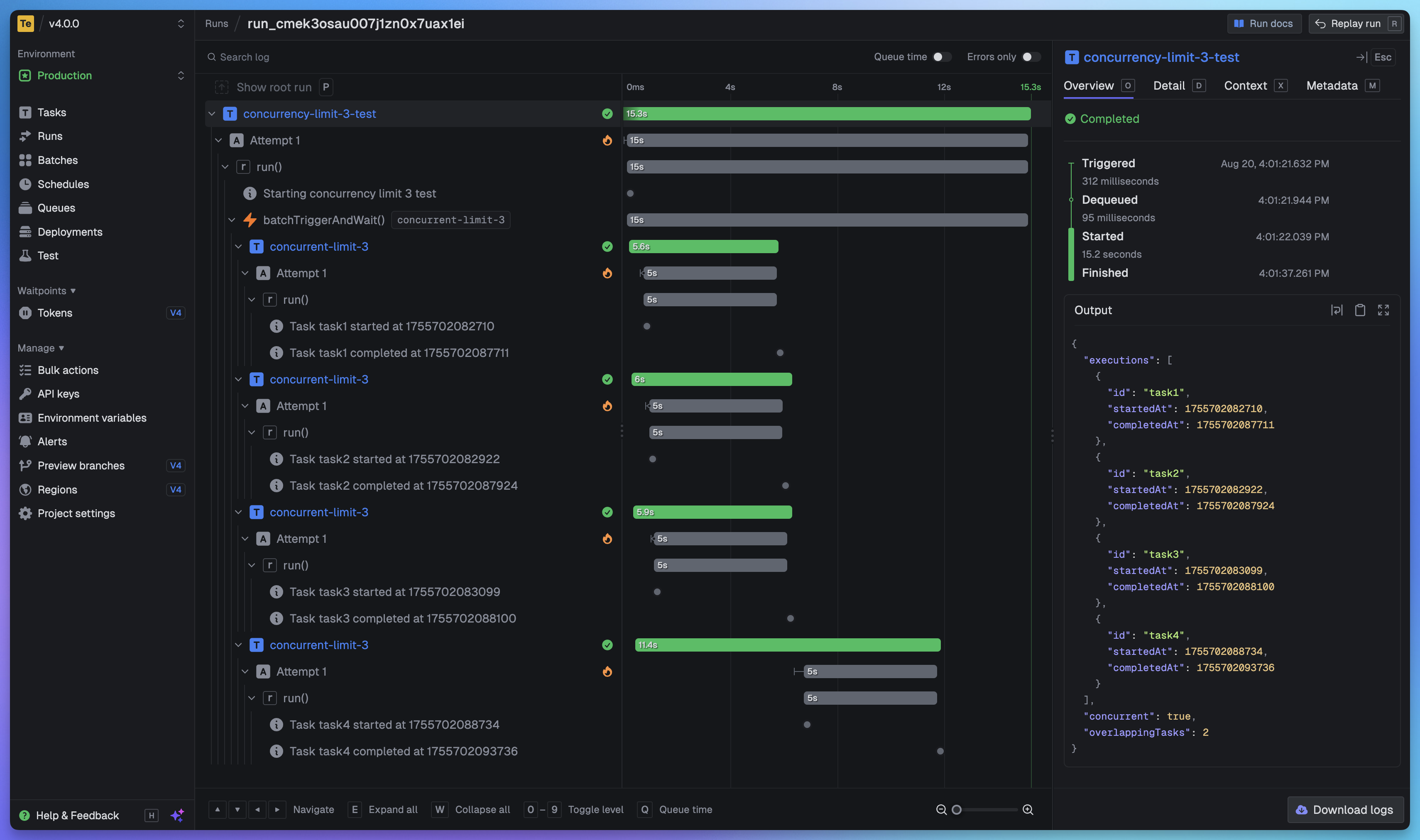
Full visibility of every job run
View every task in every run so you can tell exactly what happened. We provide a full trace view of every task run so you can see what happened at every step.
Getting started
The quickest way to get started is to create an account and project in our web app, and follow the instructions in the onboarding. Build and deploy your first task in minutes.
Useful links:
- Quick start - get up and running in minutes
- How it works - understand how Trigger.dev works under the hood
- Guides and examples - walk-through guides and code examples for popular frameworks and use cases
Self-hosting
If you prefer to self-host Trigger.dev, you can follow our self-hosting guides:
- Docker self-hosting guide - use Docker Compose to spin up a Trigger.dev instance
- Kubernetes self-hosting guide - use our official Helm chart to deploy Trigger.dev to your Kubernetes cluster
Support and community
We have a large active community in our official Discord server for support, including a dedicated channel for self-hosting.
Development
To setup and develop locally or contribute to the open source project, follow our development guide.