 Daniel Sutton
15dd973f92
Daniel Sutton
15dd973f92
## Summary

Adds the id-minting half of sharding run data across several databases.
Every entity that co-locates with a run now carries the run's shard key
inside its own id, so its row is routable on its own instead of needing
a directory table or a scatter across shards.

Nothing changes for users yet. With no shard descriptors configured,
every mint path produces exactly the ids it produces today, and the
trigger path issues no extra query.

## Design

A run's mint target travels as a single object carrying the kind and,
when sharded, the shard character. The shard and the caller's region
both occupy index 24 of a run-ops id, so passing them together makes it
impossible for a caller to set two competing sources for one slot.

A child run, a batch and a batch item read the shard from their parent's
id rather than resolving a fresh one, so a run tree never splits across
databases. Three services carried that branch separately, and one had
already drifted, so it now lives in one function.

Waitpoints mint through one shared pure function used by both the webapp
and the run engine. They have to agree byte for byte, because the
routing store refuses a waitpoint whose id is not stamped for the shard
it is being written to:

```ts
mintWaitpointIdForShard(key)   // standalone token: the environment's shard
mintWaitpointIdFor(anchorId)   // co-located: the anchor's shard, or a cuid
```

The core is always freshly minted rather than derived from the anchor,
since a derived body would be byte-identical to the run's own id.

One latent bug fixed on the way: the failed-run path duplicated the mint
branch inline and had drifted, so a child of a sharded parent would have
been written to a different database from its parent.

## Guarding the create sites

The expensive failure here is a waitpoint minted without its anchor's
shard: one of the five create sites writes through a path that has no
stamp check, so a miss there strands a blocked run with nothing logged.
An enumerated census plus a source scan fails when a new create site
appears, when an existing one stops passing its anchor, or when a site
is added to a file the scan does not yet cover.

The census was written before any site was converted, so it went red on
the first commit and green as the last site landed. Both holes an
earlier draft had, a file-granular count and a scan that missed the
directory these mints used to live in, were confirmed closed by
reintroducing them and watching the guard fail.

## Before enabling a shard

Merging this is inert: with the mint list empty the resolver returns
before it reads anything, and
ids are identical to a measured `main` baseline. Verified against a live
shard locally, including
that the resolver issues no query across thirty triggers with no shard
configured.

Enabling is gated on two other pull requests, both open, both by the
same author, each of which owns
the file involved:

- **#4781** adds the gen-2 shard arm to read-through. Without it a gen-2
run cannot wait on a token
at all: the wait route resolves the waitpoint through read-through,
which is shard-blind, so the
  wait fails. Do not set the mint list before it merges.
- **#4780** generalises the distinct-database sentinel. Without it a
shard pointed at the same
physical database as the gen-1 store boots without complaint, which
voids the disjointness the
  fan-out sums rely on.

Testing also turned up a silent read-path gap that neither pull request
covers: the paths that
hydrate runs from ClickHouse through a fixed pair of Postgres clients
drop gen-2 rows on the floor,
so the runs list would show fewer rows than its own count with nothing
logged. That needs its own
change before a shard carries real traffic, and it is filed as such.

## Notes for reviewers

Four commits in the middle of the stack do not typecheck in isolation: a
signature change and its call-site repairs are separate commits, so
bisecting inside the stack needs care. Commit `845ab06` also understates
itself, since it rewrites the primary trigger path's mint alongside the
failed-run path it names.

No changeset and no server-changes entry: every path is inert while the
feature is off, so there is nothing to tell users yet.

---------

Co-authored-by: Claude Opus 5 <noreply@anthropic.com>

Build and deploy fully‑managed AI agents and workflows
Website | Docs | Issues | Example projects | Feature requests | Public roadmap | Self-hosting








About Trigger.dev
Trigger.dev is the open-source platform for building AI workflows in TypeScript. Long-running tasks with retries, queues, observability, and elastic scaling.
The platform designed for building AI agents
Build AI agents using all the frameworks, services and LLMs you're used to, deploy them to Trigger.dev and get durable, long-running tasks with retries, queues, observability, and elastic scaling out of the box.
-
Long-running without timeouts: Execute your tasks with absolutely no timeouts, unlike AWS Lambda, Vercel, and other serverless platforms.
-
Durability, retries & queues: Build rock solid agents and AI applications using our durable tasks, retries, queues and idempotency.
-
True runtime freedom: Customize your deployed tasks with system packages – run browsers, Python scripts, FFmpeg and more.
-
Human-in-the-loop: Programmatically pause your tasks until a human can approve, reject or give feedback.
-
Realtime apps & streaming: Move your background jobs to the foreground by subscribing to runs or streaming AI responses to your app.
-
Observability & monitoring: Each run has full tracing and logs. Configure error alerts to catch bugs fast.
Key features:
- JavaScript and TypeScript SDK - Build background tasks using familiar programming models
- Long-running tasks - Handle resource-heavy tasks without timeouts
- Durable cron schedules - Create and attach recurring schedules of up to a year
- Trigger.dev Realtime - Trigger, subscribe to, and get real-time updates for runs, with LLM streaming support
- Build extensions - Hook directly into the build system and customize the build process. Run Python scripts, FFmpeg, browsers, and more.
- React hooks - Interact with the Trigger.dev API on your frontend using our React hooks package
- Batch triggering - Use batchTrigger() to initiate multiple runs of a task with custom payloads and options
- Structured inputs / outputs - Define precise data schemas for your tasks with runtime payload validation
- Waits - Add waits to your tasks to pause execution for a specified duration
- Preview branches - Create isolated environments for testing and development. Integrates with Vercel and git workflows
- Waitpoints - Add human-in-the-loop judgment at critical decision points without disrupting workflow
- Concurrency & queues - Set concurrency rules to manage how multiple tasks execute
- Multiple environments - Support for DEV, PREVIEW, STAGING, and PROD environments
- No infrastructure to manage - Auto-scaling infrastructure that eliminates timeouts and server management
- Automatic retries - If your task encounters an uncaught error, we automatically attempt to run it again
- Checkpointing - Tasks are inherently durable, thanks to our checkpointing feature
- Versioning - Atomic versioning allows you to deploy new versions without affecting running tasks
- Machines - Configure the number of vCPUs and GBs of RAM you want the task to use
- Observability & monitoring - Monitor every aspect of your tasks' performance with comprehensive logging and visualization tools
- Logging & tracing - Comprehensive logging and tracing for all your tasks
- Tags - Attach up to ten tags to each run, allowing you to filter via the dashboard, realtime, and the SDK
- Run metadata - Attach metadata to runs which updates as the run progresses and is available to use in your frontend for live updates
- Bulk actions - Perform actions on multiple runs simultaneously, including replaying and cancelling
- Real-time alerts - Choose your preferred notification method for run failures and deployments
Write tasks in your codebase
Create tasks where they belong: in your codebase. Version control, localhost, test and review like you're already used to.
import { task } from "@trigger.dev/sdk";

//1. You need to export each task
export const helloWorld = task({
  //2. Use a unique id for each task
  id: "hello-world",
  //3. The run function is the main function of the task
  run: async (payload: { message: string }) => {
    //4. You can write code that runs for a long time here, there are no timeouts
    console.log(payload.message);
  },
});
Deployment
Use our SDK to write tasks in your codebase. There's no infrastructure to manage, your tasks automatically scale and connect to our cloud. Or you can always self-host.
Environments
We support Development, Staging, Preview, and Production environments, allowing you to test your tasks before deploying them to production.
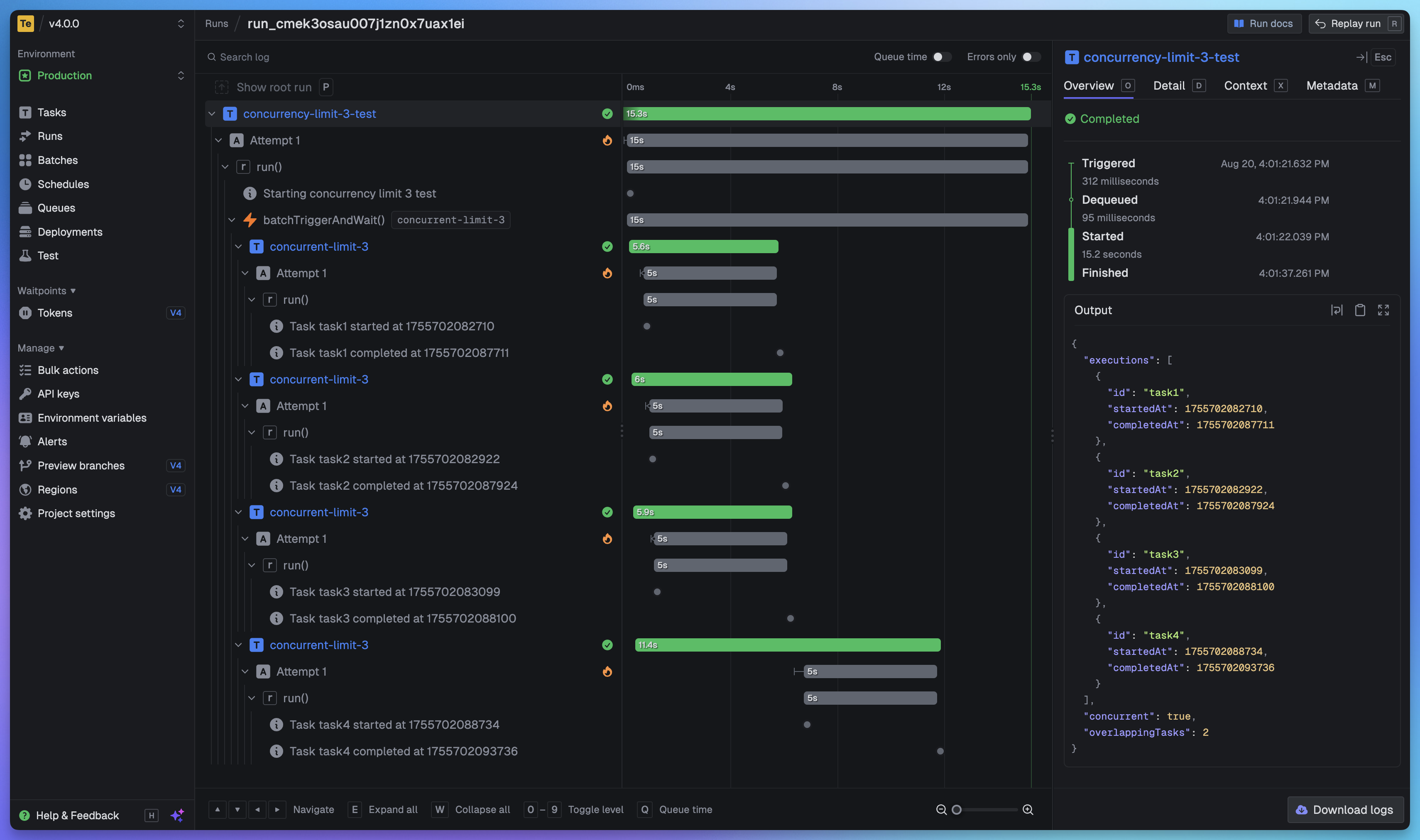
Full visibility of every job run
View every task in every run so you can tell exactly what happened. We provide a full trace view of every task run so you can see what happened at every step.
Getting started
The quickest way to get started is to create an account and project in our web app, and follow the instructions in the onboarding. Build and deploy your first task in minutes.
Useful links:
- Quick start - get up and running in minutes
- How it works - understand how Trigger.dev works under the hood
- Guides and examples - walk-through guides and code examples for popular frameworks and use cases
Self-hosting
If you prefer to self-host Trigger.dev, you can follow our self-hosting guides:
- Docker self-hosting guide - use Docker Compose to spin up a Trigger.dev instance
- Kubernetes self-hosting guide - use our official Helm chart to deploy Trigger.dev to your Kubernetes cluster
Support and community
We have a large active community in our official Discord server for support, including a dedicated channel for self-hosting.
Development
To setup and develop locally or contribute to the open source project, follow our development guide.