 Theo van Kraay
a057cd505c
Theo van Kraay
a057cd505c
* Add agent-framework-azure-cosmos-memory context provider (draft)

Introduces CosmosMemoryContextProvider, a ContextProvider that wraps the azure-cosmos-agent-memory toolkit to give agents long-term, Cosmos DB-backed memory (fact/procedural recall + user summaries). Includes package scaffolding, unit tests (mocked client), live Azure integration tests (marked), samples, README, and AGENTS.md.

Draft: uv.lock is intentionally left unchanged. This package depends on azure-cosmos-agent-memory (requires Python >=3.11), which is unsatisfiable against the workspace's current >=3.10 floor, so adding it to the shared lock requires a workspace decision (raise floor to 3.11 or exclude from workspace). Test coverage to be expanded.

* ci: exclude azure-cosmos-memory from uv workspace resolution

The package depends on azure-cosmos-agent-memory which requires Python
>=3.11 and a prompty pre-release (>=2.0.0a9). Both are unsatisfiable
against the workspace's >=3.10 floor and pre-release policy, causing
uv sync to fail in every Python CI job. Exclude the package from the
shared workspace so it is resolved and tested as a standalone package.

* ci: fix code-quality failures for azure-cosmos-memory

- Strip trailing whitespace from package files (pre-commit trailing-whitespace hook)
- Exclude the package README from markdown-code-lint: the package is excluded
  from the uv workspace, so its README snippets import a module that is not
  installed in the workspace env and Pyright cannot resolve it

* Exclude azure-cosmos-memory README from markdown-code-lint task

* Address PR review comments on cosmos-memory context provider

- Wire credential into Cosmos and AI Foundry clients; let toolkit own
  DefaultAzureCredential when none supplied (remove dead import).
- Honor auto_extract=False by zeroing extraction/summary cadence thresholds.
- Skip whitespace-only conversation turns and store stripped content.
- Show confidence 0.0 and coerce confidence to float in _format_memories.
- Register both 'integration' and 'azure' pytest markers accurately.
- Fix duplicated install block in README.
- Update and extend unit tests for new credential wiring and fixes.

* Include azure-cosmos-memory in the uv workspace

Follow the github_copilot pattern for a package with a Python 3.11-only
dependency: lower requires-python to >=3.10 and gate azure-cosmos-agent-memory
behind a python_version >= '3.11' marker. Add a direct, gated prompty
pre-release dependency so the workspace's if-necessary-or-explicit prerelease
policy permits the toolkit's transitive prompty requirement. Guard the test
modules with pytest.importorskip so the 3.10 CI leg skips cleanly. Remove the
workspace exclude and the markdown-code-lint exclude, and regenerate uv.lock.

* Address review feedback on cosmos-memory provider

Rename provider parameters to match Agent Framework conventions:
foundry_endpoint (was ai_foundry_endpoint) and embedding_model/chat_model
(were *_deployment_name). Move DEFAULT_* to module-level constants, type
memory_types as a Literal, use DEFAULT_CONTEXT_PROMPT as the default value,
and add ProcessorConfig/CosmosMemorySettings TypedDicts. Resolve connection
settings via agent_framework load_settings with required-field validation,
replacing the manual getenv/raise blocks. Scope user_id/thread_id to the
provider state and drop the unpreventable first-turn warning.

Rewrite the samples around Agent (not raw SessionContext), provider-scoped
state, and session-id threading; use PEP 723 inline dependencies instead of a
samples dependency group; use a plain input() loop; remove the dead custom
processor stub. Update README/AGENTS for the renamed parameters and env vars.
Add a samples ruff per-file-ignores entry now that the package is linted in CI.

* Add emulator-backed vector search integration test

Bump azure-cosmos-agent-memory to >=0.2.0b2 (adds the embeddings/chat client
injection seam) and add tests/test_emulator.py: an integration (not azure)
suite that exercises real Cosmos vector search with a quantizedFlat index
against a local Cosmos DB emulator, using deterministic in-memory fakes for
embeddings and chat so no Azure AI Foundry account or LLM is required.

To run on a stock emulator the fixture strips the toolkit's full-text index
(the provider only does pure vector search) and requests provisioned autoscale
throughput instead of serverless. The suite skips cleanly when no emulator is
reachable.

* Fix CI typing and package checks for azure-cosmos-memory

The package recently joined the uv workspace, so its source and tests are now covered by the Test Typing Checks and Package Checks gates for the first time.

tests: rename stale constructor kwargs to the current provider API (foundry_endpoint/embedding_model/chat_model); use a typed _STUB_AGENT for the unused agent param so pyright/pyrefly/ty/zuban all accept it; make processor_config values ints; assert non-None memory_client in the emulator tests.

source: relax reportUnknown*/reportOptional* for this package only (the toolkit ships no py.typed; mirrors the hosting-telegram precedent); decouple the conditional toolkit import from the annotation type; use settings.get(); fix memory_types list invariance; drop a redundant None guard; read role via getattr.

* Apply pyupgrade: single-arg AsyncGenerator in test_integration

* Make Cosmos memory extraction drain transparently on provider exit

The provider now drains in-flight background memory extraction in __aexit__, so applications no longer need to call flush() in their own control flow; the client's close() would otherwise cancel pending extraction tasks. flush() is hardened against clients that expose no usable background-task registry.

sample: interactive_chat reads input via asyncio.to_thread so the event loop stays free and background extraction runs during the session; removes the manual flush now that the provider drains on exit.

tests: add explicit transparent-extraction integration tests (emulator: after_run schedules extraction and __aexit__ drains it; live Azure: a fact is extracted and recalled in a later session with no manual flush). Emulator tests reuse a single fixed database to avoid exhausting the emulator's partition budget across runs.

* Add custom extraction-prompt seam and sample to cosmos-memory provider

Adds a prompts_dir option to CosmosMemoryContextProvider that points the Agent Memory Toolkit pipeline at a caller-supplied directory of Prompty templates, so callers can override extract_memories.prompty to control what the extraction LLM produces. The toolkit exposes no public prompts-directory seam, so the provider contains the one internal touch (swapping the pipeline's template loader after the store connects); applies to both provider-built and supplied clients.

sample: interactive_chat_custom_extraction.py - the interactive chat wired with a custom coding-assistant extraction rubric. It derives a complete prompts directory at runtime (copies the bundled templates and augments extract_memories.prompty) so it stays schema-compatible with the installed toolkit.

tests: unit tests assert the provider redirects the pipeline loader only when prompts_dir is set; an emulator integration test proves end to end that a unique marker in a custom extract_memories.prompty reaches the extraction LLM call.

* docs: document prompts_dir custom-extraction seam in cosmos-memory README

Replaces the stale, non-functional CustomMemoryProcessor snippet with the working prompts_dir approach, lists the new interactive_chat_custom_extraction.py sample, and corrects the interactive-sample feature list.

* Address review: rename _new_session, drop defensive toolkit import guard

Sample (comment): rename _new_thread to _new_session in both interactive samples (a new session is the new thread).

Provider (comment): replace the _memory_toolkit_available flag + __init__ ImportError guard with a plain guarded import that re-raises a clear ImportError, matching the github_copilot package's pattern for its 3.11-only SDK. Kept requires-python >=3.10 (bumping this one workspace member to 3.11 would force the entire uv workspace lock floor to 3.11). Tests now run importorskip before importing the package, mirroring github_copilot.

* Pass cadence via cadence_thresholds instead of mutating os.environ

* Mark package alpha and drop private naming in samples

* Require Python 3.11 and inject user summary as untrusted context

* CI: exclude azure-cosmos-memory from uv sync on Python 3.10

* Re-trigger CI (flaky external link check)

* Require chat/embedding models instead of silent defaults

* Fix pyright: narrow resolved chat/embedding models to str

---------

Co-authored-by: Theo van Kraay <thvankra@microsoft.com>

Welcome to Microsoft Agent Framework!




Microsoft Agent Framework (MAF) is an open, multi-language framework for building production-grade AI agents and multi-agent workflows in .NET and Python.
Microsoft Agent Framework is built for teams taking agents from prototype to production. It provides a consistent foundation for building, orchestrating, and operating agent systems across Python and .NET, while keeping architecture choices open as requirements evolve, and supports a broad ecosystem including Microsoft Foundry, Azure OpenAI, OpenAI, and the GitHub Copilot SDK, with samples and hosting patterns for both local development and cloud deployment.
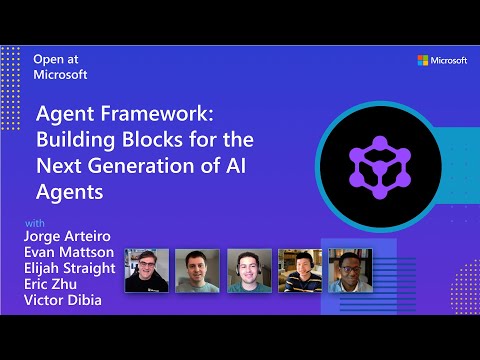
Watch the full Agent Framework introduction (30 min)
Is this the right framework for you?
MAF is a strong fit if you:
- are building agents and workflows you expect to run in production,
- need orchestration beyond a single prompt or stateless chat loop,
- want graph-based patterns such as sequential, concurrent, handoff, and group collaboration,
- care about durability, restartability, observability, governance, or human-in-the-loop control,
- need provider flexibility so your architecture can evolve without major rewrites.
Key Features
Explore new MAF capabilities and real implementation patterns on the official blog.
- Python and C#/.NET Support: Full framework support for both Python and C#/.NET implementations with consistent APIs
- Multiple Agent Provider Support: Support for various LLM providers with more being added continuously
- Middleware: Flexible middleware system for request/response processing, exception handling, and custom pipelines
- Orchestration Patterns & Workflows: Build multi-agent systems with graph-based workflows supporting sequential, concurrent, handoff, and group collaboration patterns; includes checkpointing, streaming, human-in-the-loop, and time-travel
- Foundry Hosted Agents (new): Deploy and host your agents to Foundry-hosted infrastructure with just 2 additional lines of code
- Observability: Built-in OpenTelemetry integration for distributed tracing, monitoring, and debugging
- Declarative Agents: Define agents using YAML for faster setup and versioning
- Agent Skills: Build domain-specific knowledge bases from multiple sources—files, inline code, class libraries—for agents to discover and use
- AF Labs: Experimental packages for cutting-edge features including benchmarking, reinforcement learning, and research initiatives
- DevUI: Interactive developer UI for agent development, testing, and debugging workflows
Table of Contents
Getting Started
Installation
Python
pip install agent-framework
# This will install all sub-packages, see `python/packages` for individual packages.
# It may take a minute on first install on Windows.
.NET
dotnet add package Microsoft.Agents.AI
# For Foundry integration (used in the .NET quickstart below):
dotnet add package Microsoft.Agents.AI.Foundry
dotnet add package Azure.AI.Projects
dotnet add package Azure.Identity
Learning Resources
- Overview - High level overview of the framework
- Quick Start - Get started with a simple agent
- Tutorials - Step by step tutorials
- User Guide - In-depth user guide for building agents and workflows
- Migration from Semantic Kernel - Guide to migrate from Semantic Kernel
- Migration from AutoGen - Guide to migrate from AutoGen
Quickstart
Basic Agent - Python
Create a simple Azure Responses Agent that writes a haiku about the Microsoft Agent Framework
# pip install agent-framework
# Use `az login` to authenticate with Azure CLI
import os
import asyncio
from agent_framework import Agent
from agent_framework.foundry import FoundryChatClient
from azure.identity import AzureCliCredential


async def main():
    # Initialize a chat agent with Microsoft Foundry
    # the endpoint, deployment name, and api version can be set via environment variables
    # or they can be passed in directly to the FoundryChatClient constructor
    agent = Agent(
      client=FoundryChatClient(
          credential=AzureCliCredential(),
          # project_endpoint=os.environ["FOUNDRY_PROJECT_ENDPOINT"],
          # model=os.environ["FOUNDRY_MODEL_DEPLOYMENT_NAME"],
      ),
      name="HaikuAgent",
      instructions="You are an upbeat assistant that writes beautifully.",
    )

    print(await agent.run("Write a haiku about Microsoft Agent Framework."))

if __name__ == "__main__":
    asyncio.run(main())
Basic Agent - .NET
Create a simple Agent, using Microsoft Foundry that writes a haiku about the Microsoft Agent Framework
// This sample shows how to create and run a basic agent with AIProjectClient.AsAIAgent(...).

using Azure.AI.Projects;
using Azure.Identity;
using Microsoft.Agents.AI;

string endpoint = Environment.GetEnvironmentVariable("AZURE_AI_PROJECT_ENDPOINT") ?? throw new InvalidOperationException("AZURE_AI_PROJECT_ENDPOINT is not set.");
string deploymentName = Environment.GetEnvironmentVariable("AZURE_AI_MODEL_DEPLOYMENT_NAME") ?? "gpt-5.4-mini";

AIAgent agent =
    new AIProjectClient(new Uri(endpoint), new DefaultAzureCredential())
    .AsAIAgent(model: deploymentName, instructions: "You are an upbeat assistant that writes beautifully.", name: "HaikuAgent");

// Once you have the agent, you can invoke it like any other AIAgent.
Console.WriteLine(await agent.RunAsync("Write a haiku about Microsoft Agent Framework."));
More Examples & Samples
Python
- Getting Started: progressive tutorial from hello-world to hosting
- Agent Concepts: deep-dive samples by topic (tools, middleware, providers, etc.)
- Workflows: workflow creation and integration with agents
- Hosting: A2A, Azure Functions, Durable Task hosting
- End-to-End: full applications, evaluation, and demos
.NET
- Getting Started: progressive tutorial from hello agent to hosting
- Agent Concepts: basic agent creation and tool usage
- Agent Providers: samples showing different agent providers
- Workflows: advanced multi-agent patterns and workflow orchestration
- Hosting: A2A, Durable Agents, Durable Workflows
- End-to-End: full applications and demos
Community & Feedback
- Found a bug? File a GitHub issue to help us improve.
- Enjoying MAF?
to show your support and help others discover the project.
- Have questions? Join our Discord or visit weekly office hours.
Troubleshooting
Authentication
| Problem | Cause | Fix |
|---|---|---|
| Authentication errors when using Azure credentials | Not signed in to Azure CLI | Run az login before starting your app |
| API key errors | Wrong or missing API key | Verify the key and ensure it's for the correct resource/provider |
Tip:
DefaultAzureCredentialis convenient for development but in production, consider using a specific credential (e.g.,ManagedIdentityCredential) to avoid latency issues, unintended credential probing, and potential security risks from fallback mechanisms.
Environment Variables
For environment variable configuration specific to each sample, refer to the README in the sample directory (Python samples | .NET samples).
Contributor Resources
Important Notes
Important
If you use Microsoft Agent Framework to build applications that operate with any third-party servers, agents, code, or non-Azure Direct models (“Third-Party Systems”), you do so at your own risk. Third-Party Systems are Non-Microsoft Products under the Microsoft Product Terms and are governed by their own third-party license terms. You are responsible for any usage and associated costs.
We recommend reviewing all data being shared with and received from Third-Party Systems and being cognizant of third-party practices for handling, sharing, retention and location of data. It is your responsibility to manage whether your data will flow outside of your organization’s Azure compliance and geographic boundaries and any related implications, and that appropriate permissions, boundaries and approvals are provisioned.
You are responsible for carefully reviewing and testing applications you build using Microsoft Agent Framework in the context of your specific use cases, and making all appropriate decisions and customizations. This includes implementing your own responsible AI mitigations such as metaprompt, content filters, or other safety systems, and ensuring your applications meet appropriate quality, reliability, security, and trustworthiness standards. See also: Transparency FAQ