 Steve Coffey
2d665c9a67
Steve Coffey
2d665c9a67
### Sandbox Agents

This release adds **Sandbox Agents**, a beta SDK surface for running
agents with a persistent, isolated workspace. Sandbox agents keep the
normal `Agent` and `Runner` flow, but add workspace manifests,
sandbox-native capabilities, sandbox clients, snapshots, and resume
support so agents can work over real files, run commands, edit
repositories, generate artifacts, and continue work across runs.

Key pieces:

- `SandboxAgent`: an `Agent` with sandbox defaults such as
`default_manifest`, sandbox instructions, capabilities, and `run_as`.
- `Manifest`: a fresh-workspace contract for files, directories, local
files, local directories, Git repos, environment, users, groups, and
mounts.
- `SandboxRunConfig`: per-run sandbox wiring for client creation, live
session injection, serialized session resume, manifest overrides,
snapshots, and materialization concurrency limits.
- Built-in capabilities for shell access, filesystem editing and image
inspection, skills, memory, and compaction.
- Workspace snapshots and serialized sandbox session state for
reconnecting to existing work or seeding a fresh sandbox from saved
contents.

### Sandbox clients and hosted providers

Sandbox agents now support local, containerized, and hosted execution
backends:

- `UnixLocalSandboxClient` for fast local development.
- `DockerSandboxClient` for container isolation and image parity.
- Hosted sandbox clients for Blaxel, Cloudflare, Daytona, E2B, Modal,
Runloop, and Vercel through optional extras.

The release also adds provider-specific examples and mount strategies
for common storage backends, including S3, Cloudflare R2, Google Cloud
Storage, Azure Blob Storage, and S3 Files where supported by the
selected backend.

### Sandbox memory

Adds a sandbox memory capability that lets future sandbox-agent runs
learn from prior runs. Memory stores extracted lessons in the sandbox
workspace, injects a concise summary into later runs, and uses
progressive disclosure so agents can search deeper rollout summaries
only when useful.

Memory supports:

- Read-only or generate-only modes.
- Live updates when the agent discovers stale memory.
- Multi-turn grouping through `conversation_id`, SDK `Session`,
`RunConfig.group_id`, or generated run IDs.
- Separate memory layouts for isolating memory across agents or
workflows.
- S3-backed examples for persisted memory across runs.

### Workspace mounts, snapshots, and resume

This release adds a full workspace entry and mount model for sandbox
sessions:

- Local files and directories.
- Synthetic files and directories.
- Git repository entries.
- Remote storage mounts for S3, R2, GCS, Azure Blob Storage, and S3
Files.
- Provider-specific mount strategies across Docker, Modal, Cloudflare,
Blaxel, Daytona, E2B, and Runloop.
- Portable snapshots with path normalization, symlink preservation,
mount-safe snapshotting, and remote snapshot support.
- Resume paths through runner-managed `RunState`, explicit
`SandboxSessionState`, or saved snapshots.

### Examples and tutorials

Adds a large `examples/sandbox/` suite covering:

- Local Unix and Docker sandbox runners.
- Docker mount smoke tests for S3, GCS, Azure Blob Storage, and S3
Files.
- Sandbox coding tasks with skills.
- Sandbox agents as tools and handoff patterns.
- Memory examples, including multi-agent/multi-turn memory and S3-backed
memory.
- Tax-prep and healthcare-support workflows.
- Dataroom QA and metric extraction tutorials.
- Repository code review tutorial.
- Vision website clone tutorial.
- Provider examples for Blaxel, Cloudflare, Daytona, E2B, Modal,
Runloop, Temporal, and Vercel.

### Runtime, tracing, and model plumbing

The release includes the runtime plumbing needed to make sandbox agents
work naturally inside the existing SDK:

- Runner-managed sandbox preparation, capability binding, session
lifecycle, state serialization, and resume behavior.
- Sandbox-aware `RunState` serialization.
- Unified sandbox tracing with SDK spans.
- Token usage on tracing spans.
- Runner-managed prompt cache key defaults.
- OpenAI agent registration and harness ID configuration.
- Safer redaction of sensitive MCP tool outputs when sensitive tracing
is disabled.
- Additional OpenAI client/model utilities and Chat Completions
coverage.


## Documentation & Other Changes

- docs: add Asqav to external tracing processors list.
- docs: update translated document pages.

Co-authored-by: Abdulrahman Alfozan <alfozan@openai.com>
Co-authored-by: Aditya Singh <60082699+adityasingh2400@users.noreply.github.com>
Co-authored-by: Andi Liu <andi@openai.com>
Co-authored-by: Aron <263346377+aron-cf@users.noreply.github.com>
Co-authored-by: ashwinnathan-openai <ashwinnathan@openai.com>
Co-authored-by: Codex <noreply@openai.com>
Co-authored-by: cploujoux <cploujoux@blaxel.ai>
Co-authored-by: elainegan-openai <168589666+elainegan-openai@users.noreply.github.com>
Co-authored-by: Elias Freider <freider@users.noreply.github.com>
Co-authored-by: Erik Dunteman <erik@erikds-macbook-air.local>
Co-authored-by: Jason Liu <jasonliu@openai.com>
Co-authored-by: Jason Steving <32336750+jasonsteving99@users.noreply.github.com>
Co-authored-by: Kazuhiro Sera <seratch@openai.com>
Co-authored-by: Lovre Pešut <lovre.pesut@gmail.com>
Co-authored-by: Lucas Wang <lucas_wang@lucas-futures.com>
Co-authored-by: Matt Brockman <matt.brockman@e2b.dev>
Co-authored-by: Mish Ushakov <mishushakov@users.noreply.github.com>
Co-authored-by: Naresh <ghostwriternr@gmail.com>
Co-authored-by: nicholasclark-openai <nicholasclark@openai.com>
Co-authored-by: qiyaoq-oai <qiyaoq@openai.com>
Co-authored-by: Scott Trinh <scott@scotttrinh.com>
Co-authored-by: tode-rl <tony@runloop.ai>
Co-authored-by: Wendy Jiao <wendyjiao@openai.com>
5.9 KiB
OpenAI Agents SDK 
The OpenAI Agents SDK is a lightweight yet powerful framework for building multi-agent workflows. It is provider-agnostic, supporting the OpenAI Responses and Chat Completions APIs, as well as 100+ other LLMs.
Note
Looking for the JavaScript/TypeScript version? Check out Agents SDK JS/TS.
Core concepts:
- Agents: LLMs configured with instructions, tools, guardrails, and handoffs
- Sandbox Agents: Agents preconfigured to work with a container to perform work over long time horizons.
- Agents as tools / Handoffs: Delegating to other agents for specific tasks
- Tools: Various Tools let agents take actions (functions, MCP, hosted tools)
- Guardrails: Configurable safety checks for input and output validation
- Human in the loop: Built-in mechanisms for involving humans across agent runs
- Sessions: Automatic conversation history management across agent runs
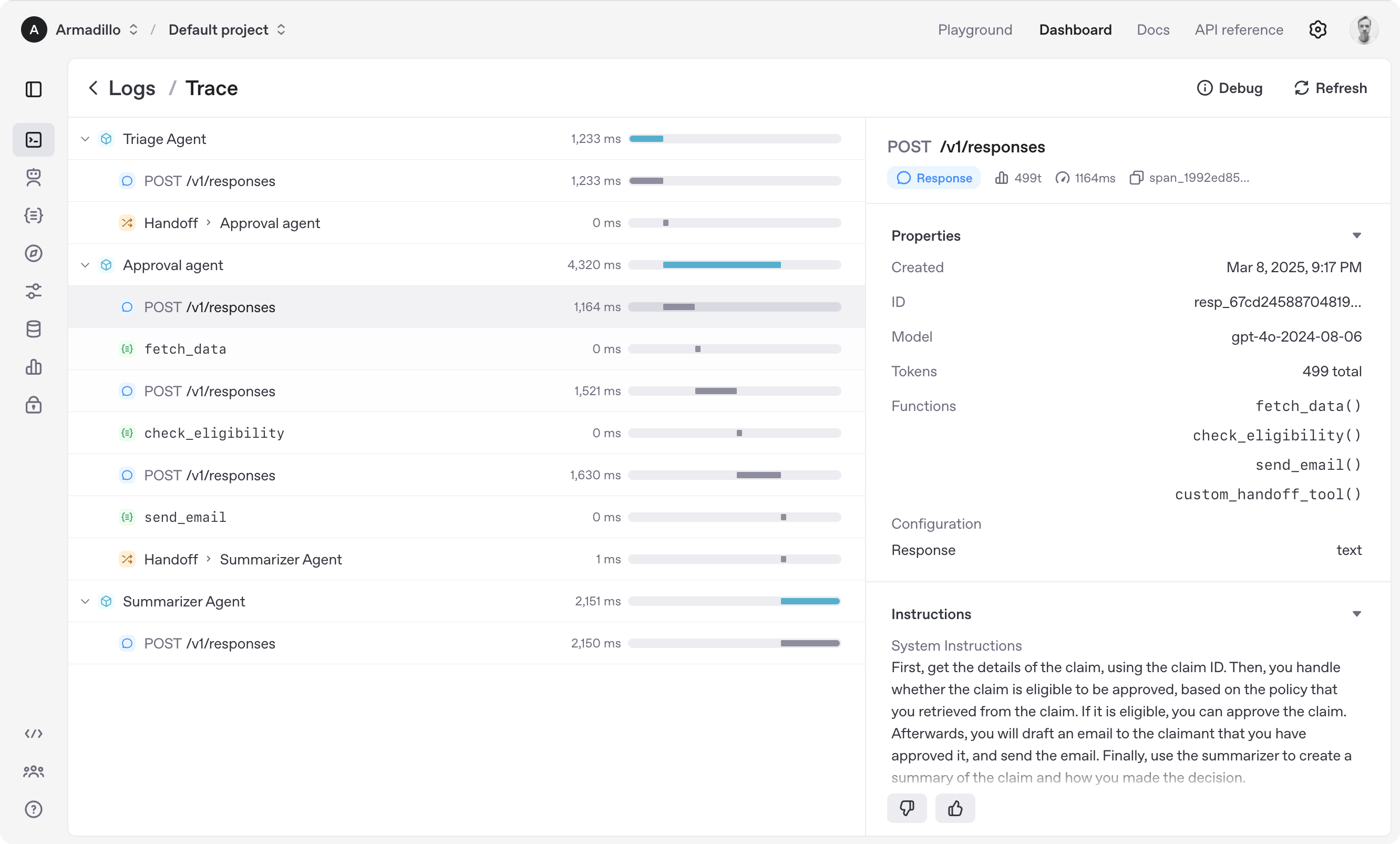
- Tracing: Built-in tracking of agent runs, allowing you to view, debug and optimize your workflows
- Realtime Agents: Build powerful voice agents with
gpt-realtime-1.5and full agent features
Explore the examples directory to see the SDK in action, and read our documentation for more details.
Get started
To get started, set up your Python environment (Python 3.10 or newer required), and then install OpenAI Agents SDK package.
venv
python -m venv .venv
source .venv/bin/activate  # On Windows: .venv\Scripts\activate
pip install openai-agents
For voice support, install with the optional voice group: pip install 'openai-agents[voice]'. For Redis session support, install with the optional redis group: pip install 'openai-agents[redis]'.
uv
If you're familiar with uv, installing the package would be even easier:
uv init
uv add openai-agents
For voice support, install with the optional voice group: uv add 'openai-agents[voice]'. For Redis session support, install with the optional redis group: uv add 'openai-agents[redis]'.
Run your first Sandbox Agent
Sandbox Agents are new in version 0.14.0. A sandbox agent is an agent that uses a computer environment to perform real work with a filesystem, in an environment you configure and control. Sandbox agents are useful when the agent needs to inspect files, run commands, apply patches, or carry workspace state across longer tasks.
from agents import Runner
from agents.run import RunConfig
from agents.sandbox import Manifest, SandboxAgent, SandboxRunConfig
from agents.sandbox.entries import GitRepo
from agents.sandbox.sandboxes import UnixLocalSandboxClient

agent = SandboxAgent(
    name="Workspace Assistant",
    instructions="Inspect the sandbox workspace before answering.",
    default_manifest=Manifest(
        entries={
            "repo": GitRepo(repo="openai/openai-agents-python", ref="main"),
        }
    ),
)

result = Runner.run_sync(
    agent,
    "Inspect the repo README and summarize what this project does.",
    # Run this agent on the local filesystem
    run_config=RunConfig(sandbox=SandboxRunConfig(client=UnixLocalSandboxClient())),
)
print(result.final_output)

# This project provides a Python SDK for building multi-agent workflows.
(If running this, ensure you set the OPENAI_API_KEY environment variable)
(For Jupyter notebook users, see hello_world_jupyter.ipynb)
Explore the examples directory to see the SDK in action, and read our documentation for more details.
Acknowledgements
We'd like to acknowledge the excellent work of the open-source community, especially:
This library has these optional dependencies:
We also rely on the following tools to manage the project:
We're committed to continuing to build the Agents SDK as an open source framework so others in the community can expand on our approach.