 githubnemo
daf335f503
githubnemo
daf335f503
The current state of the PEFT docs is not one of structure and I was constantly annoyed that whenever I wanted to change something there were several places that needed touching and they all felt disconnected. So this is my attempt at structuring the docs. Some of these ideas are quite old (discussed in 01/2025) but are still valid.

I've removed most of the code guides without replacement. That's not ideal, I think we should have code examples but I'm think they should be method-focused. Maybe one general example of a training workflow is sufficient because most methods follow the same scheme.

All details from the method guides (prompting, lora, oft/boft, etc.) are now integrated into the respective method pages instead. I would have hesitated to do this if these guides would have integrated information about the adapters but they didn't. I think it makes a lot more sense to have one place for each method to gather examples/tips/recommendations and that is now the `package_refernce/<method>` page. This page now also hosts a small space that shows the MetaMathQA (and potentially other) benchmark results highlighted for that method.

I've moved the LoRA initializations to `package_reference/lora#Initialization` and converted the init methods to `<hfoption>`-tags. This collapses them to a list but may reduce searchability through the document - at least firefox is not able to search 'through' the option tabs. This also doesn't make them appear in the ToC and people specifically searching for, say, PiSSA won't find it directly. I think that's OK though, since the search is able to locate it.

The quicktour is a bit more detailed about what happens under the hood (quick doesn't have to mean simplistic) and includes some new visualizations. I hope that we can integrate more visualizations in the future where it makes sense.

* Remove PEFT method space + front page buttons

The space was not that useful anymore since most methods are compatible
with most models.

The front page buttons are, at least temporarily, with the exception
of the quicktour and method overview buttons. I like the visuals
but there should only be elements that are useful.

---------

Co-authored-by: Benjamin Bossan <BenjaminBossan@users.noreply.github.com>
Co-authored-by: Steven Liu <59462357+stevhliu@users.noreply.github.com>
5.5 KiB
OFT
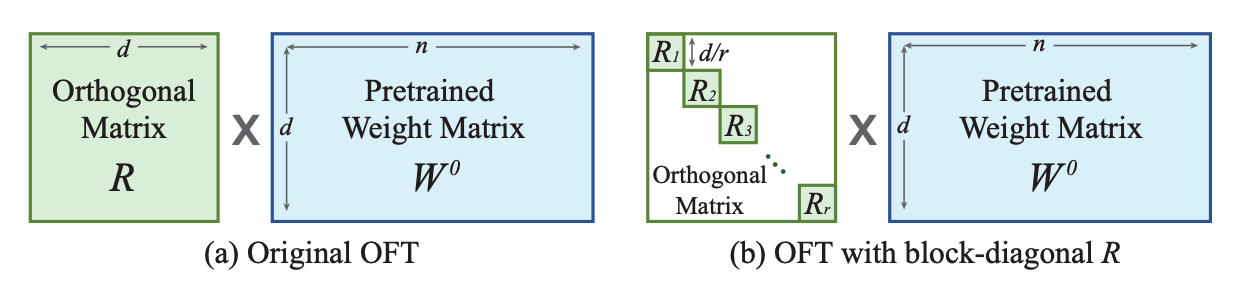
Orthogonal Finetuning (OFT) and OFTv2 is a method developed for adapting text-to-image diffusion models. It works by reparameterizing the pretrained weight matrices with its orthogonal matrix to preserve information in the pretrained model. To reduce the number of parameters, OFT introduces a block-diagonal structure in the orthogonal matrix. The method primarily focuses on preserving a pretrained model's generative performance in the finetuned model. It tries to maintain the same cosine similarity (hyperspherical energy) between all pairwise neurons in a layer because this better captures the semantic information among neurons. This means OFT is more capable at preserving the subject and it is better for controllable generation (similar to ControlNet).
The abstract from the paper is:
Large text-to-image diffusion models have impressive capabilities in generating photorealistic images from text prompts. How to effectively guide or control these powerful models to perform different downstream tasks becomes an important open problem. To tackle this challenge, we introduce a principled finetuning method -- Orthogonal Finetuning (OFT), for adapting text-to-image diffusion models to downstream tasks. Unlike existing methods, OFT can provably preserve hyperspherical energy which characterizes the pairwise neuron relationship on the unit hypersphere. We find that this property is crucial for preserving the semantic generation ability of text-to-image diffusion models. To improve finetuning stability, we further propose Constrained Orthogonal Finetuning (COFT) which imposes an additional radius constraint to the hypersphere. Specifically, we consider two important finetuning text-to-image tasks: subject-driven generation where the goal is to generate subject-specific images given a few images of a subject and a text prompt, and controllable generation where the goal is to enable the model to take in additional control signals. We empirically show that our OFT framework outperforms existing methods in generation quality and convergence speed.
OFT preserves the hyperspherical energy by learning an orthogonal transformation for neurons to keep the cosine similarity between them unchanged, potentially leading to less forgetting of previous learnt knowledge. In practice, this means taking the matrix product of an orthogonal matrix with the pretrained weight matrix. However, to be parameter-efficient, the orthogonal matrix is represented as a block-diagonal matrix with rank r blocks. Whereas LoRA reduces the number of trainable parameters with low-rank structures, OFT reduces the number of trainable parameters with a sparse block-diagonal matrix structure.
Benchmark overview
Merge OFT weights into the base model
Similar to LoRA, the weights learned by OFT can be integrated into the pretrained weight matrices using the [~OFTModel.merge_and_unload() function. This function merges the adapter weights with the base model which allows you to effectively use the newly merged model as a standalone model.
OFT Example Usage
For using OFT for quantized finetuning with TRL for SFT, PPO, or DPO fine-tuning, follow the following outline:
from transformers import AutoTokenizer, AutoModelForCausalLM, BitsAndBytesConfig
from trl import SFTTrainer
from peft import OFTConfig

if use_quantization:
    bnb_config = BitsAndBytesConfig(
        load_in_4bit=True,
        bnb_4bit_quant_type="nf4",
        bnb_4bit_compute_dtype=torch.bfloat16,
        bnb_4bit_use_double_quant=True,
        bnb_4bit_quant_storage=torch.bfloat16,
    )

model = AutoModelForCausalLM.from_pretrained(
    "model_name",
    quantization_config=bnb_config
)
tokenizer = AutoTokenizer.from_pretrained("model_name")

# Configure OFT
peft_config = OFTConfig(
    oft_block_size=32,
    use_cayley_neumann=True,
    target_modules="all-linear",
    bias="none",
    task_type="CAUSAL_LM"
)

trainer = SFTTrainer(
    model=model,
    train_dataset=ds['train'],
    peft_config=peft_config,
    processing_class=tokenizer,
    args=training_arguments,
    data_collator=collator,
)

trainer.train()
API
OFTConfig
autodoc tuners.oft.config.OFTConfig
OFTModel
autodoc tuners.oft.model.OFTModel